
A stack of thank-you notes can be the last thing you want to tackle after a wedding, baby shower or birthday. You know what you're grateful for, but the closing line can feel oddly difficult: should it sound affectionate, polished or like you?
The best thank you note sign-off reflects the giver, the occasion and your natural voice. A specific sentence about the gift makes the note personal, while the sign-off sets its final tone. Warmest thanks is a dependable middle ground when you want to be sincere without sounding overly familiar. For close family and friends, a warmer or more casual close will often feel more natural.
A handwritten note can carry particular meaning in a time when physical correspondence is less routine. ABC News reported Australia Post data showing that each Australian letterbox received 43% fewer addressed letters in 2016 than in 2008 (ABC News on Australia's changing letter habits). That doesn't mean every thank-you needs formal stationery. It means a closing that fits the relationship can help a personal note sound like you, rather than a standard acknowledgement.
1. With love
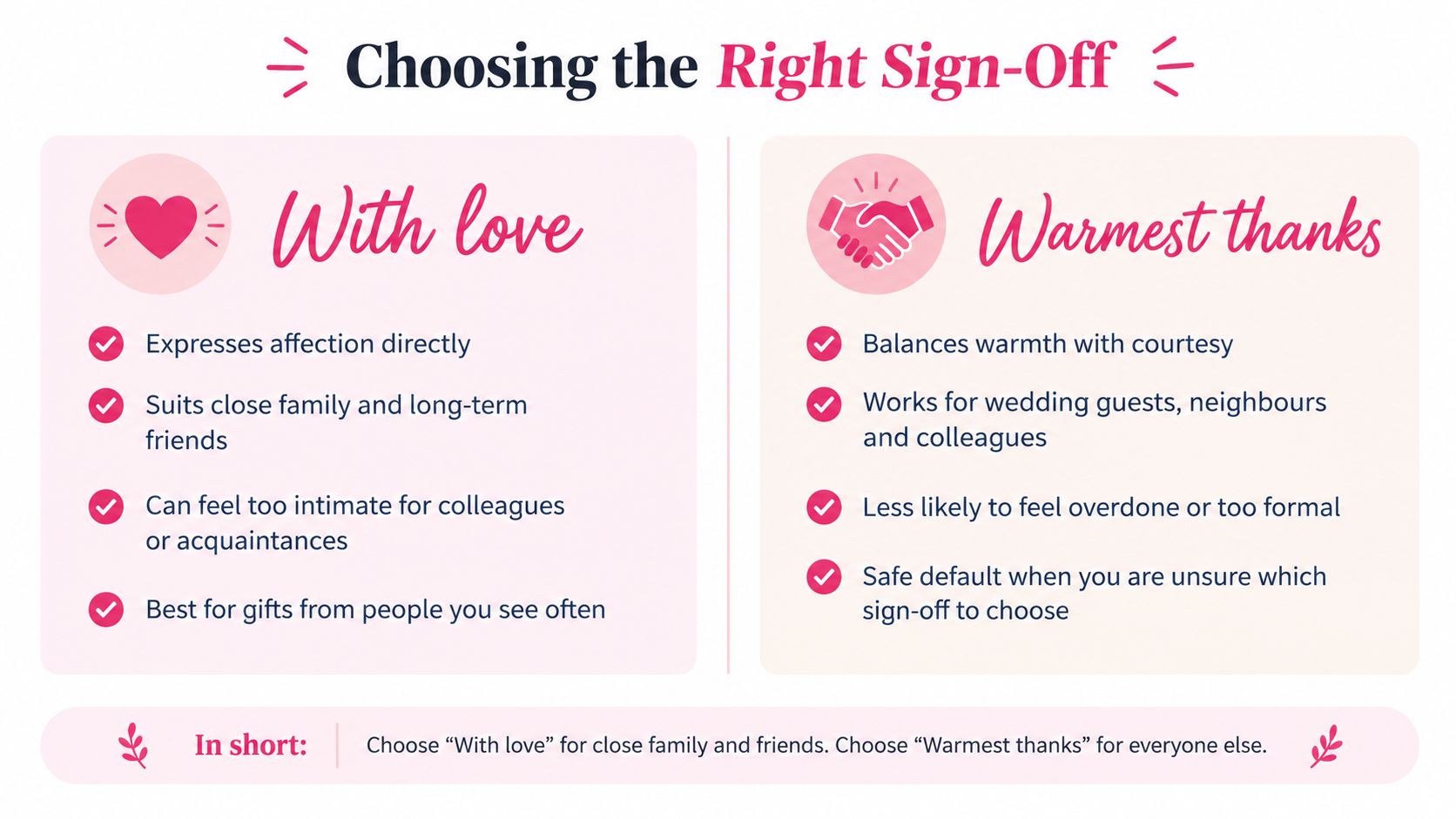
With love belongs to relationships where affection is already part of the conversation. Use it for parents, grandparents, siblings, godparents and long-standing friends, especially when you see or speak to them often. It sounds close and personal, not formal, so save it for someone who'll recognise that warmth as genuine.
Think of a grandparent who gave you a stand mixer from your registry. Rather than stopping at a broad thank-you, mention what you've done with it: Thanks so much for the stand mixer from our registry. We've already made the first batch of scones. With love, Sarah. The detail gives your grandparent something to picture, while the closing reflects the relationship.
Practical rule: Use "With love" when you'd say something equally affectionate to the recipient in person.
Keep the affection specific
For a baby shower, a parent might write: The cot linen arrived perfectly. Thank you for thinking of us. With love, Mel and Jordan. The wording suits a relative who's close to the growing family. If the same gift came from a colleague or a guest you've met only a few times, Warmest thanks would show appreciation without implying a level of intimacy that isn't there.
A first name can feel natural in a note to someone you know well. For shared gifts from a couple, sign both names so the recipient knows the thanks comes from both of you. Add one real detail about how the gift will be used or enjoyed, then let the close do its work.
2. Warmest thanks
Warmest thanks is the useful all-rounder: courteous, friendly and sincere without leaning too heavily on sentiment. Choose it for wedding guests, extended family, neighbours and colleagues who contributed to a group gift. It's particularly handy when you know you want warmth but aren't sure whether "With love" would feel too intimate.
A couple thanking a wedding guest for a serving platter might write: Thank you for the beautiful serving platter. It's already been christened at our first dinner party. Warmest thanks, Priya and Tom. A note about a honeymoon contribution could say: We were touched by your generous contribution to the honeymoon fund. Warmest thanks, Daniel.
A strong default for shared occasions
If a guest contributed to a wishing well, name the gesture and, if appropriate, what it will help make possible. Australian guidance on wishing-well wording for special occasions can help you describe a contribution graciously. Don't include private financial details in the note. Focus on the thought behind the gift and the experience or plan it will support.
Keep the message concise, but make its central detail personal. A colleague who helped organise a group gift deserves a note that recognises the effort, not only the item. If you're unsure about the relationship's level of formality, use Warmest thanks, then let the rest of the note carry the personal detail.
3. With gratitude
With gratitude makes appreciation the heart of the closing. Choose it when a gift shows particular thought, represents a meaningful effort or arrived at a time when you needed support. It's sincere without being highly sentimental, which makes it a considered choice for older relatives, generous family friends and more formal occasions.
For example: Your gift of a set of cast-iron pans will get plenty of use. With gratitude, Helen Morrison. Or, for a major gesture of practical help: Thank you for helping us with the deposit on our first home. Your support means a great deal to us. With gratitude, Ben and Kate.
Let the note explain what mattered
The phrase has more weight when the body tells the recipient why the gift mattered. Name the item or gesture, then add a line about how you'll use it or what their help made possible. That gives With gratitude a clear reason to be there, instead of making it sound like a formal flourish pasted onto a generic card.
Reserve it for the notes where you want to foreground real appreciation. If every card in a large batch ends with the same formal phrase, it can start to feel automatic. For a neighbour who brought a casual birthday gift, Warmest thanks may sound more relaxed; for someone whose support carried genuine significance, With gratitude gives the close the right emphasis.
4. Thanks again
Thanks again suits someone you've already thanked in person, by message or during the event itself. The word "again" acknowledges that conversation and makes the note feel like a follow-up, rather than your first expression of appreciation. It works well for a friend who brought a hamper to a party or a guest you thanked while saying goodbye.
A relaxed follow-up might read: We loved catching up at the party, and the hamper was a delight. Thanks again, Lachlan. After a christening, you could write: Thanks again for coming to the christening and for the lovely card. We were glad you could celebrate with us. Thanks again, the Nguyen family.
"Again" should refer to a real earlier thank-you, not fill space at the end of a note.
Follow up without sounding rushed
Even when you've already said thank you, include a genuine detail. Mention what you enjoyed, how you've used the gift or what it meant to have the person there. Without that detail, a short message ending in Thanks again can come across as an afterthought.
The phrase also fits a follow-up email after a shower or celebration, particularly when a quick digital message is more practical than another card. If you need help starting a message, EasyRegistry's thank-you message generator can help shape a draft around the recipient and gift. Personalise the result before sending so the detail and closing sound like you.
5. Many thanks
Many thanks is clear, polite and mildly formal. It's a good fit for practical help and business-related gestures, such as a supplier's present, a contribution made through a workplace or a group gift organised by a sports club. The phrase shows appreciation while keeping a professional boundary.
A colleague who collected contributions for a team farewell gift might receive: Thank you for your contribution to the team farewell gift. We appreciate you being part of it. Many thanks, Olivia. For a school or community group, try: Thanks for the lovely gift and for organising the group present. Many thanks, the Year 4 parents' committee.
Recognise the person doing the organising
Group-gift organisers often manage messages, payments and practical arrangements on behalf of other people. Address the organiser directly and mention what they did. If a group is signing together, identify the group in the closing so the recipient can tell who's writing.
EasyRegistry's wishing-well wording generator can help with a message about a shared contribution. The sign-off still needs to suit the relationship: Many thanks is a sensible choice for a committee or work contact, while Warmest thanks will feel more personal for a friend who organised a present outside work. Match the closing to the person, not only to the gift.
6. Cheers
Cheers is a familiar Australian close for mates, siblings, housemates and workmates you know well. It feels relaxed and conversational, so it works best when the rest of your message has the same easy tone. Used with a clear thank-you, it sounds friendly. Used alone after a significant gift or in a formal note, it can feel too casual.
For a friend who brought a hamper to a birthday, try: That hamper was ridiculously good. Thanks heaps. Cheers, Jess. A mate who gave you a bottle of wine might get: Loved the bottle of wine. We're opening it on Saturday. Cheers, Mick.
Keep the relationship in view
The gift doesn't determine the close on its own. A bottle of wine from your sibling and a bottle from your manager may call for different wording, even if the presents are similar. With a mate, Cheers can make a handwritten note feel like an actual conversation; with a grandparent, in-law or formal contact, Warmest thanks is a safer choice.
For a casual gathering, this sign-off also fits a group thank-you text. Make sure the message itself says what you're grateful for, rather than relying on "Cheers" to do all the work. A video can add context on casual Australian communication and the way tone changes with the recipient.
<iframe src="https://www.youtube.com/embed/Hwj7atRRzb4" allow="accelerometer; autoplay; clipboard-write; encrypted-media; gyroscope; picture-in-picture" allowfullscreen></iframe>
7. With love and thanks
With love and thanks combines affection with a direct expression of gratitude. Use it for close family members and friends when a gift has sentimental value, particularly in wedding or baby shower notes. It feels more emotionally complete than With love alone because it names both the relationship and the appreciation.
A couple might write: Your gift of the vintage pram blanket means the world to us. We can't wait to wrap the baby in it. With love and thanks, Anna and Michael. For a family keepsake: We'll treasure the family photo frame and the memories it holds. With love and thanks, Nan and Pop.
Choose it for a meaningful connection
This close suits the grandparent who has passed down a treasured family item, or the close friend who made a thoughtful gift for a new baby. It may be too emotional for an acquaintance or colleague, where Warmest thanks or Many thanks keeps the tone comfortable.
Make it personal: Name the gift and say why it matters to your family.
If the note comes from a couple, both names make the shared thanks clear. The person who knows the recipient best can write the message, while the sign-off can represent both partners. Keep the wording honest to the relationship: warmth sounds most convincing when it matches how you speak to one another.
8. Gratefully yours
Gratefully yours has a formal, slightly old-fashioned air. That can suit a printed thank-you letter, a ceremonial gift or a recipient who appreciates traditional etiquette. It's less common in everyday conversation than With gratitude or Warmest thanks, so choose it deliberately rather than using it as a routine close.
For a silver cake knife from a relative, you might write: Thank you for the silver cake knife, which we'll use at our first anniversary. It's a lovely keepsake. Gratefully yours, Margaret Hall. A couple could say: Your generous gift arrived safely and is much appreciated. We're grateful for your thoughtfulness. Gratefully yours, Robert and Eleanor Stone.
Keep the whole note in the same register
Printed or heavyweight stationery can support the formality of this close. Keep the message brief and courteous, and avoid pairing Gratefully yours with slang or chatty language. If the recipient is a close friend who gave you a sentimental present, With love and thanks will usually sound more natural.
Use the full name or both partners' names where that makes the sender clear. A traditional closing should still feel like it came from a real person. The note's specific detail, not its formality, is what makes the recipient feel remembered.
8 Thank-You Note Sign-Offs Compared
| Sign-off | Tone & 🔄 Complexity | Ideal Use Cases | Expected 📊 Impact | Key Advantage / 💡 Caution |
|---|---|---|---|---|
| With love | Warm, affectionate; ⭐ easy to use with close contacts | Close family and long-term friends; personal cards or emails | Makes a brief note feel personal | 💡 Use when there is a genuine close connection; may feel too intimate for colleagues |
| Warmest thanks | Polished, friendly; 🔄 straightforward | Wedding guests, neighbours, extended family and colleagues | Communicates sincere gratitude with courtesy | ⭐ Safe default when unsure; may feel formal to very close friends |
| With gratitude | Sincere, measured; 🔄 moderately formal | Thoughtful or substantial gifts; older relatives and formal settings | Emphasises that the gift was valued | 💡 Name the gift or gesture; can sound stiff in casual messages |
| Thanks again | Relaxed, conversational; ⚡ quick to write | Follow-up notes, group thank-yous and workplace messages | Signals continued appreciation after earlier thanks | 💡 Use only if the giver has already been thanked; add a personal detail |
| Many thanks | Polite, mildly formal; ⚡ efficient for multiple notes | Business, community and group-gift acknowledgements | Keeps appreciation professional and clear | ⭐ Suitable for people you do not know well; may feel impersonal for milestone events |
| Cheers | Casual and distinctly Australian; ⚡ quick and natural | Mates, siblings, housemates and workmates; texts or casual cards | Makes a note feel conversational and friendly | 💡 Include a clear thank-you; can seem too casual for elders or formal occasions |
| With love and thanks | Heartfelt and affectionate; 🔄 requires a close relationship | Close family and very close friends; milestone-event notes | Acknowledges both the gift and the relationship | ⭐ Combines affection with gratitude; may be too intimate for distant contacts |
| Gratefully yours | Traditional and formal; 🔄 best matched with formal stationery | Formal weddings, anniversaries and ceremonial gifts | Gives the note a considered, polished feel | 💡 Keep the message courteous and brief; can feel dated in casual settings |
Match the Close to the Note
Choose the sign-off that feels natural for your relationship with the recipient, then support it with a specific reference to the gift or gesture. The wording doesn't need to be elaborate. A couple who mention the first dinner party made possible by a serving platter will sound more personal than a couple who write a long message that could have gone to anyone.
The same gift can lead to different notes depending on who gave it. A grandparent who gave a serving platter might receive: Thank you for the beautiful platter. We'll think of you whenever we bring it out for Sunday lunch. With love, Priya and Tom. A close friend who gave the same item might get: Thanks for the serving platter. It's already earned a spot on the table for dinner with friends. Cheers, Priya and Tom.
One gift, four different relationships
For a colleague who contributed to the platter, focus on the group's appreciation and keep the tone courteous: Thank you for being part of the group gift. We're looking forward to using the platter when we host our next dinner. Warmest thanks, Priya and Tom. For the person who organised the group gift, acknowledge their effort as well: Thanks for bringing everyone together to choose the platter. We appreciate the thought and the organising. Many thanks, Priya and Tom.
The item hasn't changed, but the relationship has. That's why a list of closings is a starting point, not a substitute for considering the recipient. If you're writing to an older relative or a close friend, affection may sound right. For colleagues, suppliers or distant guests, a warm but less intimate close gives thanks without overstating familiarity.
Write the body first, then choose the close
Start with the gift or gesture, then say what it meant or how you'll use it. Add a short line about the person or the occasion if it feels natural. Pick the sign-off after that, using a phrase you'd be comfortable saying to the recipient in person. Australian guidance on wedding thank-you card wording and timing can also help couples plan their notes after the celebration.
For a wedding note, both partners can sign, even if one person writes the message. That works well when one partner knows the guest better, or when each person writes to guests from their own side of the family. With different surnames, use the names the recipients know you by. A sign-off should make the senders clear, not force the couple into a single naming convention.
Avoid repeating the same closing mechanically across every note. If you're writing a large batch, keep the structure consistent but tailor the gift detail, personal line and relationship-specific sign-off. Before sending, read the opening and closing together. If the message sounds affectionate but ends in a stiff formal phrase, or starts casually before an overly ceremonial close, adjust one so the whole note feels like it came from the same person.
For inspiration on notes after a child's celebration, browse these first birthday thank-you card ideas. Then make the wording your own. The best closing isn't the fanciest phrase on the page. It's the one that sounds right for the person receiving your thanks.
EasyRegistry helps Australian hosts create and share gift registries for weddings, baby showers, birthdays and other celebrations, then track contributions in one place. Use that gift detail to make each thank-you note more personal, and visit EasyRegistry to explore its registry and thank-you tools.