
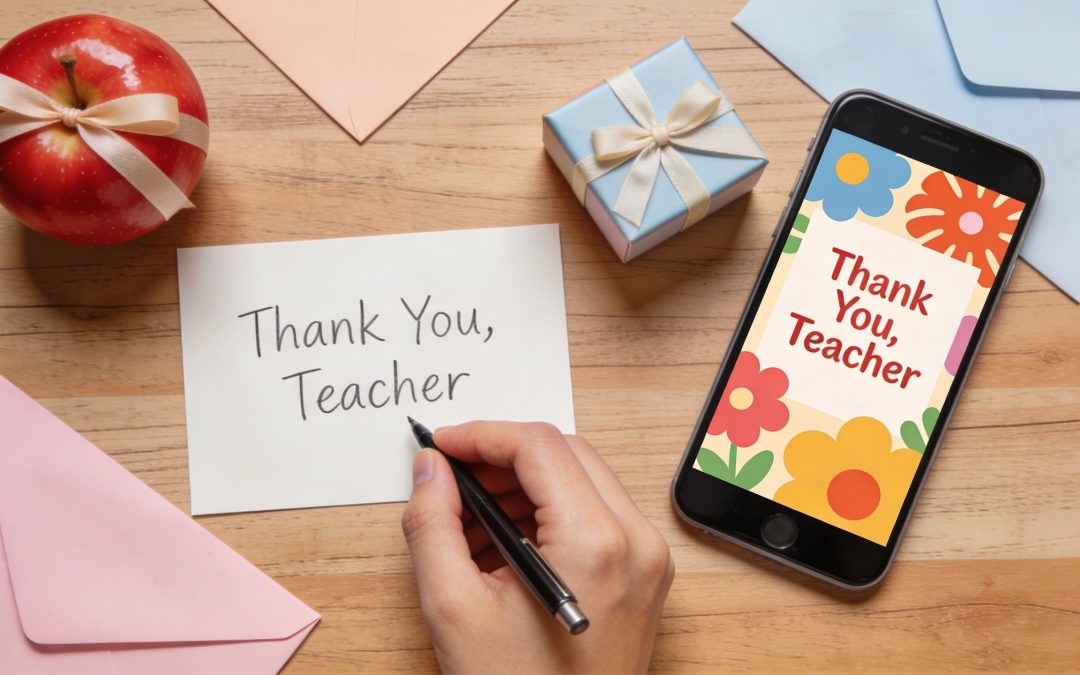
It’s the last week of term. The lunchboxes are nearly done for the year, the concert uniform is still draped over a chair, and there’s a blank card on the kitchen bench waiting for someone to write in it.
That moment catches a lot of parents out. You know you want to say thank you. You know the teacher has mattered. But turning a whole year of patience, effort, emails, encouragement, and classroom care into a few lines can feel oddly difficult.
After years of helping organise class gifts and end-of-year cards through school communities, I’ve learned that thank you cards for teachers don’t need to be polished to be meaningful. They need to be specific, warm, and honest. And when the gift is from a whole class, they also need a bit of coordination so the organiser doesn’t end up chasing money, signatures, and messages at the worst possible time of year.
Why a Simple Thank You Matters More Than You Think
A teacher might receive plenty of noise in a week. Notes about absences. Questions about homework. Permission slips. Last-minute reminders. What they often don’t receive is clear, personal appreciation.

That’s why a simple card can land so strongly. It doesn’t have to be expensive. It doesn’t have to be long. It tells a teacher that someone noticed the daily work that usually disappears into the routine of a school term.
Gallup research shows that consistent recognition can improve teacher productivity and retention, yet only about 25% of teachers feel they receive praise or recognition on a weekly basis in Gallup’s article on why appreciating teachers is important. That stat isn’t about cards specifically, but it does explain why even a small gesture matters.
What teachers tend to remember
The cards that stick aren’t always the fanciest ones. Usually, they’re the ones that mention something real.
A parent writes that their child stopped dreading maths. A student thanks a teacher for making school feel safe. A family mentions the extra care shown during a rough patch. Those details tell the teacher their effort reached someone.
A short note with one real memory usually means more than a long message full of general praise.
Why the card often matters more than the gift
When parents are choosing both a gift and a card, the card can feel like the add-on. In practice, it’s often the part a teacher keeps.
That’s especially true with class gifts. The shared present is lovely, but the written message gives it emotional weight. If you’re pairing a card with something more personalized, curated guides like these gifts for music teachers can help when you’re buying for a specialist teacher and want the present to feel thoughtful rather than generic.
For many families, the hardest part isn’t deciding whether to say thank you. It’s finding words that don’t sound copied, awkward, or too vague. That’s where a simple structure helps.
Crafting a Message That Resonates
Overcomplicating this is common. A card doesn't need to sound profound. It doesn’t. The strongest thank you cards for teachers usually do three things well. They open warmly, mention something specific, and close with generosity.

Start with warmth, not formality
You don’t need to sound like you’re writing a speech. A natural opening works better than a stiff one.
Try language that sounds like you:
- From a parent: Thank you for all the care you’ve shown this year.
- From a student: Thanks for making your class feel welcoming.
- From a group: We wanted to thank you for everything you’ve given our class this year.
What usually falls flat is language that could be addressed to absolutely anyone.
Use: “Thank you for helping Sam settle in so gently at the start of the year.”
Avoid: “Thank you for your dedication and commitment.”
The second line isn’t wrong. It’s just interchangeable. If your note could be copied into ten cards without changing a word, it probably needs one more personal detail.
Put one specific memory in the middle
This is the part that makes the card feel real. Don’t try to summarise the entire year. Pick one moment, one habit, or one change you noticed.
That detail might be academic. It might be emotional. It might even be funny, if you know the teacher well enough for that tone to work.
Good specifics often come from questions like these:
- What changed for my child this year? Maybe they became more confident reading aloud or less anxious about school.
- What did the teacher do that helped? Think about patience, structure, encouragement, feedback, or calm handling of a difficult patch.
- What moment still gets mentioned at home? That’s often your best clue.
Keep the middle concrete
Specificity doesn’t mean writing a novel. One or two grounded sentences are enough.
Here are examples of the kind of detail that works:
- Academic growth: You helped Ava stop saying “I’m bad at writing” and start having a go.
- Confidence: We noticed how much more comfortable Noah became speaking up in class.
- Care: Thank you for how gently you handled the tough start to term.
- Interest sparked: Ella came home talking about science in a way we hadn’t seen before.
The best line in the card is often the one only your family could write.
End with appreciation and a human closing
The final line should leave warmth, not drift into clichés. Keep it simple and direct.
A few reliable closings:
- We’re very grateful for the year our child had with you.
- Thank you for the difference you’ve made.
- We hope you have a restful break. You’ve earned it.
- Our family will remember your kindness.
If your child is writing the card, let their own language stay in it. A slightly crooked sentence that sounds like the student is better than a polished paragraph that sounds borrowed.
What to avoid
Some messages miss because they try too hard. Others become bland because they say nothing concrete. A few things usually don’t help:
- Overly broad praise: “You are the best teacher ever” is sweet, but stronger with a reason attached.
- Too much humour: Joke lines can work, but only if the relationship supports it.
- Backhanded compliments: Anything that starts with “Even though this year was chaotic…” can go sideways quickly.
- A message written entirely by committee: Group cards still need one clear voice.
A good formula to keep in mind is this:
Warm opening + one specific example + gracious closing
That structure works whether the card is from a prep student, a high school family, or a whole class.
Message Ideas and Templates for Every Situation
Sometimes you don’t need a full script. You need a starting line that gets the pen moving. That’s where prompts help.
The strongest prompts give you a direction rather than a complete message. That matters because thank you cards for teachers feel warmer when they sound like the sender, not like a template library.
Teacher Thank You Message Starters
| Sender Type | Focus | Example Snippet |
|---|---|---|
| Young child | Simple affection | “Thank you for helping me learn and for being kind to me.” |
| Young child | Favourite classroom moment | “I liked when we did painting and stories with you.” |
| Teenager | Feeling understood | “Thank you for treating us with respect and making your class feel comfortable.” |
| Teenager | Subject confidence | “You made this subject feel less intimidating, and that changed a lot for me.” |
| Parent | Academic growth | “We noticed how much more confident our child became with reading this year.” |
| Parent | Emotional support | “Thank you for helping our child feel settled, safe, and included.” |
| Parent | Specific challenge | “We’re grateful for the patience you showed during a difficult patch this term.” |
| Parent | Communication | “We appreciated how clearly and calmly you kept us informed throughout the year.” |
| Group of parents | Collective thanks | “From all of our families, thank you for the care and energy you brought to the class.” |
| Group of students | Shared classroom experience | “You made our classroom feel encouraging, organised, and fun to be part of.” |
| Specialist teacher | Niche impact | “Thank you for helping students enjoy your subject and feel proud of their progress.” |
| End of year card | Looking ahead | “Your impact will carry well beyond this school year.” |
How to turn a snippet into a real message
A starter line is only the first piece. Add one detail and one closing, and the card is done.
For example:
- Starter: Thank you for helping our child feel settled.
- Add detail: The first few weeks were a big adjustment, and your calm approach made a real difference.
- Close: We’re very grateful for the care you’ve shown all year.
That gives you a note that feels personal without taking ages to write.
Prompts that work well for group cards
Group messages need a different tone. They should sound collective without becoming bland. The easiest way to do that is to focus on shared experience rather than trying to speak on behalf of every individual family.
Useful directions for a group message:
- Classroom atmosphere: mention warmth, structure, patience, humour
- Shared outcomes: confidence, curiosity, enthusiasm, belonging
- Collective gratitude: thank the teacher for what they gave the class as a whole
For group cards, write one central message in a clear voice, then let individual families add short personal notes around it.
That approach avoids the usual problem where the main message becomes vague because it tries to include everyone’s perspective at once.
Choosing Your Format Physical vs Digital Cards
The format changes the feel of the thank you. Neither option is automatically better. It depends on timing, age of the student, whether multiple people are contributing, and how much admin you want to carry.

Where physical cards win
A handwritten card still has a different kind of presence. If a young child has drawn on it, signed their own name, or added a little note in their own spelling, it often becomes a keepsake.
Physical cards work well when:
- The message is personal: one family, one student, one teacher
- The child wants to make something: drawings, stickers, cut-out shapes, handprints
- You’re giving a gift in person: the card completes the gesture
- You want emotional weight: handwritten notes tend to feel more intimate
The trade-off is practical. Physical cards are easy to forget, hard to circulate to a whole class, and awkward when people want to contribute from different locations.
Where digital cards make life easier
Digital cards are useful when speed and coordination matter more than paper. They’re also much easier for group thank-yous, especially when families need to add messages on different days.
Digital options suit situations like these:
- Last-minute thanks: no shopping trip required
- Class gifts: multiple contributors can add messages
- Remote participation: grandparents, co-parents, or absent students can still contribute
- Cleaner organisation: one link is easier than passing around a card folder
If you’re collecting both contributions and messages, a tool designed for that flow can reduce the back-and-forth. For families comparing card-and-gift options, the gift card registry page shows one example of how a shared link can simplify a group present.
Side-by-side trade-offs
| Format | Strengths | Limitations | Best fit |
|---|---|---|---|
| Physical card | Personal, tactile, good for drawings and handwriting | Harder to coordinate for groups, easy to leave until the last minute | Individual thanks, younger children, in-person gifts |
| DIY card | Memorable, child-led, low-cost | Can be messy, time-consuming, not ideal for class-wide input | Primary school children, family-made gestures |
| Digital card | Fast, easy to share, simple for multiple contributors | Can feel less personal if the message is generic | Group gifts, late organisation, distributed families |
| Email note | Immediate, practical, no printing needed | Less ceremonial, easier to dash off too quickly | Short sincere thanks when time is tight |
Choose the format that makes it easier to send a good message, not the format that looks most impressive.
A rushed handwritten card with no thought in it isn’t automatically better than a carefully written digital one. The substance still matters most.
The Smart Way to Organise a Group Thank You Gift
Friday afternoon is when group teacher gifts usually come unstuck. One parent is asking for the bank details again, another wants to add a message after school pickup, three families meant to contribute but forgot, and the card is still blank.
That pile-up is why class parents dread organising a “simple” thank-you. The hard part is rarely choosing the gift. It is coordinating money, names, messages, deadlines, and last-minute changes without turning a kind gesture into admin.
The pattern is predictable because the weak spots are always the same:
- Contributions come in unevenly: some families pay straight away, others need reminders, and a few only respond once the gift is already being bought.
- Messages arrive across different channels: text, email, WhatsApp, pickup chat, or a photo of a note that still needs to be typed up.
- One person ends up holding the whole job: even in a helpful class, the organiser usually becomes the collector, editor, treasurer, and reminder service.
- The card gets left until the end: by then, everyone is focused on wrapping up the gift, so the wording feels rushed.
I’ve coordinated enough class presents through the P&C to know where the time goes. It is not the present itself. It is the follow-up. If the process is loose, the organiser spends more energy chasing people than shaping a thoughtful thank-you.
A good group card also needs structure. Without it, you get two common problems. The message sounds so broad it could go to any teacher, or it becomes a messy stack of unrelated mini-notes.
The cleanest approach is to split the writing in two:
- Write one shared class message for the main thank-you.
- Add short family notes only if parents want to include something personal.
That format works because it gives the teacher one clear message to read first, while still leaving room for specific comments from families who have a story or detail to add. It also makes editing much easier. The organiser is polishing one main note, not trying to stitch together twenty different writing styles into a single paragraph.
Gift choice matters too. A group present feels more genuine when it matches the tone of the card. If the class has chosen something personal, practical, or locally sourced, the thank-you message has a clearer reason behind it. For organisers who want an alternative to the standard mug-and-chocolates cycle, these teacher appreciation flower ideas can help.
For group collections, the smartest setup is one system for both money and messages. A shared page such as a free gift registry for teacher group gifts gives families one place to contribute and add their note, instead of sending payment details in one thread and collecting card wording somewhere else.
That is what keeps the gift feeling warm and organised. Less chasing, fewer missed names, and a final card that sounds like the class meant every word.
Streamline Your Group Gift with EasyRegistry
When a class gift needs contributions, messages, and a clear record of who’s done what, the process works better if everything lives in one place instead of across texts, emails, and manual lists.

A practical workflow that reduces chasing
For class parents, the cleanest setup is usually:
- Create one registry page for the teacher gift
- Share one link with families
- Collect contributions and messages through the same flow
- Review who contributed before finalising the gift and card
- Compile the thank-you note using the shared class message plus individual comments
That approach removes the usual friction points. Families don’t need separate payment details and separate instructions for card messages. The organiser doesn’t need to match names from one channel to comments from another.
Where this helps most
This is especially useful when:
- Parents contribute at different times
- You’re buying one combined gift rather than separate items
- Several families want their own short message included
- You need a tidy record for follow-up and thank-you note prep
If you want to see the setup process, the EasyRegistry how it works page outlines the basic flow for creating and sharing a registry page.
The practical advantage isn’t that technology makes the thank-you more heartfelt. It doesn’t. What it does is remove enough admin that the organiser has time to make the message heartfelt in the first place.
Keep the final delivery human
Even when you organise digitally, the presentation can still feel personal. You can print the compiled message, handwrite a final card using the collected notes, or pair the group gift with a physical tag signed by the class.
That hybrid approach works well. Use the platform for coordination. Deliver the thanks in a format that suits the teacher and the occasion.
If you’re organising a class gift and want one place to collect contributions, messages, and follow-up details, EasyRegistry gives you a simple way to keep the process organised without relying on cash envelopes, scattered emails, or last-minute message chasing.
