The nursery often starts as the spare room with the odd lamp, a stack of boxes, and a lot of possibility. Then the practical questions arrive fast: Where will the nappies go, what belongs near the change table, and how do you make a small room feel calm instead of crowded?
That is where wall shelves for nursery spaces earn their keep. Done properly, they free up floor space, keep everyday items close, and give the room some warmth before the cot, books, and soft toys fully move in. Done badly, they become cluttered, badly placed, or worse, unsafe.
For Australian parents, there is another layer to get right. You are often working with compact rooms, plasterboard walls, timber studs, and a real need to balance style with safety compliance. The good news is that a well-planned shelf setup is manageable, even if you are not a seasoned DIY person.
Creating Your Dream Nursery One Shelf at a Time
You get the cot position sorted, stand back, and notice the wall above the dresser is still doing no work at all. In a nursery, that empty wall is usually your best storage opportunity.
Wall shelves suit the way many Australian parents set up a nursery. Spare rooms are often compact, apartment bedrooms need to stay easy to move through, and plenty of homes use plasterboard over timber studs, which affects what you can safely mount and where. Shelves help you store the things you reach for every day without giving up precious floor space for another cabinet or trolley.
They also let the room feel finished early, even before every drawer is organised.
A well-placed shelf can hold books, creams, a small lamp, or the keepsakes people love giving at a baby shower. The trade-off is simple. The higher and lighter the styling, the safer and calmer the room tends to feel. The lower and heavier the shelf load, the more care the installation needs. That balance matters in a nursery more than in almost any other room.
I have found that parents are usually happiest with shelves when each one has a clear job. One ledge above the change area for items adults use. One display shelf well out of reach for framed photos or sentimental pieces. That approach keeps the room practical and stops it turning into a wall of decorations that collect dust.
If you are still settling on the look, browsing inspiring nursery ideas can help you narrow down finishes, colours, and shelf shapes before you buy. It also helps to review real baby registry examples from Australian parents so you can match shelf styling with the products you will use, gift, and store.
For Australian families, shelves also sit inside a bigger safety picture. The room needs to feel soft and personal, but it also needs hardware, finishes, and placement choices that support safe setup and align with the broader AS/NZS mindset many parents already apply to cots, furniture, and nursery products. Get that right, and shelves do more than fill a blank wall. They make the room easier to live in from day one.
Choosing the Perfect Shelves for Your Nursery
Not every shelf belongs in a nursery. Some look lovely online but warp, chip, or feel flimsy once you start loading them with board books and storage baskets.
The best choice usually comes down to three things: Safety, material, and use. Style matters, but it comes after those.
Start with materials that suit Australian homes
If you are buying or building shelves for a nursery, timber quality matters more than many parents expect. For Australian conditions, FSC-certified hardwoods such as Tasmanian Oak are a strong option. A custom shelf built with proper pocket-screw construction can support significant weight. Imported particleboard is far more prone to problems and can warp in humid coastal areas. A low-VOC polyurethane finish also supports compliance with AS/NZS child safety standards, based on the build guidance outlined in this nursery shelving resource.
That does not mean every family needs custom joinery. It means you should be cautious with bargain shelves made from thin engineered board, especially if the nursery gets afternoon sun or seasonal humidity.
Match the shelf type to the job
Different shelf styles do different work. Choosing one without thinking about what will sit on it is where disappointment starts.
A picture ledge is excellent for showing book covers. A bracket shelf is usually the safer choice if you know you want storage tubs or a heavier nappy caddy nearby.
The checklist I would use before buying
Some shelf listings make it hard to tell what you are really getting. This is the shortlist that helps most.
Rounded edges: Sharp corners are a poor fit for a baby’s room, especially once the nursery becomes a toddler room.
Low-VOC finish: Paints and sealants matter in small rooms.
Clear load guidance: If the product page is vague about weight, be cautious.
Solid timber or quality hardwood veneer: Better for durability than very light particleboard.
Mounting hardware worth using: Many included fixings are the first thing I replace.
Style still matters
Nursery shelves are not just storage. They help the room feel settled.
Light oak or ash works well in soft neutral rooms. Painted shelves can tie into wall colour, but I usually prefer timber in nurseries because it ages better as the room changes. A baby room with a cloud theme might later become a toddler book corner. Timber adapts without looking childish.
If you are torn between “prettier” and “stronger”, choose stronger. You can style a sturdy shelf beautifully. You cannot decorate around sagging.
Measure Twice Drill Once Planning Your Shelf Layout
The easiest time to fix a bad shelf decision is before the drill comes out. In a nursery, a layout can look fine on paper and still feel wrong once the cot, chair, and change table are in the room.
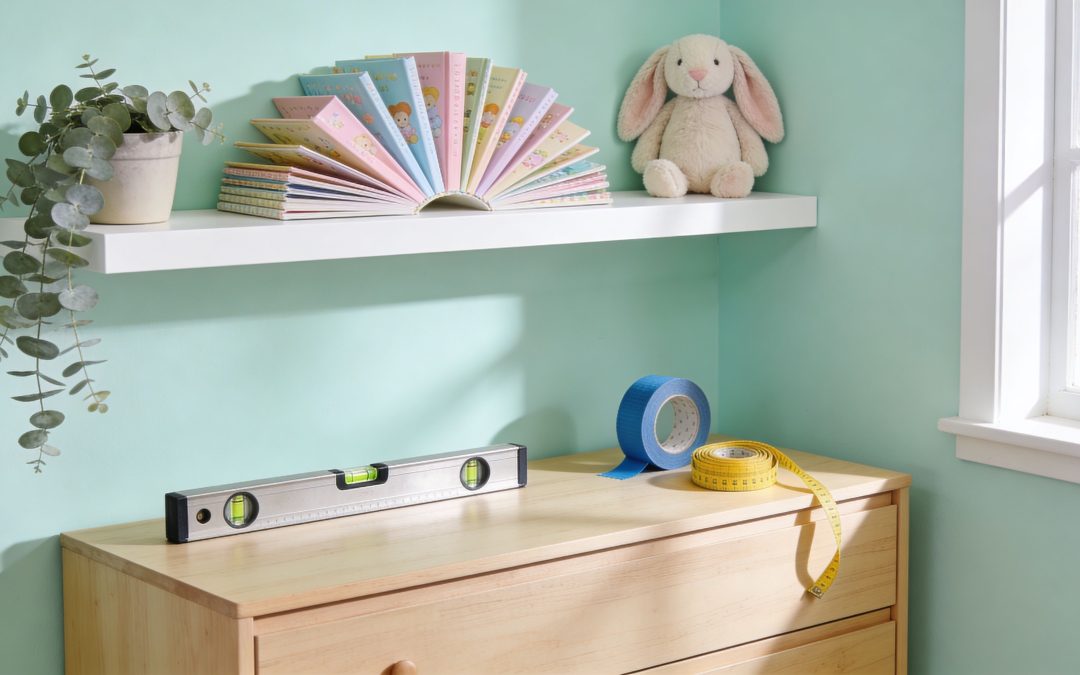
Painter’s tape helps you test the plan at full size. Mark the shelf width and depth on the wall, then mark the main furniture too if it has not been delivered yet. I do this every time because it catches problems early. A shelf that seems centred can end up crowding the glider, clipping the visual line of the dresser, or sitting awkwardly once the mattress height changes.
Plan for the room your baby will grow into
A newborn cannot reach a shelf. A toddler can drag a toy over, climb, and surprise you in seconds. That is why shelf placement needs to work for both stages.
As a practical rule, keep shelves well clear of the cot and out of a child’s climbing zone. Product safety in Australia is handled through standards and mandatory requirements for specific nursery items, and suppliers are expected to provide safe installation guidance. If a shelf is intended to hold anything with real weight, place it where an adult can use it comfortably without creating a temptation above the cot, change table, or a piece of furniture that can be climbed.
In many Australian homes, that means checking more than just eye level. Older weatherboards can have uneven walls. Brick veneer homes often limit where fixings make sense. Newer builds with plasterboard can make a shelf look easy to place until stud locations force a different spacing.
Tape first, then test the room properly
Stand in the nursery and look at the taped layout from the places you will use every day.
From the doorway: Does the wall feel settled, or does one side look heavy?
From the change table: Can you reach the top shelf without stretching while holding a baby?
From the nursing chair: Is the shelf edge or bracket sitting where your head or shoulder might end up?
From cot height: Is anything positioned above the sleep space that should be moved elsewhere?
This step matters more than people expect. A shelf over a dresser often works well because the furniture below visually anchors it. A floating shelf on a blank wall can also work, but only if it does not look stranded halfway up the room.
Layouts that usually work
One longer shelf above a dresser is often the easiest option to live with. It gives you display space without scattering visual clutter around the room.
Two shorter shelves can suit a narrow wall, especially if there is a window, a wardrobe return, or a tall chest changing the sightlines. Keep the spacing intentional. If the gap looks accidental, the whole wall feels unsettled.
Front-facing book ledges are useful in nurseries and early toddler rooms, but placement matters. Low shelves can support independent book access. They also need more thought in homes where older siblings are likely to climb, pull, or treat them like a ladder.
Leave space for what comes next
Nurseries fill up fast. Gifts, books, keepsakes, wipes, creams, and soft toys all need a home, and your baby shower list often adds pieces at different times rather than all at once. Leave enough blank wall that you can adjust after the room starts being used.
That flexibility is especially helpful if you are adding shelves to your EasyRegistry list. You might begin with one well-placed shelf, then add a second matching piece later once you know whether the room needs more books, more storage, or less visual fuss.
A taped outline costs a few minutes. Patching bad holes and living with a poor layout costs much more.
A Practical Guide to Safe Shelf Installation
A good nursery shelf should feel boringly secure. No wobble, no creak, no quiet doubt every time you put a stack of books on it.
In many Australian homes, you are working with plasterboard over timber framing. That makes the stud finder your most important tool. A spirit level is close behind.
The rule that matters most
For a safe load capacity, brackets need to be fixed directly into timber studs using 75mm galvanised wood screws. Drywall anchors alone are a weak point. They can fail under typical loads, and they often fail under levering forces. When the bracket hits two studs, success rates rise to over 95%, as outlined in this installation guide.
That single point changes almost every installation decision. If a shelf location looks pretty but misses the studs, either change the shelf, change the bracket, or change the plan.
The basic tool kit
You do not need a workshop full of gear, but you do need the right few things.
Electronic stud finder: Essential for finding timber centres behind plasterboard.
Spirit level: A short torpedo level works, but a longer one is easier for multiple shelves.
Drill and drill bits: For pilot holes and driving screws cleanly.
75mm galvanised wood screws: For fixing into timber studs.
Pencil and painter’s tape: For marking without guesswork.
Heavy-duty steel bracket: Aim for proper strength, not decorative hardware first.
A straightforward installation sequence
Mark the studs
Run the stud finder slowly across the wall and mark both edges of each stud, then mark the centre. In many homes, studs are spaced at regular intervals, but do not assume. Check them.
Be careful around switches and power points. Avoid drilling near them.
Set the bracket position
Hold the bracket where it will sit and use a level to make sure it is true. Mark the screw holes only after the bracket is level.
If you are installing more than one shelf, mark the top line for all of them first. That helps you catch alignment issues before drilling starts.
Drill pilot holes
Pilot holes make the work cleaner and reduce the risk of splitting timber. They also help the screws bite properly instead of wandering.
Drive the screws in firmly, but do not over-tighten to the point that the bracket twists or the timber compresses unevenly.
Here is a useful visual walkthrough before you start the drilling stage:
Mount the shelf and test it
Once the bracket is fixed, slide or attach the shelf according to its design. Then test it before styling.
Use a controlled load test, not a dramatic yank. Press down gently, check for movement, and make sure the shelf stays level.
Common mistakes I would avoid
Some mistakes show up again and again with wall shelves for nursery rooms.
Relying on anchors only: Fine for very light décor in some rooms. Not what I would trust for nursery storage.
Ignoring wall type: Plasterboard over brick veneer behaves differently from straight stud walls.
Installing above the cot: Even a perfectly installed shelf does not belong there.
Using flimsy included hardware: Many packaged screws are not what I would use for a child’s room.
Skipping the load test: Better to discover a problem before the books and keepsakes go up.
When to call in help
If your wall construction is unclear, the bracket span does not line up with studs, or the shelf is especially heavy, a handyman or carpenter is worth it. Nursery shelving is not the place for a “good enough” install.
In a nursery, neat holes matter less than solid fixing. You can repaint a wall. You cannot negotiate with gravity.
Styling Your Nursery Shelves from Practical to Personal
Once the shelf is secure, the room starts to feel real. This is the part where function and sentiment can sit side by side.
A nursery shelf should not be styled like a display in a shop. It needs to work on a tired Tuesday night, not just in a photo. That usually means the lower shelf carries the practical load, while the upper one gets the softer touches.
A simple way to style them
On the shelf closest to your change area, keep useful things contained. A small basket for creams, a stack of muslin cloths, and a few board books work well. Closed or soft-sided containers keep the look tidy and stop small items from spreading.
Higher up, add the pieces that make the room feel personal. A framed ultrasound photo, a timber toy, a small ceramic keepsake, or a favourite book from your own childhood all work nicely.
If you need help balancing shape and spacing, this guide on how to decorate shelves in any room gives useful visual ideas that adapt well to nurseries too. For more baby-focused inspiration, the articles at https://blog.easyregistry.com.au/ are handy for seeing how practical nursery choices fit into the bigger setup.
What tends to look best
A few styling habits make shelves feel calm instead of crowded.
Mix heights: Lean a taller book or frame behind smaller items.
Repeat one material: Timber, woven baskets, or soft fabric bins help the arrangement feel intentional.
Leave some empty space: Full shelves rarely look better. They just look busy.
Keep fragile décor high: If it can break or be grabbed later, it belongs out of reach.
What I would skip
Very heavy décor, glass pieces on low shelves, and lots of tiny objects usually create more maintenance than charm. The same goes for styling every shelf edge-to-edge. In a nursery, visual quiet is part of the comfort.
Shelves also do not need to stay the same. The display that starts with a rattle and a birth announcement can later become a row of readers and toy animals. That flexibility is one of the best things about wall shelving.
Adding Nursery Shelves to Your EasyRegistry
Registry decisions feel a lot easier once you separate the nice-to-have items from the pieces you will use every day. Nursery shelves usually land in the second group. They help with storage, they shape the look of the room, and they are the kind of gift many Australian friends and family are happy to contribute to because they can see exactly where it will go.
From our own EasyRegistry trends, nursery organisation is a steady theme on baby shower lists, and shelves are one of the more common ways parents tackle it. That makes sense. A well-chosen shelf is practical from day one, then keeps earning its place as the room changes from newborn setup to toddler space.
Why shelves work well on a registry
Shelves suit registry gifting because they solve a real problem. Guests often want to buy something more lasting than consumables, but still useful. A shelf, picture ledge, or small set of wall-mounted book ledges hits that middle ground nicely.
They also work for different budgets. One guest might purchase a single ledge. A group might chip in for a matching set, or help cover better-quality timber shelving that will last beyond the baby years.
The two registry options that make the most sense
The practical choice is to add the exact shelf you want if you have already settled on the size, finish, and fixing style. That is the best option for parents who have measured the wall, checked stud locations, and know whether they need something light for plasterboard or a sturdier shelf for books and baskets.
The flexible choice is to add a contribution toward nursery shelving or room setup through your baby shower registry at EasyRegistry. I recommend this route if you are still deciding between a ready-made shelf and a custom solution, which is common in Australian homes where wall types, room sizes, and rental rules can change the plan quickly.
That flexibility matters more than many parents expect.
A shelf that looks perfect online may not suit double brick, older lath-and-plaster, or a rental where patching holes later is part of the deal. A registry fund gives you room to buy the right version once the practical details are clear, instead of locking in the wrong product too early.
If you do add a specific shelf, include a short note on the registry with the colour, quantity, or preferred retailer. That small bit of guidance helps guests choose confidently and cuts down the chance of ending up with mismatched pieces you cannot safely install or easily return.
Your Nursery Shelf Questions Answered
A few shelf questions tend to come up once the plan gets real and the drill comes out.
What is the best height for nursery shelves
A sensible guide is to keep shelves in the 120 to 150cm range, provided they are also well clear of the cot and any climbable furniture. Height is not just about reach. It is about how the room will function once your baby becomes mobile.
Are no-drill shelves a good nursery option
For lightweight decoration in some rooms, renters may be tempted. For nursery storage, I would be cautious. Books, baskets, and everyday use put repeated strain on fixings, and this is one area where a proper mounted shelf is usually the safer call.
How do I clean nursery shelves
Keep it simple. Dust with a microfibre cloth, and wipe marks with a soft damp cloth and a mild cleaner. Harsh sprays are unnecessary, especially around baby items.
How do I childproof them as my baby grows
Reassess the room every few months. The shelf might still be secure, but the nearby armchair, toy box, or dresser may suddenly become a climbing aid. Move furniture if needed, keep fragile objects high, and remove anything you would not want pulled down.
How many items should go on each shelf
Less than you think. A shelf that is easy to dust, easy to reach, and easy to glance at during a 2 am nappy change is the one that keeps working. If styling starts to interfere with storage, practicality should win.
A well-chosen nursery shelf does not have to be complicated. It needs safe fixing, sensible placement, and enough restraint that the room still feels restful.
If you’re planning your nursery and want friends and family to contribute in a way that’s useful, thoughtful, and easy to organise, EasyRegistry makes it simple to add specific gifts or cash funds for your shelf project, décor, and other baby essentials in one place.
A guest messages you two weeks before your wedding and asks, “Can I just send a PayPal gift card?” You pause, because it sounds simple, but you are not quite sure what that means in Australia.
That confusion is common. People use PayPal all the time, so it feels like there should be one easy gift card that works like cash for a registry, a wishing well, or a baby fund. In practice, “PayPal gift card” can mean a few very different products, and that is where hosts and guests often get tripped up.
Introduction to Gifting with PayPal in Australia
If you are planning a wedding, baby shower, birthday, or group gift, you probably want one thing from gifting. Less admin. You want guests to understand what to do without needing a follow-up text, a phone call, or a rescue email on the morning of the event.
Many Australians are already leaning towards digital gifting. The Australia Gift Card market was valued at USD 6,548.12 million in 2023 and is projected to reach USD 12,981.04 million by 2032, while 57% of Australians prefer an environmentally friendly digital gift card over plastic options that contribute up to 140 tonnes of waste annually, according to Marketing Mag’s coverage of PayPal Digital Gifts in Australia.
Why the wording causes problems
The phrase paypal gift card australia sounds like it should mean “a gift card that lets someone receive money through PayPal”. That is what many hosts think. It is also what many guests hope.
But that is usually not what they are buying.
Instead, a guest may end up with:
A store-specific digital voucher for somewhere like Woolworths or JB Hi-Fi
A top-up product that adds funds to their own PayPal balance after a separate redemption step
A code with special rules that does not behave like a simple cash gift
That mismatch matters most for events. A registry fund is usually meant for something broad, like a honeymoon, pram, cot, house deposit, or general family support. A retailer voucher can be useful, but it is not the same as a flexible contribution.
Tip: If your goal is a cash-style gift for an event, treat “PayPal gift card” as a phrase that needs checking, not a ready-made solution.
What people need
Hosts need a gift flow that is easy to explain. Guests need a payment flow that feels familiar. PayPal helps with the second part. It does not solve the first part.
The key is understanding what type of product a guest is looking at before anyone clicks “buy”. Once you know the difference, the whole process gets much easier and far less awkward.
The Two Types of PayPal Gift Cards Explained
The easiest way to understand this is to stop thinking of PayPal as the gift itself. Think of PayPal as the wallet or checkout method sitting in the middle of other products.
PayPal stays top of mind because it is already widely used. 70% of surveyed Australians used PayPal for online payments between July 2023 and June 2024, and card payments represented 76% of all transactions, as shown in Statista’s Australia PayPal adoption data. That familiarity makes people assume every PayPal-related gift product works the same way. It does not.
Type one retailer e-gift cards
This is the version many people see first.
PayPal’s Digital Gifts setup in Australia lets people buy retailer-specific digital cards. These are not generic PayPal cash cards. They are store vouchers delivered digitally, often for brands people already know.
A simple analogy helps. Picture PayPal as a shopping centre.
You can use your wallet in the shopping centre to buy a gift voucher for one store inside it. That voucher only works with that store. It does not become open cash.
If a guest buys a Woolworths digital card through a PayPal-linked storefront, the recipient gets a Woolworths gift, not a flexible event contribution.
Type two third-party PayPal top-up cards
This second product is where confusion really spikes.
Some third-party sellers offer cards marketed as PayPal gift cards. In reality, these are usually top-up tools. They are designed to add value to a PayPal balance after the user redeems a code on the seller’s own system.
Using the same shopping-centre analogy, this is less like buying a store voucher and more like using a machine inside the centre to add funds to your own wallet.
This difference is key:
A retailer e-gift card points to one merchant
A top-up card points to one person’s PayPal balance
Neither one is the same as a direct event fund contribution built for a registry
Why hosts and guests mix them up
The names are similar. The goals are different.
Guests often think, “I want to send money online, so I’ll buy a PayPal gift card.” Hosts hear “PayPal” and assume it will work like a digital wishing well contribution. Both sides are acting logically. The products are what make it messy.
Here is the simplest rule to remember:
Product
Best description
Usually suited to a registry cash fund
Retailer digital gift card
A voucher for one brand
No
Third-party PayPal top-up card
A code used to load someone’s balance
Not directly
Direct payment into a fund
A contribution made at checkout
Yes
Key takeaway: In Australia, a “PayPal gift card” is usually not a universal cash gift for someone else’s event.
How to Purchase and Redeem PayPal-Linked Vouchers
From a guest’s point of view, there are really two different journeys. One is buying a store voucher through a PayPal-linked gift storefront. The other is buying a top-up code from a third party.
Those journeys look similar at first. They lead to different outcomes.
Buying a retailer digital gift card
This option suits a guest who wants to give a voucher for a specific shop or brand.
A typical process looks like this:
Find the digital gift storefront Guests usually start on a PayPal-linked marketplace such as the Australia Digital Gifts storefront.
Choose the retailer They pick a participating brand, such as a major retailer, entertainment provider, or everyday shopping option.
Select the amount and enter recipient details The guest chooses the value, adds the recipient’s name or email if required, and often includes a short message.
Pay using PayPal at checkout PayPal is the payment method here. It is not the thing being gifted.
Receive the code by email The voucher is then sent digitally, usually as a code or gift message.
Recipient redeems with that retailer The recipient follows the retailer’s rules for using it online, in app, or sometimes in store.
This is clean and fast when the host wants a retailer gift. It gets awkward when the host expected a flexible cash contribution instead.
Buying a third-party PayPal top-up product
This option works differently. It is not redeemed on PayPal itself.
According to the product details at VidaPlayer’s PayPal worldwide prepaid card listing, third-party top-up cards from platforms like Rewarble are redeemed via a 16-digit code on their specific portal, not on PayPal itself. The process takes under 60 seconds, moves the value minus a platform fee into the user’s PayPal balance, and is designed to bypass traditional credit card verification hurdles.
A guest using this route would usually do the following:
Buy an AUD-denominated top-up card from the third-party seller
Wait for the delivery email containing the redemption code
Go to the seller’s redemption page, not the PayPal app
Enter the 16-digit code and account details
Complete the transfer so the funds land in the nominated PayPal balance
That sounds simple enough, but notice what has changed. The gift is no longer a direct event contribution. It has become a balance-loading process with an extra step.
The part guests often miss
If someone says, “I bought you a PayPal gift card,” ask one polite question before assuming anything:
Is it a retailer voucher or a top-up code?
That one question prevents most mix-ups.
If you are a guest trying to work out the cleanest payment path for an event, it helps to look at a registry’s payment flow first. A practical overview of that process is available on the EasyRegistry how it works page.
Practical tip: If your goal is to contribute to a honeymoon fund, baby fund, or wishing well, check whether the event page already accepts card or PayPal payments directly before buying any code-based product.
A quick mental checklist before purchase
Use this before you press “buy”:
Question
If the answer is yes
What it means
Does the card name mention a specific retailer?
It is likely a store voucher
Good for shopping, not broad cash gifting
Does redemption happen on a third-party site?
It is likely a top-up tool
Extra step before funds appear
Does the host want money for a fund, not a shop?
A code may be the wrong fit
Direct contribution is usually better
Understanding Key Fees and Redemption Rules
Digital gifting feels frictionless until the fine print shows up. This often leads many guests to accidentally buy the wrong thing with the right intention.
Who is responsible for what
When someone buys a retailer gift through PayPal’s Digital Gifts arrangement, PayPal is acting as the facilitator, not the party taking responsibility for how that retailer handles redemption. Under its agency model with InComm Australia, PayPal Australia Pty Ltd (ABN 93 111 195 389) assumes no liability for retailer listings or redemption issues, which means buyers need to review the retailer’s own terms before purchase, as stated in PayPal Australia Digital Gifts terms and conditions.
In plain English, that means:
If the retailer limits where the card can be used, that is the retailer’s rule
If there are redemption conditions, those sit with the retailer
If there is a problem, the buyer may need to deal with the retailer or provider, not PayPal
The two trade-offs
Each product type solves one problem and creates another.
Retailer e-gift cards are usually straightforward. The trade-off is that the money is locked to one brand.
Third-party top-up cards offer more flexibility after redemption. The trade-off is that service fees can apply and the recipient has to complete an extra step.
That is why a product that looks more “cash-like” can feel less convenient for event gifting.
A simple way to judge the risk
Before buying any PayPal-linked voucher, check three things:
Where redemption happens If the code is redeemed outside PayPal, read that provider’s process carefully.
Whose terms apply Retailer card rules belong to the retailer. Top-up card rules belong to the seller.
What the host wants If they want a flexible contribution, a locked voucher may miss the mark.
For people comparing event payment options more broadly, the EasyRegistry pricing page is a useful benchmark because it makes the payment setup easy to inspect before guests choose how to give.
Rule of thumb: If a gift requires the host to learn a new redemption workflow, it is probably not the simplest option for an event.
Integrating PayPal with Your EasyRegistry Gift Fund
Here is the key shift that removes most of the confusion. Do not ask guests for a “PayPal gift card” if what you really want is money towards a fund.
That phrase sends guests down the wrong path.
A known gap in the market is that people keep searching for ways to use PayPal gift cards with Australian wedding registries, but official PayPal information focuses on retail redemption rather than registry use. It also creates a practical risk because top-up style cards are for account loading, not direct gifting, and some digital cards can revert to the sender if not activated within 30 days, as described in this G2A listing discussing Rewarble PayPal gift card use.
The better wording for hosts
If your registry includes a wishing well, honeymoon fund, nursery fund, or general contribution option, tell guests what to do in direct language.
Good wording sounds like this:
We’re saving for our honeymoon and future home. If you’d like to contribute, please use the secure fund below. You can pay using your preferred card or your own PayPal account at checkout.
Notice what is missing. No mention of gift cards.
That matters because it tells guests to pay through PayPal if they like, not to buy a PayPal product first.
A workflow that avoids confusion
For hosts, the clean workflow looks like this:
Create your fund page with a clear label such as Honeymoon Fund, Baby Essentials Fund, or House Deposit Fund
Add a short explanation so guests know what their contribution supports
Tell guests to contribute directly on the page
Use simple wording that mentions card payment or personal PayPal account access at checkout
Avoid phrases like PayPal voucher, PayPal gift card, or PayPal code
You can also look at examples of how gift-focused registries are structured on the EasyRegistry gift card registry page to get a feel for the wording guests find easiest to follow.
Copy you can paste into your registry
Different events need different tones. These examples keep the instructions clear.
Wedding
We’re lucky to have what we need at home. If you’d like to contribute to our honeymoon fund, please use the secure contribution option below. You can use your preferred payment method, including your own PayPal account.
Baby shower
Your support means so much to us. If you’d like to help with pram, nappies, and baby essentials, please contribute through the fund below using card or PayPal at checkout.
Group gift or milestone birthday
We’re collecting contributions towards one shared gift. Please use the contribution link below rather than sending store vouchers, so everything stays organised in one place.
Best practice: Ask for the outcome you want. “Please contribute to our fund below” is much clearer than “send a PayPal gift card”.
Comparing Better Alternatives for Cash Gifts
Once you stop chasing the idea of a generic paypal gift card australia product, the alternatives become easier to compare. The primary question is not “Can I buy a PayPal gift card?” It is “What is the easiest way for guests to send money without creating admin for the host?”
What to compare
For events, four things matter most:
Ease of use for the guest
Privacy for the host
Tracking and thank-you organisation
Fees and friction
If you want a broader view of digital gifting ideas beyond registries, this guide to best ways to send digital gifts is a helpful companion read because it shows how different gift formats suit different situations.
Cash Gifting Methods Comparison
Method
Ease of Use (Guest)
Privacy (Host)
Tracking & Thank You's
Fees
PayPal.Me link
Familiar for some guests, less clear for others if they do not use PayPal often
Host shares a direct payment endpoint rather than bank details
Manual tracking unless the host keeps a separate list
Varies by payment setup
Direct bank transfer
Straightforward for guests comfortable with online banking
Lower privacy because account details must be shared
Manual to reconcile names, amounts, and messages
Often simple, but depends on bank and setup
Dedicated cash fund on a registry platform
Clear for most guests because the event context sits around the payment
Better privacy because host does not need to circulate banking details
Strongest option for keeping contributions and guest notes in one place
Depends on platform settings
Retailer digital gift card
Easy if the host wants that exact store
Good privacy
Poor fit for cash gifting because value is locked to a merchant
Usually tied to the merchant terms
Third-party PayPal top-up card
More steps because code redemption happens elsewhere
Moderate privacy
Awkward for event tracking because it behaves like an account top-up
Platform fees may apply
Which option fits which situation
A PayPal.Me link can work when the host and guest already know each other well and everyone is comfortable with PayPal. It is quick, but it can feel a bit detached from the event itself.
A bank transfer is practical, especially for family members who prefer banking apps. The drawback is that hosts often end up juggling screenshots, reference notes, and message threads to work out who sent what.
A dedicated registry fund usually gives the neatest experience because the guest sees the occasion, the purpose of the fund, and the payment path in one place. That reduces the need for explanatory texts and follow-up reminders.
The simplest conclusion
For event gifting, people do best when the payment method sits inside a clear event context. That is why a registry fund generally works better than asking guests to figure out codes, vouchers, or separate payment links on their own.
Your Simple and Secure Gifting Strategy for 2026
If you are planning an event, the cleanest strategy is simple. Do not ask guests to send a “PayPal gift card” when what you want is a flexible contribution.
That phrase usually leads to a retailer voucher or a top-up product, not a smooth registry payment. Instead, ask guests to contribute directly to your event fund and let them choose a payment method they already trust, including their own PayPal account where available.
That approach is easier to explain, easier to track, and less likely to create awkward surprises. It also keeps the focus where it belongs, on the celebration.
If you are also planning pre-wedding events and want inspiration for smaller themed presents, this roundup of Hens Party Gift Ideas is a useful extra read.
If you want one link to share, one place to organise gifts, and a smoother experience for guests, explore EasyRegistry. It gives you a simple way to collect gift contributions for weddings, baby showers, birthdays, and group celebrations without the confusion that often comes with trying to use a “PayPal gift card” as a registry solution.
You’re probably here because you want a wedding that feels like you, not a project plan with seating charts, vendor spreadsheets, and a bill that keeps creeping upward.
That is exactly why so many couples are looking at a registry office wedding Brisbane and realising it is not the “backup option” people once assumed. It can be clean, stylish, intimate, and wonderfully low-drama. You get the legal clarity, the city views, the short guest list, and the freedom to celebrate in your own way afterwards.
The Brisbane Registry works especially well for couples who want meaning without theatre. You can keep it simple, dress it up, bring the right people, say what matters, and walk out married without feeling like you spent a year producing an event.
Why a Brisbane Registry Wedding is the Perfect Modern Choice
A lot of couples come to this decision the same way. They start with a broad idea of a traditional wedding, then quickly realise they do not want half of what usually comes with it. They do not want family politics driving the guest list. They do not want to spend months comparing chair styles. They do want a beautiful day, but they want it to feel calm.
That is where Brisbane Registry weddings shine.
The ceremony rooms at 180 Ann Street have a very different feel from the old stereotype of a registry office. You are not standing in a dull administrative corner. You are on Level 32, with Brisbane around you, in a space designed for short, intimate ceremonies. The focus stays where it should. On the two of you.
The popularity of that choice is no accident. The Brisbane Registry of Births, Deaths and Marriages officiated weddings for a significant number of couples, which reflects how strongly couples are gravitating toward affordable, polished ceremonies instead of the average national wedding cost of around $36,000 (Queensland Government news).
It feels intentional, not stripped back
The best registry weddings do not feel like less. They feel edited.
That distinction matters. A well-planned registry ceremony keeps the elements that shape memory:
A strong entrance: Good timing, great outfit, calm arrival.
A chosen guest list: The people who matter.
Personal words: Vows that sound like you.
A proper follow-on plan: Lunch, photos, drinks, or a city stroll that keeps the day moving.
What works best for modern couples
Registry weddings suit couples who want freedom after the ceremony. Some head to a long lunch. Some book a photographer and walk to nearby portrait locations. Some keep the ceremony tiny and hold a larger casual celebration later.
The most stylish registry weddings are usually the simplest ones. Sharp outfits, a small guest list, a clear timeline, and one lovely plan for after the ceremony.
If you have been feeling torn between “we want something special” and “we do not want a huge wedding”, Brisbane Registry gives you a very workable middle ground.
Navigating the Essential First Steps and Paperwork
You have the outfit idea, the guest list is tiny, and lunch after the ceremony is starting to feel real. Then the admin arrives. This is the point where couples either get organised early or end up scrambling for documents the week they wanted to book.
A Brisbane registry wedding is simple, but it still runs on legal timing and correct paperwork. Get those two things right and the rest of the planning feels much lighter.
The first form to sort out
The main document is the Notice of Intended Marriage, usually called the NOIM.
You need to lodge it at least one month before the ceremony and no more than 18 months ahead. That rule shapes your whole timeline. If you leave it too late, you can miss out on the date you wanted, even if everything else is ready.
If you like to keep the admin side tidy from the start, it also helps to understand how a digital wedding registry works alongside your planning checklist. Couples often leave gifts and post-ceremony logistics until the end, but a clean system early on makes the whole experience feel more modern and less pieced together.
In practical terms, the early paperwork flow looks like this:
Complete the NOIM carefully. Names should match your ID exactly.
Book your ceremony interview. This is the appointment where the registry checks your documents and progresses the booking.
Gather your original documents early. Do not assume copies will be accepted.
Go in with a few date options. Flexibility helps.
Finalise payment at the required stage. Until that is done, nothing should be treated as fully secured.
Documents that regularly cause delays
The paperwork itself is not difficult. Missing one item is what slows couples down.
Have these ready before your interview:
A birth certificate or passport
Current photo identification
Proof that any previous marriage has ended, if that applies to you
NAATI-accredited translations for any non-English documents
The document that catches people out most often is evidence of divorce or widowhood. I see this come up regularly with couples who assumed an old photocopy or incomplete paperwork would be enough. It is worth checking that file well before the appointment, especially if you have changed names before.
What happens at the ceremony interview
The interview is the registry’s formal check that everything is in order and that your ceremony can proceed legally. It is also where practical details start becoming fixed rather than tentative.
Expect the appointment to cover:
Lodging your paperwork
Showing original documents
Confirming ceremony details
Making payment
Flagging any practical requirements or questions
For a lot of couples, this meeting is the moment the wedding shifts from “we’re thinking about it” to “it’s happening.”
This explainer is a good visual companion if you want the process to feel less abstract before you attend.
My practical advice is simple. Pack your documents the night before, check every name and date, and treat the interview like an appointment you want to breeze through in one go. That small bit of preparation protects the calm, stylish version of a registry wedding that makes Brisbane couples choose it in the first place.
Booking Your Ceremony and Understanding the Costs
You have lodged the paperwork, picked a rough date, and now the practical questions start. Which time slot suits your day, and what does the registry fee cover once everything is added up?
A Brisbane registry wedding works well because the pricing is clear and the format is efficient. For couples who want a polished, intimate city ceremony without the cost and sprawl of a full venue booking, that clarity is a real advantage.
The basic booking flow
The booking process is fairly straightforward once your documents are underway. In practice, the ceremony is secured when your details are confirmed and the fee is paid.
Step
What happens
Choose your timing
Decide whether a weekday, Saturday, or Saturday evening best suits your guest list and celebration plans
Attend the interview
Finalise the legal details and present your original documents
Confirm room and ceremony details
Lock in the ceremony space, guest count, and key preferences
Pay the fee
Your booking is secured
Order your official certificate
This is usually a separate cost, so add it to the budget early
One smart move is to map your wedding admin costs alongside your celebration extras from the start. If you also plan to use a digital gift list, the EasyRegistry pricing page helps you cost that side of things before it gets lost in the excitement.
Brisbane Registry ceremony fees
The core registry costs are usually easier to manage than couples expect, especially if the goal is a stylish ceremony followed by a private lunch, dinner, or drinks in the city.
Current ceremony pricing is:
Weekday ceremony:$384.10
Saturday ceremony:$499.40
Saturday evening ceremony:$658.50
Official marriage certificate:$54.40
As noted earlier, the registry provides the confirmed fee schedule and payment process during the booking stage. The part that matters for planning is simple. Your ceremony fee and your official certificate are separate items, so budget for both.
What you pay for
The registry fee covers the legal and practical foundation of the ceremony:
A registered celebrant
Use of the ceremony room
A short legal marriage ceremony
A ceremonial certificate on the day
That stripped-back structure is exactly why the registry appeals to modern couples. Money goes on the parts that shape the experience, not on mandatory extras you did not ask for.
In my experience, the best registry weddings are the ones that stay intentional. A sharp outfit, a beautiful bouquet, a photographer who understands fast city ceremonies, and a good restaurant booking will usually do more for the day than stretching the budget for things no one will remember.
Choosing between weekday and Saturday
Each time slot creates a different kind of day.
A weekday ceremony is usually the most budget-friendly option. It suits couples who want a simple city wedding, a shorter guest list, and a relaxed lunch or early dinner afterwards. It can also be easier to book a quality restaurant or private dining space without weekend minimum spends.
A Saturday ceremony gives guests more breathing room, especially if family are travelling or juggling school and work schedules. The trade-off is higher demand, a higher fee, and a little more pressure to book your post-ceremony plans early.
A Saturday evening ceremony feels more dressed up from the outset. It works particularly well if you want the registry ceremony to flow straight into cocktails, a long dinner, or a chic rooftop celebration.
If your budget has limits, put it where guests will notice it. Clothing, flowers, photography, and food tend to carry the atmosphere.
For couples planning their look carefully, even shoe choice changes the feel of the day in photos. If you are weighing classic city-ceremony outfits, this guide to styling white satin pumps is a useful reference.
The room and guest count trade-off
Guest numbers shape the feel of a registry wedding more than people realise.
The Brisbane Registry has two ceremony rooms. One suits a smaller gathering and the other allows a larger group, but capacity on paper is only part of the decision. A registry wedding feels best when the room is comfortably full, everyone can settle quickly, and no one is squeezed in as an afterthought.
Use this rule of thumb:
Choose the smaller room if you want the ceremony to feel close, calm, and personal
Choose the larger room if immediate family and a few close friends already bring the numbers up
Trim your list early if you are near the limit, because late guest-count changes create unnecessary stress
A registry wedding in Brisbane is at its strongest when it owns what it is. Intimate, modern, and well planned. Then you can spend the rest of your energy on the celebration that follows.
Designing Your Intimate and Personal Ceremony
A registry ceremony is short, but it does not need to feel generic. The couples who enjoy it most are the ones who treat the format as a framework, not a limitation.
You will have legal wording to include, but there is still room for personality.
What the ceremony usually feels like on the day
The flow is neat and fast. You check in downstairs, head to Level 32, meet your celebrant, and settle in before the ceremony begins. The ceremony itself usually runs for 15 to 20 minutes, including the legal wording, vow exchange, and signing.
You will need two witnesses over 18. Choose people who are reliable, calm, and happy to arrive early. This is not the job for the friend who is always parking three streets away at the last minute.
The signing is an important part of the rhythm. Three marriage certificates are signed by the couple, celebrant, and witnesses. One is for you, one goes to the registry, and one is retained by the celebrant.
Personal touches that work
The best personalisations are the ones that fit the room and the timing.
Good options include:
Custom vows: Keep them warm and concise. Long speeches can feel awkward in a short legal format.
Music: Choose something non-religious that suits the tone of the room.
A considered entrance: Walk in together, separately, or in a way that feels natural for you.
Florals and attire: Even one beautiful bouquet can change the feel of a compact ceremony.
If you are deciding on shoes for a city ceremony, this guide to styling white satin pumps is useful for registry brides who want something elegant that still works for walking between photos and lunch.
Keep your guest experience realistic
The fastest way to make a registry ceremony feel stressful is to treat it like a ballroom wedding in miniature.
Do this instead:
Tell guests the ceremony is small and timely
Give them a clear arrival time
Set expectations for what happens next
Avoid adding too many moving parts before the ceremony
Registry ceremonies feel more emotional when the logistics are quiet. Clear communication makes that possible.
One practical point matters more than couples expect. Room size changes the mood. If you are inviting close family only, lean into that. A pared-back guest list does not need padding. It usually feels stronger without it.
After 'I Do' Planning Your Celebration and Gifts
This is the part most registry guides rush past, but it is the part guests remember. Once the ceremony ends, your day needs somewhere to go.
A registry office wedding Brisbane works best when the celebration afterwards matches the ceremony itself. Simple. Thoughtful. Easy to move through.
Choose one clear post-ceremony plan
You do not need a formal reception to make the day feel complete. You need a plan with shape.
The most practical options are:
A long lunch in the city: Good for family groups and easy to time after the ceremony.
Cocktails and canapés: Best if you want a more relaxed social feel.
A park gathering with a photographer: Great for couples who want portraits and a looser atmosphere.
Dinner with your inner circle: Works beautifully for very small weddings.
What does not work is leaving guests to guess. If there is no reception, say so kindly and clearly. If there is a meal, tell people where and when.
Why digital gifting makes sense for a small wedding
Registry weddings often have compact guest lists, mixed friendship groups, and less of the traditional “gift table” format. That is exactly why digital gifting feels so natural in this setting.
According to the Brisbane wedding registry guide at Light Collections, there has been a 22% rise in Australian couples preferring cash funds, and forums show 300+ unanswered threads on “registry wedding gifts Brisbane”, which points to real confusion around etiquette and logistics for smaller weddings (Brisbane wedding registry guide).
That confusion usually shows up in a few ways:
Guests ask whether gifts are expected for a registry ceremony
Couples receive duplicate items they do not need
People want to contribute to a honeymoon or shared goal, but there is no easy way to do it
Cash on the day feels awkward
The cleaner option is a single online registry that guests can access in advance.
For couples planning this side of the day, the https://www.easyregistry.com.au/wedding-gift-registry page shows how a modern wedding registry can be structured around cash contributions, selected gifts, and guest messages in one place.
Good gift wording for a registry wedding
Keep the tone light and matter-of-fact. You are not apologising for having a small wedding, and you are not demanding gifts.
Simple wording works best:
If your presence is our present, please know that is enough
If you would like to give, a contribution towards our honeymoon or next chapter is appreciated
We have kept things simple and would love contributions in place of physical gifts
That approach suits the style of a registry wedding because it is consistent with the whole day. Less clutter. More intention.
Match the gift style to the celebration style
Different after-party plans suit different registry setups.
Celebration style
Gift approach that fits
Private lunch
Cash fund for honeymoon, photography, or a home goal
Picnic or park celebration
Group contributions instead of boxed gifts
Dinner with family
A mix of cash gifts and a few selected physical items
No formal event after
One simple link shared digitally before the day
The practical benefit is obvious. Guests know what to do. Couples avoid duplicate presents. Nobody is carrying envelopes, boxed appliances, or awkwardly labelled bags through a city building.
A registry ceremony can be minimal without feeling unfinished. The trick is giving the day a clean second act.
Your Registry Wedding Timeline and Common Pitfalls to Avoid
The smoothest registry weddings are usually the ones with the least improvisation. Keep the timeline simple and lock decisions in earlier than you think you need to.
Due to increased demand, average wait times for peak slots at the Brisbane Registry can extend significantly, and many couples have shifted to midweek dates to avoid missing out (YouTube source referenced in brief). If you want a popular date, do not assume you can grab it at the last minute.
A practical timeline
3+ months out: Lodge the NOIM, gather originals, shortlist your dates.
1 to 2 months out: Confirm your celebration plan, book lunch or dinner, finalise photography.
Wedding week: Pack documents, steam outfits, and send one clear message to guests with arrival details.
After the wedding: Sort your certificate-related admin and send thank-yous.
If you are helping a groom choose something polished but not overdone for a city ceremony, this guide to wedding suits for men is a practical starting point.
Pitfalls that catch couples out
Some mistakes come up again and again:
Leaving the booking too late: Peak dates disappear first.
Forgetting original documents: Especially prior marriage paperwork.
Over-inviting: Registry rooms reward restraint.
Choosing unreliable witnesses: Lovely people are not always organised people.
Having no post-ceremony plan: Even a simple lunch booking makes the day feel complete.
The easiest way to reduce stress is to treat a registry wedding like a short, well-timed event rather than a stripped-back traditional wedding.
A registry office wedding Brisbane can be one of the most elegant ways to get married in the city. It works when you respect the format, make a few smart choices early, and build the day around what matters most.
If you want a simple way to organise gifts for a small Brisbane wedding, EasyRegistry makes it easy to share one link, collect contributions, avoid duplicate presents, and keep guest gifting tidy from start to finish.
You book a vineyard, plan a shared feast, line up a string quartet for aperitivo hour, and suddenly the wedding has the mood of Tuscany without asking 80 guests to buy international flights.
This is the core appeal of an Italian-style wedding in Australia. Couples usually are not chasing Italy for the passport stamp. They want a day that feels generous, slow, beautiful, and social. They want olive trees, stone, wine-country views, long tables, and a menu that encourages people to stay in their seats and keep talking.
The problem with marrying in Italy is rarely the dream. It is the logistics. Flights change. Accommodation costs climb. Legal paperwork takes time. Vendors work in different time zones. Guest numbers drop once travel becomes expensive or complicated. The Australian Bureau of Statistics tracks marriages registered overseas through its marriages collection, which shows why destination weddings need careful planning on both the romance and administration side (ABS marriages data and methodology).
For many couples, the better decision is to create the destination feel locally and spend the budget where guests notice it. Better food. Better drinks. A ceremony backdrop that does not need much styling. A venue with a wet-weather plan that still looks good in photos. A team that can run the day without fifteen supplier calls in the final week. If you are still comparing properties, this list of smart questions to ask a wedding venue before booking will save time quickly.
That is the lens for this guide. These are not venues in Italy. They are Australian venues that deliver the same emotional cues, organised by region across VIC, QLD, and NSW, so you can weigh atmosphere against travel time, accommodation access, weather, and guest comfort.
Some feel closest to a Tuscan vineyard wedding. Others capture the Italian brief through food, architecture, or the pace of the celebration. The best choice is usually the one that gives you the mood you want without creating extra work for you or your guests.
1. Zonzo Estate
Zonzo Estate is one of the easiest recommendations for couples chasing a Tuscan vineyard feel in Victoria. It sits in Yarra Glen, and it gets the fundamentals right. Vines, warm timber, generous food, a purpose-built chapel, and wedding formats that are simple to understand without endless back-and-forth.
That matters more than people think. The venues that feel "effortless" on the day usually did the hard organisational work upfront.
Why it works for an Italian-style wedding
The strongest feature here is flexibility without chaos. Zonzo offers ceremony-only, reception-only, and full-estate options, so you can shape the day around your guest list and budget rather than forcing yourselves into an all-or-nothing package. The Capella chapel gives you a weather-safe ceremony option that still feels architectural and romantic, while the outdoor lawn leans more countryside and relaxed.
Food is another reason this venue lands so well. Shared Italian-style feasting suits the local-destination brief better than overly formal alternate drop service. Guests settle in faster, tables feel warmer, and the whole reception reads more like a celebration than a function.
A useful planning extra is that Zonzo provides 360° wedding venue tours and package details. That is not a gimmick. In venue planning, virtual walkthroughs help couples make faster shortlists and ask sharper questions before a site visit.
If you want the day to feel Italian, spend less energy on imported styling props and more on menu flow, drinks service, and where guests gather before dinner.
Real trade-offs to know
Zonzo is strongest for couples who want clarity. If you like transparent tiers and a venue team that has done this many times, it is a good fit. If you want to customise every operational detail from scratch, the structure may feel less open-ended.
A few practical notes stand out:
Best fit for mid-sized weddings: The Estate package suits many guest lists well, but it will not be the right choice for everyone if you are planning a very large celebration.
Popular dates move early: Couples looking at peak-season Saturdays should not assume time is on their side.
The look is already established: That helps most couples, but it also means your styling should complement the venue rather than fight it.
Before you sign, run through a solid list of questions to ask your wedding venue. At a place like Zonzo, I would focus on wet-weather flow, ceremony changeover timing, and exactly how the dedicated coordinator interfaces with your other suppliers.
2. Stones of the Yarra Valley
Stones of the Yarra Valley is for couples who want the strongest "we could be in Europe" effect without leaving Victoria. The stone chapel, barn, stables, vines, and on-site accommodation create a cohesive estate experience that feels far more immersive than a single-room venue.
This is one of the closest local answers to the classic Tuscany fantasy.
The appeal is the full estate feel
Some Italian wedding venues in Australia give you a beautiful reception room but not much else. Stones gives you layers. Ceremony, portraits, drinks, dinner, and accommodation can all happen within the same estate, which changes the energy of the day. Guests settle in. Nobody is rushing from one suburb to another. The celebration feels contained in the best way.
The multiple spaces are also a practical strength. If weather turns, you are not scrambling for a marquee backup that never quite matches the original plan. Indoor options are built into the venue’s identity, which makes planning calmer from the start.
The accommodation component matters too. When couples want a destination feel locally, overnight stay options are one of the fastest ways to create it. It encourages a slower, more communal rhythm and gives close family or the wedding party somewhere to anchor.
Where couples need to be realistic
Stones is polished and highly sought-after. That brings obvious upside, but also a few trade-offs.
Pricing comes by enquiry: Some couples prefer published pricing because it helps them filter faster.
Demand is consistently high: If you have a narrow date window, flexibility helps.
A distinctive style comes with expectations: This venue suits elegant rustic-chic particularly well. It is less suited to a concept that is ultra-modern or intentionally minimal.
The right couple for Stones is usually not trying to "make" a venue feel Italian through heavy styling. The venue already does most of that work through texture, architecture, and layout. Your job is to use those bones well. Lean into candlelight, textured linen, family-style food moments, and a drinks reception that spills naturally between spaces.
The most convincing destination-style weddings feel geographically simple for guests. One estate, one visual language, one clear flow from vows to late evening.
3. Pietro Gallus Estate (Olivigna)
A couple wants an Italian wedding that feels like a family celebration, not a styled photo set. They want olive trees, a meal guests will remember, and a venue close enough to Melbourne that nobody has to wrestle with passports, airport transfers, or a week of logistics. Pietro Gallus Estate fits that brief well.
In Warrandyte South, Olivigna gives you a local version of the estate wedding many couples picture when they say “Tuscan”, but it does it through food, gardens, and warmth rather than scale. That distinction matters. If you are trying to create destination energy in Victoria without sending guests overseas, this venue makes the idea believable because the experience feels hosted, not manufactured.
Best for food-led weddings with a genuine estate feel
Some Italian-style venues look the part in photos. Pietro Gallus Estate also works operationally for couples who want the day to revolve around shared dining, a relaxed flow, and a strong sense of place.
The strongest advantage here is the hospitality format. Ceremony in the gardens, drinks that move naturally through the estate, then a reception built around in-house food and beverage is usually simpler to run than a wedding that depends on multiple outside suppliers. Fewer moving parts often means fewer timing problems, fewer styling patches, and less budget creep.
That makes Olivigna especially strong for couples planning a wedding weekend feel on a local scale. You can add a welcome dinner, next-day brunch, or family gathering nearby and still keep the main event anchored in one venue. If you are trying to create that “everyone has gone away together” mood in Victoria, this is one of the cleaner ways to do it.
Gift planning tends to matter more in this format too. Once couples start adding transport, extra events, and accommodation support for key guests, cash flow gets tighter than expected. A single registry setup helps keep contributions organised, and it pairs well with practical budgeting choices like these tips to save money on your wedding day. If you want one place for honeymoon funds, contributions, and physical gifts, a wedding gift registry through EasyRegistry is a tidy option for guests.
The practical watch-outs
Transport is the first one.
Warrandyte South is part of the appeal, but couples should not treat guest movement as an afterthought. If people are coming from the CBD, the Yarra Valley, and different parts of Melbourne, book buses early and spell out pickup points clearly. Rideshare can work for some guests, but I would not build the whole night around it.
A few trade-offs are worth checking before you sign:
Access needs planning: The location suits a destination-style atmosphere, but guests need clear transport instructions.
Capacity depends on the exact space and format: Check ceremony, cocktail, and seated numbers against your actual run sheet.
The mood is intimate and warm: Couples chasing a sprawling, high-drama estate look may find it less suited to that brief.
This venue works best for couples who want the Italian influence to come through in the hosting style. Long-table energy, strong food, good drinks, and an atmosphere that encourages people to stay present. You can explore the venue directly through Pietro Gallus Estate.
4. Locale at De Bortoli Yarra Valley
A lot of couples ask for an Italian wedding venue, then describe something much more specific. They want vineyard views, excellent wine, a menu guests will talk about, and a reception that feels like a long lunch in Tuscany, without passports, freight costs, or the usual destination-wedding coordination issues. Locale fits that brief better than many larger estates.
The appeal here is the restaurant-first model. That sounds simple, but it changes the whole run sheet. Service is tighter, the pacing is cleaner, and the guest experience usually feels more relaxed because the venue already knows how to host around food and wine rather than around a big blank-canvas setup.
For couples planning a local wedding with destination energy, that matters.
Locale’s ceremony lawn, barrel styling, estate wines, and Italian-leaning menu do a lot of the heavy lifting. You do not need to force extra theme work onto the space. In practice, the best version of this venue is restrained. Good stationery, considered florals, warm lighting, and confident table styling will carry the mood much further than oversized installations. Couples who want to keep the budget focused on guest experience should read these wedding budget-saving tips that protect the parts guests notice.
The format also supports the “weekend away” feeling that makes Australian Italian wedding venues so appealing. Lunch or dinner service with a clear start and finish gives guests a proper hosted experience, and adding a recovery breakfast the next morning helps the celebration feel bigger than a single event without creating the admin load of a wedding in Italy.
Where Locale works best, and where it does not
Locale suits intimate to mid-sized weddings where hospitality is the centrepiece. It is a strong choice for couples who care more about the quality of the meal, wine service, and atmosphere than a huge dance floor or a high-production reveal.
There are trade-offs.
Guest count needs discipline: Restaurant scale creates warmth, but it also means the venue will not stretch comfortably for a fast-growing list.
Styling should suit the room: The space already has character. Heavy draping, ballroom-style staging, and oversized decor can feel mismatched.
Entertainment plans need realism: A lively dance set can still work, but this is not the same brief as a large marquee or estate built for a late-night party.
Operational timing matters: Because it sits on a working winery estate, couples should confirm access windows, bump-in limits, and any estate-specific restrictions early.
One of the most common mistakes I see at restaurant venues is overspending on decor to chase a ballroom result the space was never designed to deliver. Locale works better when couples accept what it does well and build around that. Keep the ceremony personal, let the food and wine lead the reception, and use the Yarra Valley setting to create the Italian mood locally instead of trying to manufacture something grander than the venue wants to be.
You can explore the venue directly through Locale at De Bortoli Yarra Valley.
Got a new gift card burning a hole in your digital pocket? Let's get it spent. Using it online is usually a breeze, but knowing exactly what to do can save you that moment of confusion at the checkout.
When you're ready to pay, keep an eye out for a field labelled 'Gift Card,' 'Voucher,' or sometimes 'Promo Code.' This is where you'll type in that long string of numbers from your card.
If you have a physical card, you’ll probably need to flip it over. Look for a PIN or security code, which is often hidden under a silver scratch-off panel. Just scratch it off gently with a coin, and you're good to go.
Your Quick Guide to Using Gift Cards Online
Most people get through the online checkout with a gift card in no time. In fact, some recent studies show 81% of Aussie shoppers complete their online redemptions in under two minutes. The key is knowing what kind of card you're working with.
Know Your Card Type
Gift cards in Australia generally fall into two camps:
Store-Specific Cards: These are cards from a single retailer, like JB Hi-Fi or The Iconic. You can only use them at that specific store, either on their website or in person.
Network Cards: You'll recognise these by the Visa or Mastercard logo. They work a lot like a debit card, meaning you can use them at any online shop that accepts those payment methods.
If you have an e-gift card that arrived by email, all the details you need—the number, PIN, and expiry date—will be right there in the message. For a practical look at how a retailer presents this info, you can check out the terms for a Vivien Lauren Gift Card.
Before we get into the nitty-gritty, here’s a quick overview of where you’ll usually enter your details for different card types.
Gift Card Types and How to Redeem Them Online
This table breaks down the most common gift cards you'll find in Australia and where to use them during an online checkout.
Card Type
Where to Enter Your Code
Common Australian Examples
Store-Specific
In the 'Gift Card/Voucher' field at checkout.
Myer, Bunnings, The Iconic
Network (Visa/Mastercard)
In the standard 'Credit/Debit Card' payment section.
Prepaid Visa, Gift Card Store
Shopping Centre Cards
Usually in the 'Credit/Debit Card' section if it has a Visa/MC logo.
Westfield, AMP Capital
Knowing this little difference between entering a code in a gift card field versus a credit card field can save you a lot of hassle.
For those planning a baby shower with EasyRegistry, this simplicity is a huge plus. It means guests can easily contribute to your registry or purchase gifts without any fuss. It’s no surprise that 56% of digital cards in Australia are redeemed within six months—people are eager to use them! To see how seamless it is, learn more about how EasyRegistry makes group gifting simple.
A Look at Desktop vs. Mobile Checkout
Knowing where to enter your gift card details online is half the battle. While the basic steps don't change, the checkout process can look quite different depending on whether you’re shopping on a computer or your phone.
On a desktop, you’ve got more screen space, so retailers usually lay everything out in the open. You'll find the gift card field right there with the other payment methods like credit card or PayPal, often with a clear label like “Apply Gift Card” or “Add Voucher Code.”
This simple diagram breaks down the flow from grabbing your card to completing your purchase.
It really comes down to just three things: having your card details handy, finding that field at checkout, and punching in the number and PIN to apply your credit.
Finding the Field on Mobile
Mobile is a different story. To keep things tidy on a small screen, payment sections are often collapsed. You might need to look for and tap on a prompt like “Payment Options” or “Add a gift card?” to make the entry box appear. It’s a tiny extra step, but it’s one that often trips people up.
Here’s a practical tip I swear by: before you even start shopping, open the gift card email and take a screenshot. That way, you won't have to switch between apps to copy and paste the code, which minimises the chance of typos.
A Special Note for EasyRegistry Hosts
If you’re running a registry for a wedding or baby shower with EasyRegistry, the process is wonderfully straightforward. Instead of dealing with individual store gift cards, your guests are simply contributing cash into one central fund.
As the host, you can withdraw this entire cash balance directly to your Australian bank account. This effectively turns all your contributions into one flexible fund that you can spend anywhere, on any website, just like your own money.
This system gives you complete freedom. You’re not locked into a single retailer, which is perfect for big-ticket items. You can shop around for the best price on that new pram or even put the funds towards a honeymoon flight, using the money wherever you see fit.
Managing Your Balance and Splitting Payments
So, what happens when your gift card doesn't quite cover your whole shopping cart? It's a common scenario, but thankfully, most Australian online stores are well-equipped to handle it by letting you split the payment.
The process is usually straightforward. You’ll enter your gift card details first during the checkout process. The store's system will then automatically deduct the gift card amount from your total, showing you exactly what’s left to pay. From there, you can cover the remaining balance with a credit card, PayPal, or whatever other payment method you prefer. It's designed to be simple so you can use every last dollar.
This kind of flexibility is a big reason why online gift cards are so popular. In fact, a huge 68% of these transactions now happen on mobile devices, and recent data shows that 76% of digital gift cards are spent completely within the first 30 days.
Checking Your Balance Before You Shop
To avoid any surprises at the checkout, I always recommend checking your card's balance before you start shopping. For most physical cards, you’ll find a website address printed on the back. Just pop over to the site, enter your card number, and you’ll see exactly how much you have to spend.
This idea of combining funds for a purchase is very similar to how contributions from an EasyRegistry work. When guests give you cash gifts, you have the freedom to pool those funds with your own money to buy bigger-ticket items. You can see how this works by exploring the features of a flexible registry.
For example, say you receive $300 in registry contributions for a new pram that costs $500. You can withdraw the gifted funds and simply add your own $200 when you go to buy it, ensuring you get exactly what you want without being locked into a single retailer.
How to Troubleshoot Common Gift Card Errors
There’s nothing quite like the frustration of hitting an "Invalid Code" message just as you’re about to check out. I’ve been there, and it’s a real momentum-killer. The good news is that most gift card errors are surprisingly simple to fix, and usually, it’s just a simple typo.
Before you panic, take a breath and carefully re-enter the code. It’s incredibly easy to mix up characters that look alike, especially on a small phone screen.
Are you looking at a zero (0) or the letter O?
Is that a one (1) or a capital I?
Did you miss any of the hyphens? Some systems need them, others don't, but it's worth a try.
Another common pitfall is putting the code in the wrong spot. Most online checkouts have two very different boxes: one for discount or promo codes and another for gift cards. Remember, a gift card is a form of payment, not a promotion. Double-check that you’re using the field labelled "Gift Card" or "Voucher".
Common Issues Beyond Typos
If you've triple-checked the code and you’re certain it's in the right field, it's time to dig a little deeper. Sometimes the problem has nothing to do with how you're entering the code, but with the card itself.
One of the most common issues I see is a card that was never properly activated. If the gift card was purchased in a physical store, there’s a small chance it wasn't scanned correctly at the register. You’ll likely need to contact the retailer with your receipt to get it sorted.
Another thing to watch out for is regional locking. A gift card for an Australian retailer, for instance, probably won’t work on their US or UK website. Always make sure you're shopping on the correct regional site, which for us in Australia typically ends in .com.au.
If you're still stuck after trying these fixes, your best bet is to get in touch with the retailer’s customer support team. They can look up the card’s status on their end and tell you exactly what’s going on.
Keep Your Gift Cards Safe: A Few Smart Habits
Think of your gift card, whether it's a physical one in your wallet or a digital code in your inbox, as digital cash. It has real value, and you need to protect it just as carefully. The single most important rule I tell people is to only use your card on a secure website. Before you type in a single digit, always check your browser’s address bar for the little padlock icon and ‘https’—that ‘s’ stands for secure.
Never, ever share your gift card number and PIN on social media or in an unsecure email. Scammers are always on the lookout. For digital gift cards, a simple trick I've learned is to create a dedicated "Gift Cards" folder in your email inbox. It keeps everything organised, safe from accidental deletion, and ready to go when you are. Even better, add the card to your phone's digital wallet if the retailer supports it.
Putting Security into Practice
A little bit of caution goes a long way. Here are a few practical tips to keep your gift card balance safe.
Guard the PIN: Treat the PIN or security code like you would your bank card PIN. Don't write it on the card or store it in an obvious place.
Spot phishing scams: Be sceptical of any unsolicited email asking for your gift card details to "verify" an account. Legitimate retailers will never do this.
Stick to secure networks: Grabbing a coffee and doing some shopping on public Wi-Fi is tempting, but it’s a huge risk. Wait until you're on a trusted, secure network before entering any payment details.
The good news is that using gift cards online is generally very safe, and getting safer. Thanks to recent Australian Consumer Law reforms, we've seen clearer terms for consumers and a significant 37% drop in fraud complaints. For our hosts using EasyRegistry, this provides extra peace of mind, as only they can access the funds contributed to their registry. You can discover more insights on these positive trends and the growth of mobile payments.
A Few Common Questions About Using Gift Cards Online
Got a gift card burning a hole in your pocket? You're not alone. When it comes to spending them online, a few questions pop up time and time again. Let's walk through the most common ones so you can get straight to the good part: shopping.
Can I Use Multiple Gift Cards on a Single Online Order?
This is a big one, and the short answer is: it depends entirely on the retailer. Many major Australian stores have updated their checkout systems to let you stack several gift cards in one go. You’ll usually spot an "Add another gift card" button right where you enter the first one.
But what if you're shopping with a smaller business or an older website that only accepts one card per transaction? I’ve run into this myself. Here's a handy workaround: see if you can use your multiple gift cards to buy a single, larger e-gift card from that same store. This consolidates your funds onto one code, solving the problem instantly.
What's the Difference Between a Gift Card and a Discount Code?
It’s easy to get these two mixed up, but they function very differently. Think of it this way: a gift card is a form of payment, like digital cash with a set value. A discount code (or promo code) is a special offer that reduces the price, like "20% off" or "free shipping."
Every online checkout has separate boxes for these. If you paste a gift card number into the discount code field, you'll get an error message every time. Always look for the field specifically labelled "Gift Card" or "Voucher."
A Pro Tip From Experience: Always enter your discount codes before you apply the gift card. That way, the discount is taken off the full price first, and your gift card balance goes much further.
Should I Keep My Physical Gift Card After I've Used It Online?
Yes, definitely! I can't stress this enough. Always hang onto your physical card until your order arrives and you’re sure you won't be returning anything.
If you need to send an item back, most retailers refund the money to the original payment method—which, in this case, is the gift card. Tossing it out too early can make getting your refund a real headache.
How Does This Work with Contributions from an EasyRegistry?
EasyRegistry flips the script on traditional gift cards to give the host ultimate freedom. Instead of guests buying individual store-specific cards, they contribute money to a single registry fund.
The host can then withdraw the total amount directly into their bank account. Once it's there, you can spend it however you like, anywhere online or in a physical store, just like your own money. It’s like having the world’s most flexible gift card with zero brand restrictions, making it perfect for big-ticket items or saving for an experience.
At EasyRegistry, we believe giving should be simple and meaningful. Create your free registry today and discover just how easy it is to bring your dream gifts to life. Visit us at https://www.easyregistry.com.au to get started.