
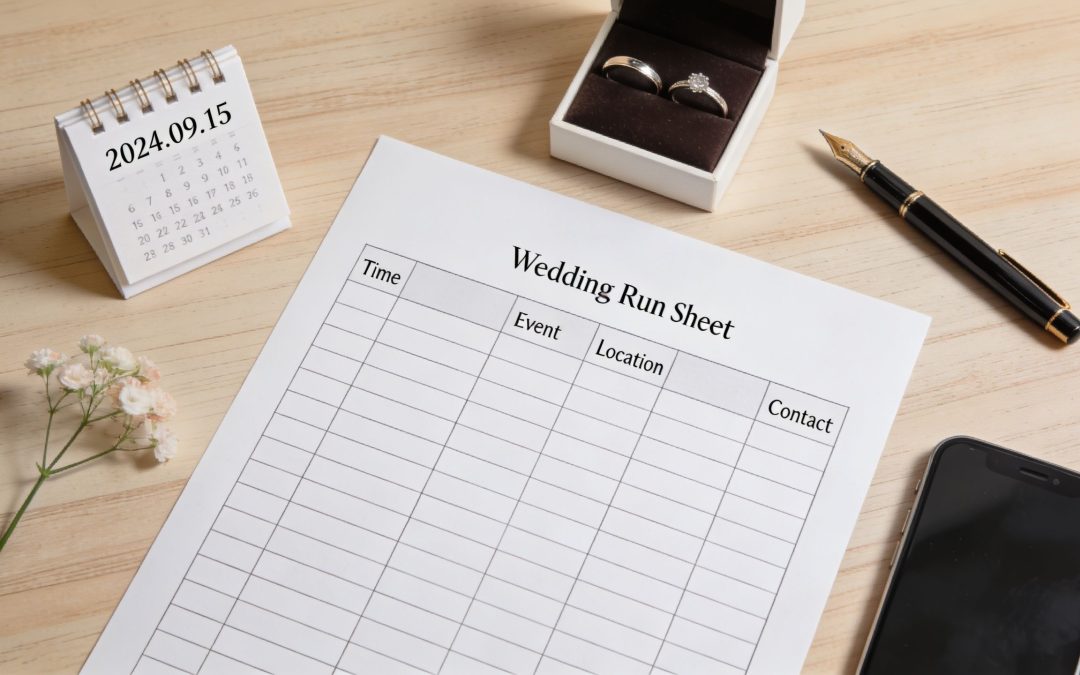
You’re probably looking at a growing stack of open tabs right now. One for the venue. One for the photographer. Another for transport. A note on your phone with ceremony ideas. A text thread with family questions. An email from your florist asking when they can access the venue. Another from your celebrant asking how long you’ve allowed for signing.
That jumble is exactly why a wedding run sheet matters.
Not because it’s glamorous. Not because it belongs in a planner’s binder. Because it turns a day with many moving parts into a day that feels calm, clear and well held.
Why Your Wedding Day Needs a Run Sheet

A lot of couples treat the run sheet as a final admin task. It isn’t. It’s the document that protects the whole day from avoidable confusion.
In Australia, the average wedding costs approximately $36,000 AUD, and a detailed run sheet helps manage that investment by keeping timing tight, avoiding unnecessary overtime, and coordinating 15-20 suppliers. It also matters emotionally. 70% of couples report stress during planning, which is exactly where a single, reliable timeline starts earning its keep, according to Hey Jack’s wedding run sheet guide.
If you haven’t mapped your day yet, a practical place to start is to create your wedding day timeline before you worry about styling details or tiny ceremonial extras. Timing decisions affect almost everything else.
It’s not just a timeline
A proper wedding run sheet does more than list times. It answers the questions people will ask on the day without needing to ask you.
Who opens the venue? When does the florist arrive? Where does the bus wait after drop-off? Who has the rings? When does the photographer leave for the reception venue? Who tells the DJ that speeches are about to start? If rain rolls in, who calls the move indoors?
That’s why the best run sheets become the single source of truth for the whole team.
Practical rule: If a supplier or family member could need the information on the day, it belongs somewhere on the run sheet.
What happens without one
When a wedding doesn’t have a clear run sheet, the problems are rarely dramatic at first. They’re small. A bouquet delivery lands while no one is ready to receive it. Hair and makeup drift late. The family photo list hasn’t been shared. Guests reach cocktail hour before the bar is set. The MC starts speeches while mains are being cleared.
Those little slips stack up.
A delayed start can push photography, transport, venue access and meal service out of sync very quickly. The couple then becomes the decision-maker for details they should never have to manage in formalwear.
Calm is built, not hoped for
A good run sheet creates breathing room. It tells everyone what’s happening, where it’s happening, who owns it, and what happens if something changes.
That’s the difference between a schedule and a resilient plan. One assumes the day will behave perfectly. The other assumes real life will show up and makes room for it.
Building Your Wedding Run Sheet Foundation
Before you fill in times, build the frame properly. Most run sheets fail because they’re too vague, not because they’re too detailed.
The strongest version is usually a spreadsheet or table in Excel or Google Sheets. Keep it simple enough that anyone can scan it quickly, but complete enough that your key people don’t need to chase missing details.
Start with anchor points
Professional planners build the day around anchors first. These are the fixed points that can’t move without affecting everything else.
The most common anchors are:
- Ceremony start: This is the spine of the day. Hair, makeup, photography, transport and guest arrival all flow backwards from it.
- Reception entry: Caterers, venue staff, musicians and your MC all need this fixed early.
- Sunset or portrait light: Photographers should help shape this timing because they cover most major moments and know how long movements take.
- Venue rules: Bump-in, bump-out, curfews, sound checks, parking access and gate times matter more than couples expect.
- Travel windows: If your ceremony and reception are in different locations, travel time becomes a mandatory block, not a rough guess.
According to Kombi Keg’s wedding run sheet template guide, planners recommend locking anchor points first, consulting photographers early, and adding 10-15 minute buffers around movements because 80% of weddings exceed planned timings without them.
Use columns that solve problems
A run sheet works best when every line answers a practical question. These columns are the ones I’d consider essential:
| Column | What to include | Why it matters |
|---|---|---|
| Time | Specific time blocks | Keeps everyone working from the same clock |
| Event or activity | What is happening | Removes guesswork and vague labels |
| Location | Exact venue area or address | Helps suppliers and family move correctly |
| Responsible person | One named person, not a generic team | Someone owns the task |
| Contact number | Day-of mobile | Fast fixes when plans shift |
| Notes | Access, props, weather plan, buffer reminders | Stops preventable mistakes |
“Venue staff” is too broad. “Maddie, venue coordinator” is useful. “Groom’s family photos” is incomplete. “Groom’s family photos on lawn, list with photographer, grandparents first” is usable.
Include the overlooked details
Many couples write only the guest-facing moments. Professionals also include the hidden logistics.
That means adding:
- Supplier access details: Gates, loading zones, stairs, lift access, power limits
- Setup milestones: Ceremony install complete, sound check done, candles lit, signage placed
- Decision points: When a wet weather call must be made
- Emergency contacts: Venue manager, planner, transport lead, family contact
- Version control: One master copy, then only essential variations
A strong planning companion for this stage is a list of questions to ask your wedding venue, because venue rules shape the bones of your run sheet more than most couples realise.
The run sheet should tell people what to do without needing to interrupt the couple. That’s the standard.
Draft early, finalise late
Create the first proper draft a few weeks before the wedding. Final details will still move, and that’s normal. Finalise the live version closer to the day once your suppliers have confirmed arrival times, setup windows and service order.
The goal isn’t perfection on the first pass. The goal is a structure solid enough that refining it becomes easy.
Planning the Morning From Wake-Up to 'I Do'
The wedding morning sets the emotional tone for everything that follows. If the first half of the day feels frantic, that tension carries forward. If it feels paced and prepared, the rest of the day has a much better chance of staying steady.
Start with the immovable point. The ceremony time. Once that’s fixed, work backwards through transport, getting dressed, photography, hair and makeup, and breakfast or lunch. Don’t build the morning from when someone wants to wake up. Build it from when you need to arrive calm, dressed and ready.
Build backwards from the ceremony
This part catches couples out all the time. They allow enough time for makeup itself, but not for the moments around it.
There’s the delay when someone’s running late to the room. The extra touch-up after a happy cry. The time it takes to steam a dress that was hanging perfectly yesterday and somehow creased overnight. The search for a missing cufflink. The bouquet delivery that arrives during lipstick.
A practical morning sequence often includes:
- Wake-up and food: You need time to eat and hydrate, not just sit for styling.
- Hair and makeup start: Confirm the artist’s schedule for every person receiving services.
- Photographer arrival: This should line up with detail shots, prep candids and dressing.
- Florals delivered: Bouquets, buttonholes and any special family flowers need a receiving person.
- Getting dressed: Build proper time for fastening, adjusting and portraits.
- Travel to ceremony: Include loading time, not just driving time.
- Arrival buffer: Aim to arrive ready, not in a sprint.
The reason planners consult photographers early is simple. They see and document nearly every key moment, so they often have the clearest sense of realistic timing. As noted in the earlier planning guidance, buffers around movement matter because transitions are where mornings usually slip.
Where buffers save the day
The most useful morning buffer isn’t hidden at the end. It’s woven through the entire lead-up.
If hair and makeup is scheduled tightly with no flex, one slow appointment affects everyone after it. If transport arrives exactly when you hope to walk out the door, any delay becomes a stress point. If you plan to finish dressing the minute the photographer arrives, you lose all breathing room for natural photos.
Leave white space around movement, dressing and travel. That’s where a wedding morning either settles down or unravels.
Here’s the practical standard. Add a small cushion around every transition. Dressing takes longer when jewellery, veils, suit buttons, shoes and family involvement are part of the moment. Group movement always takes longer than one person expects.
A short visual guide can help if you want to see how planners think through the flow of the day:
A realistic wedding morning mindset
The morning shouldn’t feel like a production line. It should feel managed.
That means deciding in advance who handles practical interruptions. One person can receive deliveries. One can answer supplier calls. One can keep an eye on time. If you don’t assign those jobs, they fall back to you.
A resilient run sheet for the morning also notes the little local realities that affect Australian weddings:
- Warm weather: Build in time for touch-ups and cool-down breaks
- Remote venues: Allow extra time for travel, patchy reception and supplier access
- Shared accommodation: Know which room is for prep, photography and dress storage
- Regional transport: Confirm exactly where drivers meet you and who has their number
What works and what doesn’t
What works is a morning with clear ownership. Your stylist knows who is first. Your photographer knows when details are ready. Transport knows where to wait. A trusted person keeps the room clear enough for everyone to work.
What doesn’t work is optimism disguised as planning. If six people are having styling and the sheet says “Hair and makeup done by late morning,” that isn’t a plan. It’s a hope.
The best wedding mornings feel unhurried because the work was done before the alarm went off.
Mapping the Main Events From Vows to Last Dance
Once the ceremony begins, your day shifts from private preparation to guest experience. At this point, flow matters most.
Guests don’t see the spreadsheet. They feel the rhythm. They notice whether drinks appear at the right time, whether speeches drag too long before dessert, whether the room feels ready when they enter, and whether there’s a natural build from formal moments into celebration.

Sequence the guest experience first
A strong reception run sheet doesn’t start with “what traditions do we want?” It starts with “what will guests need at each point?”
Immediately after the ceremony, guests need direction. If you’re leaving for portraits, they need drinks, canapés, shade or shelter, bathrooms and a clear sense of where to go next. If you’re staying on site, they still need hosting while family photos happen.
Then the reception needs a sensible shape. Entrance. Seating. Service. Speeches. Cake. Dance floor. Farewell. Not every wedding uses every tradition, but the order still matters because catering, entertainment and venue operations depend on it.
According to Blue Wren Farm’s reception run sheet advice, couples often underestimate timings by 20-30%, and group photos typically need an extra 10 minutes for guest herding. The same guidance notes that a detailed run sheet shared one week prior yields an 85% on-time execution rate.
A sample reception flow
For a reception beginning at 5:30pm, one practical sequence is:
- 6pm entrée
- 7pm main and speeches
- 8pm cake and dance
- 11pm last call
That doesn’t mean every wedding should copy those exact placements. It means the major parts of the evening need a deliberate order that supports service and energy.
Here’s a simple example of how that can look on paper.
| Time | Event | Key Contact | Notes |
|---|---|---|---|
| 5:30pm | Guests seated for reception | Venue coordinator | Confirm all guests called in from cocktail hour |
| 5:45pm | Couple entrance | MC | DJ cued, photographer in position |
| 6:00pm | Entrée served | Catering lead | Check dietary meals first |
| 7:00pm | Main and speeches | MC | Confirm speech order before mains land |
| 8:00pm | Cake cutting and first dance | DJ or band lead | Cake knife ready, photographer alerted |
| 11:00pm | Last call and final farewell prep | Venue manager | Transport contact on standby |
Don’t forget the hidden logistics
The guest-facing schedule is only half the story. The stronger run sheets also include the operational moments that keep the public moments smooth.
Those often include:
- Supplier bump-in times
- Ceremony pack-down
- Sound check completion
- Band or DJ meal timing
- Cake delivery and storage
- Styling resets between ceremony and reception
- Venue bump-out and collection instructions
These details are where Australian venue realities show up fast. Rural properties may have stricter access windows. Heritage spaces may control sound and candles closely. Private properties often need firmer guidance for parking and supplier arrivals. If your vendors are travelling from different areas, your sheet needs to account for who arrives first, who needs site access, and who can’t do their job until another supplier has finished.
Guests remember a wedding as seamless when the handover between moments feels natural. That smoothness usually comes from logistics they never see.
Keep formalities moving
Reception energy rises and falls. That’s normal. The trick is not leaving guests in a long flat stretch.
A common mistake is stacking too many formalities together. If you place speeches, then cake, then a long video, then another thank-you before opening the dance floor, the room can lose momentum. A better approach is to use formal moments with intention and give the room a release point.
That matters even more if you’ve planned a choreographed dance. If you’re doing that, build in private rehearsal confidence before the day. Couples sometimes find outside resources useful for this, even if they’re overseas, because the teaching cues are still applicable. A good example is Philadelphia first dance instruction that breaks down how to prepare for a dance without overcomplicating it.
Build for movement, not perfection
A wedding reception run sheet should be specific, but not brittle. You want enough structure that the evening stays on track, and enough flexibility that a heartfelt speech or a weather-related reset doesn’t ruin the whole night.
That’s why the best planners write notes like “hold cake until mains cleared” or “delay entrance if grandparents need seating” rather than treating the timeline as untouchable. A resilient run sheet keeps the night moving without making people feel managed.
Sharing the Plan With Your Wedding Day Team
A wedding run sheet only works if the right people have the right version at the right time.
That’s the part couples often leave too late. They build a good document, then send one giant file to everyone and assume it will sort itself out. It won’t. Different people need different levels of detail.

Give each person the version they need
Your photographer may need prep details, family photo timing, travel notes and reception formalities. Your MC needs a clean list of cues, order of events and who to check with before announcing anything. A driver needs pickup times, addresses and the correct contact person. A parent usually only needs a high-level overview.
Think in layers.
- Master run sheet: Full operational version for planner, coordinator or lead organiser
- Supplier version: Relevant logistics and timing for each vendor
- Family version: Key moments, arrival times, transport details, special responsibilities
- MC version: Event order, pronunciation notes, speech order, cue points
If gift logistics are part of your wider wedding planning, couples often appreciate having one organised place for that side of things too. A practical example is a wedding services registry that keeps giving simple and clear without creating extra back-and-forth.
When to send it
You don’t need to flood inboxes months ahead with a document that will still change. You do need to send a near-final version early enough that suppliers can query anything important.
A clean process looks like this:
- Draft the full run sheet once your key timings are established.
- Check it with major vendors such as venue, photographer, celebrant and catering lead.
- Refine access details and contact numbers once all suppliers confirm.
- Send final versions to the relevant people before the wedding.
- Confirm they’ve received it rather than assuming they have.
Appoint one keeper of the sheet
Someone needs to own the live document on the day. If you have a planner or coordinator, that’s ideal. If you don’t, choose a calm, reliable person who won’t vanish during cocktail hour.
This person does not need to micromanage every supplier. They need to know the plan, hold the contacts, and make minor timing calls without dragging the couple into every decision.
The couple should be the least interrupted people at their own wedding.
What to include at the top
The first lines of the run sheet should solve the fastest-moving problems.
Put these at the top of the page:
- Couple names and wedding date
- Ceremony and reception addresses
- Primary day-of contact
- Emergency backup contact
- Wet weather decision note
- Version date
That top section matters when someone opens the sheet on a phone in a hurry and needs the key details immediately.
Avoiding Common Wedding Run Sheet Mistakes
Most run sheet problems aren’t caused by laziness. They’re caused by assumptions. Couples assume travel will be smooth. They assume speeches will stay short. They assume everyone knows where to be. They assume a venue run sheet covers the whole day.
Those assumptions are where avoidable stress sneaks in.
Mistake one. Treating the venue sheet as the full plan
Venue teams usually focus on what happens inside their walls. That leaves gaps around off-site prep, transport, ceremony logistics, family movements and supplier coordination before arrival.
Fix it by building one master run sheet for the entire day, then folding the venue timing into it. Don’t let two competing documents run side by side.
Mistake two. Skipping the wet weather call
Outdoor weddings need more than a vague backup idea. They need a decision-maker, a decision time and a practical switch plan.
If rain becomes likely, your run sheet should already note who makes the call, who informs suppliers, what changes for seating and styling, and how guests are directed. If you need a little financial breathing room elsewhere in your plans so you can budget for sensible contingencies, this guide with tips to save money on your wedding day can help you prioritise what’s worth spending on.
Mistake three. Forgetting direct contact details
On the day, nobody wants to dig through old emails to find a mobile number. If the florist is at the wrong gate or the driver can’t locate the pickup point, speed matters.
Put day-of contact numbers directly on the sheet. Not office numbers. Not social handles. The mobile number that will be answered.
Mistake four. Planning too tightly
A run sheet should guide the day, not squeeze the life out of it.
If every minute is packed with no room to breathe, the plan becomes fragile. If a heartfelt hug line forms after the ceremony or your grandparents need more time getting to photos, the whole afternoon shouldn’t collapse. Build in room for the human parts of the day.
A good wedding run sheet is firm on sequence and flexible on exact pace.
Mistake five. Writing a document nobody can use
The prettiest run sheet is not always the most practical one. Overdesigned PDFs, tiny fonts and vague labels make life harder for the people trying to use them quickly.
Keep it readable. Use plain language. Name real people. Make the notes useful. If someone opens the sheet on a phone while standing in a car park, they should still be able to understand it immediately.
A resilient wedding run sheet doesn’t promise a flawless day because weddings are live events and real life always gets a vote. It does something better. It gives your people a clear plan, a backup plan, and enough structure to protect the feeling of the day when small things shift.
If you’re organising all the moving parts of a wedding, gifts shouldn’t be another messy spreadsheet to manage. EasyRegistry gives couples one simple place to create a registry, share it with guests, track contributions and keep everything organised in one link. It’s a practical way to reduce admin while keeping your wedding plans clear and guest-friendly.
