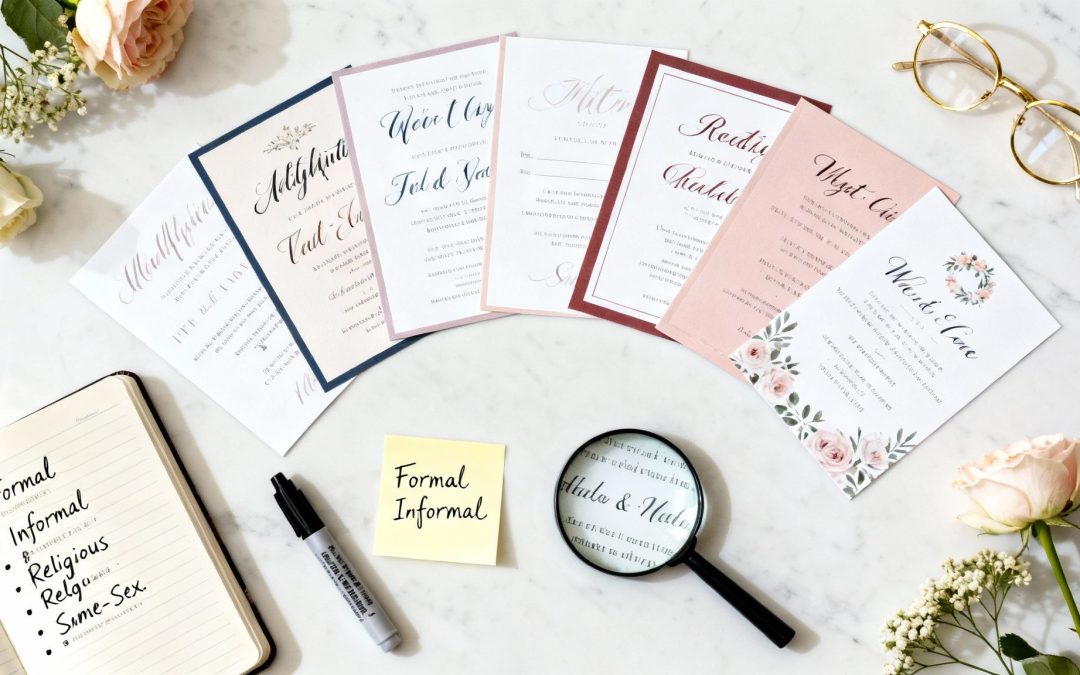
Welcome to your definitive guide on mastering the art of wording for wedding invitations. The words you choose are the very first glimpse your guests will have into the style, tone, and heart of your celebration. They set the stage, convey crucial information, and most importantly, invite your loved ones to share in one of the most significant moments of your life.
But with so many traditions, etiquette rules, and modern twists, finding the perfect phrasing can feel overwhelming. Are you aiming for timeless elegance with a formal invitation, a touch of modern simplicity, or a unique reflection of your fun-loving personalities? How do you correctly honour parents who are hosting, or politely mention your gift registry? Getting the wording right is essential for communicating the key details while capturing the spirit of your upcoming day.
This guide is organised to demystify the entire process and provide clear, actionable solutions. We will explore a comprehensive collection of wedding invitation wording templates, diving deep into eight distinct styles from formal and traditional to casual, humorous, and destination-specific. For each category, we will provide detailed examples, strategic analysis, and practical takeaways you can immediately apply.
By the end of this article, you'll have the confidence and clarity to craft an invitation that not only looks beautiful but speaks authentically for you as a couple. This ensures your guests feel genuinely welcomed, fully informed, and truly excited to celebrate with you. Let’s find the perfect words for your special day.
1. Formal Traditional Wording
Formal traditional wording for wedding invitations sets a tone of classic elegance and timeless sophistication. This style adheres to long-standing etiquette, making it the perfect choice for black-tie affairs, religious ceremonies, and grand celebrations held in historic venues or exclusive country clubs. It communicates a deep respect for tradition and signals to guests that they can expect a formal, ceremonious event.
This approach follows a strict structure, typically hosted by the bride's parents. It uses third-person phrasing and full, formal names, leaving no room for nicknames or casual language.
Example Breakdown
Here is a classic example of formal wording for wedding invitations, hosted by the bride’s parents:
Mr. and Mrs. Jonathan Williams request the honour of your presence at the marriage of their daughter Amelia Rose to Mr. Oliver Thomas Davies son of Mr. and Mrs. David Davies Saturday, the seventh of November Two thousand and twenty-five at half-past three in the afternoon St. Mary's Cathedral, Sydney Reception to follow at The Grand Ballroom
Strategic Analysis
Host Identification: The invitation is issued by the bride's parents ("Mr. and Mrs. Jonathan Williams"), establishing them as the official hosts.
Ceremony Distinction: The phrase "honour of your presence" is traditionally reserved for a ceremony held in a place of worship. For a secular venue, "pleasure of your company" is the customary alternative.
Formal Naming: Full names are used for everyone. The groom is formally introduced with his title ("Mr.") and his parents are also named, signifying the union of two families.
Spelled-Out Details: All numbers, including the date and time, are written out in full words ("seventh of November," "half-past three"). This is a hallmark of the utmost formality.
Actionable Takeaways
To successfully implement this style, focus on these key details:
Use Full Names: Always use full names, including middle names or initials if desired. Avoid nicknames.
Spell Everything Out: Write out dates, times, and street numbers in your address. For example, "Two thousand and twenty-six" instead of "2026".
Mind Your Phrasing: Use "honour of your presence" for religious ceremonies and "pleasure of your company" for secular ones. Remember to use the Australian/UK spelling of "honour".
Structure is Key: Follow the traditional line-by-line format: Hosts, Request Line, Bride's Name, Connector, Groom's Name, Date, Time, Venue. Each element typically gets its own line.
2. Semi-Formal Modern Wording
Semi-formal modern wording for wedding invitations strikes a beautiful balance between traditional reverence and contemporary warmth. This style is perfect for couples who want to honour wedding etiquette but prefer a slightly more relaxed and personal tone. It suits a wide range of celebrations, from chic city restaurant receptions to elegant garden ceremonies, signalling an event that is sophisticated yet comfortable and welcoming.
This approach often shifts the hosting focus from the parents to the couple themselves, using first-person or joint-family language. While it maintains a sense of occasion, it allows for more flexibility in phrasing and design, reflecting the personalities of the couple more directly than strict formal wording.
Example Breakdown
Here is a popular example of semi-formal modern wording, hosted by the couple and their families:
Together with their families Amelia Rose Williams and Oliver Thomas Davies invite you to celebrate their marriage Saturday, 7th November 2025 at 3:30 in the afternoon The Botanical Garden Pavilion, Sydney Dinner, drinks and dancing to follow
Strategic Analysis
Inclusive Hosting: The phrase "Together with their families" is a warm and modern way to acknowledge parental support without adhering to the traditional host-line format. This makes it ideal for situations where both sets of parents, or the couple themselves, are contributing.
Accessible Details: Unlike formal wording, numbers are presented as digits ("7th November 2025," "3:30"). This is more direct and easier for guests to read at a glance, reflecting a modern sensibility.
Conversational Tone: The request line "invite you to celebrate their marriage" feels more personal and joyous than the formal "request the honour of your presence." Similarly, "Dinner, drinks and dancing to follow" is friendly and sets a clear expectation for a fun reception.
Focus on the Couple: The couple's names are the central focus. They are presented without titles like "Mr." and "Miss," creating a more intimate and less hierarchical feel.
Actionable Takeaways
To effectively use this popular style for your wedding invitations, keep these points in mind:
Decide on the Host: Choose a host line that fits your situation. "Together with their parents" is common, or you can begin directly with your names if you are hosting yourselves.
Use Clear Numerals: Feel free to use digits for dates and times for clarity and a modern look. You can still spell out the month for a touch of elegance.
Adopt a Warmer Tone: Use inviting language like "celebrate with us" or "share in our joy." It makes the invitation feel more like a personal message.
Clarify Registry Information: This style pairs well with modern solutions for gift-giving. You can discreetly guide guests on an details card, mentioning how a wedding gift registry can help you start your new life together.
3. Casual/Informal Wording
Casual and informal wording for wedding invitations trades traditional formality for warmth, personality, and a relaxed atmosphere. This style is perfect for modern couples hosting laid-back celebrations like backyard gatherings, beach ceremonies, or cocktail-style parties. It sets the expectation for a fun, heartfelt event where guests can feel completely at ease.
This approach uses conversational language, first-person phrasing ("we're getting married!"), and often incorporates humour or a personal touch. It prioritises authenticity and connection over strict etiquette, making it a popular choice for millennial and Gen Z couples.
Example Breakdown
Here is a common example of casual wording for wedding invitations, hosted by the couple themselves:
Because you have shared in our lives with your friendship and love, we, Amelia and Oliver, invite you to celebrate with us as we say "I do!" Saturday, 7th November 2025 at 3:30 PM The Botanical Gardens, Sydney Party to follow!
Strategic Analysis
Couple as Hosts: The invitation comes directly from the couple ("we, Amelia and Oliver"), creating a personal and intimate tone from the start.
Conversational Language: Phrases like "celebrate with us" and "as we say 'I do!'" feel friendly and approachable, as if the couple is speaking directly to their guests.
Modern Formatting: Details like the date and time are written using numerals ("7th November 2025," "3:30 PM"), which is standard for informal stationery and enhances readability.
Enthusiastic Tone: The simple, energetic phrase "Party to follow!" perfectly captures the fun and relaxed vibe of the celebration, letting guests know to expect a good time rather than a formal reception.
Actionable Takeaways
To create an effective casual invitation, keep these tips in mind:
Let Your Personality Shine: Use wording that reflects you as a couple. Whether you're funny, sentimental, or adventurous, let the invitation's tone match your style.
Prioritise Clarity: While the tone is relaxed, ensure all essential information (who, what, where, when) is clear and easy to find. Casual should not mean confusing.
Know Your Audience: Tailor the level of informality to your guest list. A lighthearted joke is great for friends, but ensure it won't alienate older or more traditional family members.
Keep Gift Info Separate: Even with a casual style, it is best practice to keep registry or wishing well details off the main invitation. For guidance on tactfully wording these requests, you can explore options like a wishing well registry.
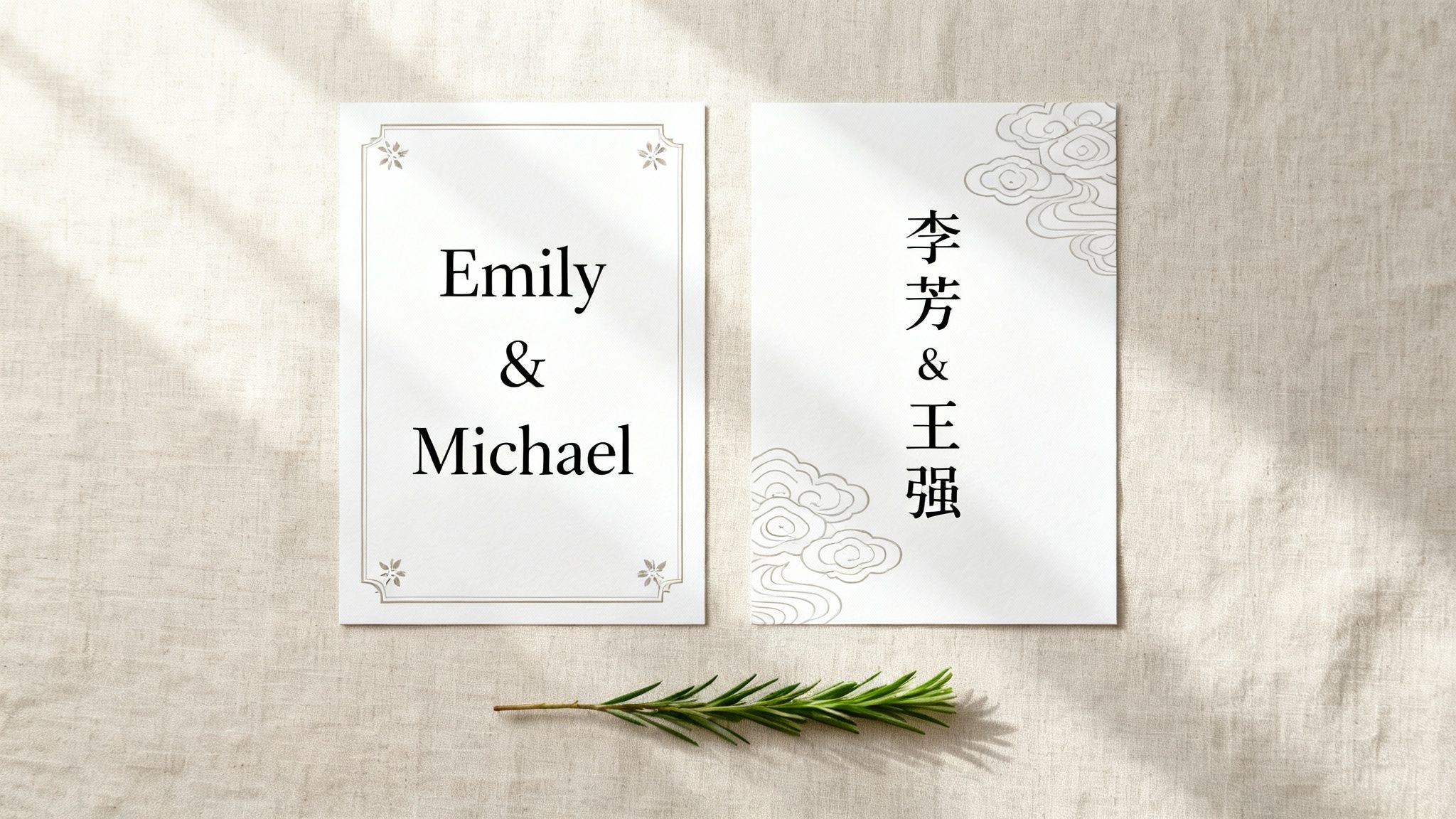
4. Multicultural/Bilingual Wording
Multicultural or bilingual wording for wedding invitations is a thoughtful approach that honours the diverse heritage of the couple and their families. This style is essential for international couples or those with families who speak different languages, ensuring all guests feel included, respected, and well-informed. It beautifully symbolises the union of two backgrounds, setting a tone of unity and celebration of cultural diversity from the very first point of contact.
This approach involves presenting the invitation text in two or more languages, often side-by-side or on opposite sides of the card. It requires careful planning to ensure both cultural etiquette and linguistic accuracy are respected, creating an invitation that is both functional and deeply meaningful.
Example Breakdown
Here is a side-by-side example of a bilingual invitation in English and Spanish, hosted by both sets of parents:
English Version
Spanish Version
Together with their parents
Junto con sus padres
Mr. and Mrs. Michael Jones
Sr. y Sra. Michael Jones
and
y
Mr. and Mrs. Carlos Garcia
Sr. y Sra. Carlos Garcia
invite you to celebrate the marriage of
le invitan a celebrar el matrimonio de
Isabella Marie Garcia
Isabella Marie Garcia
and
y
Liam James Jones
Liam James Jones
Saturday, the twenty-first of June
Sábado, veintiuno de junio
Two thousand and twenty-six
Dos mil veintiséis
at four o'clock in the afternoon
a las cuatro de la tarde
The Botanical Gardens, Melbourne
The Botanical Gardens, Melbourne
Dinner and dancing to follow
Recepción a continuación
Strategic Analysis
Equal Representation: The side-by-side layout gives equal visual importance to both languages, showing respect for both families and cultures.
Unified Hosting: By stating "Together with their parents," the invitation immediately establishes a sense of unity and shared celebration between the two families.
Clear and Direct Translation: The translation is direct and maintains the formal tone across both languages. Key details like names, dates, and locations are consistent and easy for all guests to understand.
Cultural Nuances: The wording in Spanish ("le invitan") uses the formal "usted" form, which is appropriate for a wedding invitation, demonstrating an understanding of cultural etiquette.
Actionable Takeaways
To create a beautiful and respectful multicultural invitation, focus on these details:
Prioritise Professional Translation: Avoid automated online translators. Hire a professional translator, preferably one familiar with formal event language, to ensure accuracy and cultural appropriateness.
Consult with Family: Involve family members from both sides to review the wording. They can offer invaluable insights into cultural norms, proper honorifics, and traditional phrasing.
Design for Clarity: Choose a layout that presents the information clearly. Side-by-side columns, front-and-back printing, or a dual-language fold-out design are all effective options.
Ensure Accuracy in Official Documents: For couples navigating international marriages, the importance of accurate language extends to all wedding-related paperwork. You might find services for things like seamless marriage certificate translation services useful.
5. Humorous/Witty Wording
Humorous wording for wedding invitations injects personality and fun into your first official communication with guests. This style is perfect for laid-back, unconventional couples who don't take themselves too seriously and want to set a relaxed, celebratory tone from the very beginning. It signals that the wedding will be less about formal tradition and more about a joyful, lighthearted party.
This approach swaps formal phrasing for clever jokes, playful anecdotes, or witty one-liners. It’s a chance to showcase your unique relationship dynamic and get your guests excited for a fun-filled event. While it breaks from tradition, it still needs to clearly communicate all the essential information.
Example Breakdown
Here is an example of humorous wording for a wedding invitation that balances comedy with clarity:
After swiping right, many arguments over the remote, and one very elaborate proposal… Casey & Jordan are finally making it official! Come watch us say "I Do" (and for the free booze) Saturday, the fifteenth of February Two thousand and twenty-six at four o'clock in the afternoon The Lakeside Pavilion, Perth Dinner, questionable dance moves, and cake to follow
Strategic Analysis
Narrative Hook: The opening lines ("After swiping right…") tell a brief, modern love story that is relatable and amusing, immediately setting a casual tone.
Balancing Act: The core details of the couple's names and the request to attend are clear and simple. The humour is layered on top without obscuring the essential purpose of the invitation.
Playful Motivation: The line "(and for the free booze)" is a classic, self-aware joke that acknowledges what guests often look forward to at a wedding reception, making the couple seem down-to-earth.
Informal Tone: Phrases like "making it official" and "questionable dance moves" replace formal language, reinforcing the relaxed and fun atmosphere of the planned celebration.
Actionable Takeaways
To successfully implement this style, focus on these key details:
Know Your Audience: Ensure your humour will land well with all guests, including older relatives. Test your jokes on a small, diverse group of friends or family first.
Prioritise Clarity: Humour should be the flavour, not the main course. The who, what, where, and when must be perfectly clear and easy to find.
Keep It Classy: Avoid jokes that are overly personal, inside jokes that most guests won't understand, or any humour related to politics, religion, or past relationships.
Let the Design Help: Pair witty wording with a playful design. Fun fonts, quirky illustrations, or a unique format can enhance the comedic effect and make the invitation feel cohesive.
6. Eco-Friendly/Sustainable Wording
Eco-friendly wedding invitation wording directly communicates a couple's commitment to sustainability, setting a conscious and modern tone for the celebration. This approach is perfect for environmentally-aware couples who want their wedding to reflect their values, from using recycled materials to minimising waste. The wording itself becomes a tool to inform guests about these choices and invite them to participate in a more sustainable celebration.
This style is often paired with digital RSVPs and non-traditional invitation materials, such as plantable seed paper or recycled cardstock. The language is typically warm and sincere, explaining the sustainable choices in a way that feels inspiring rather than preachy.
Example Breakdown
Here is an example of sustainable wording for wedding invitations that highlights eco-conscious choices:
With joy and a deep love for our planet Chloe Nguyen and Liam Smith invite you to celebrate their marriage
Saturday, the twelfth of April Two thousand and twenty-six at four o'clock in the afternoon Earth Sanctuary, Alice Springs
Dinner and dancing to follow
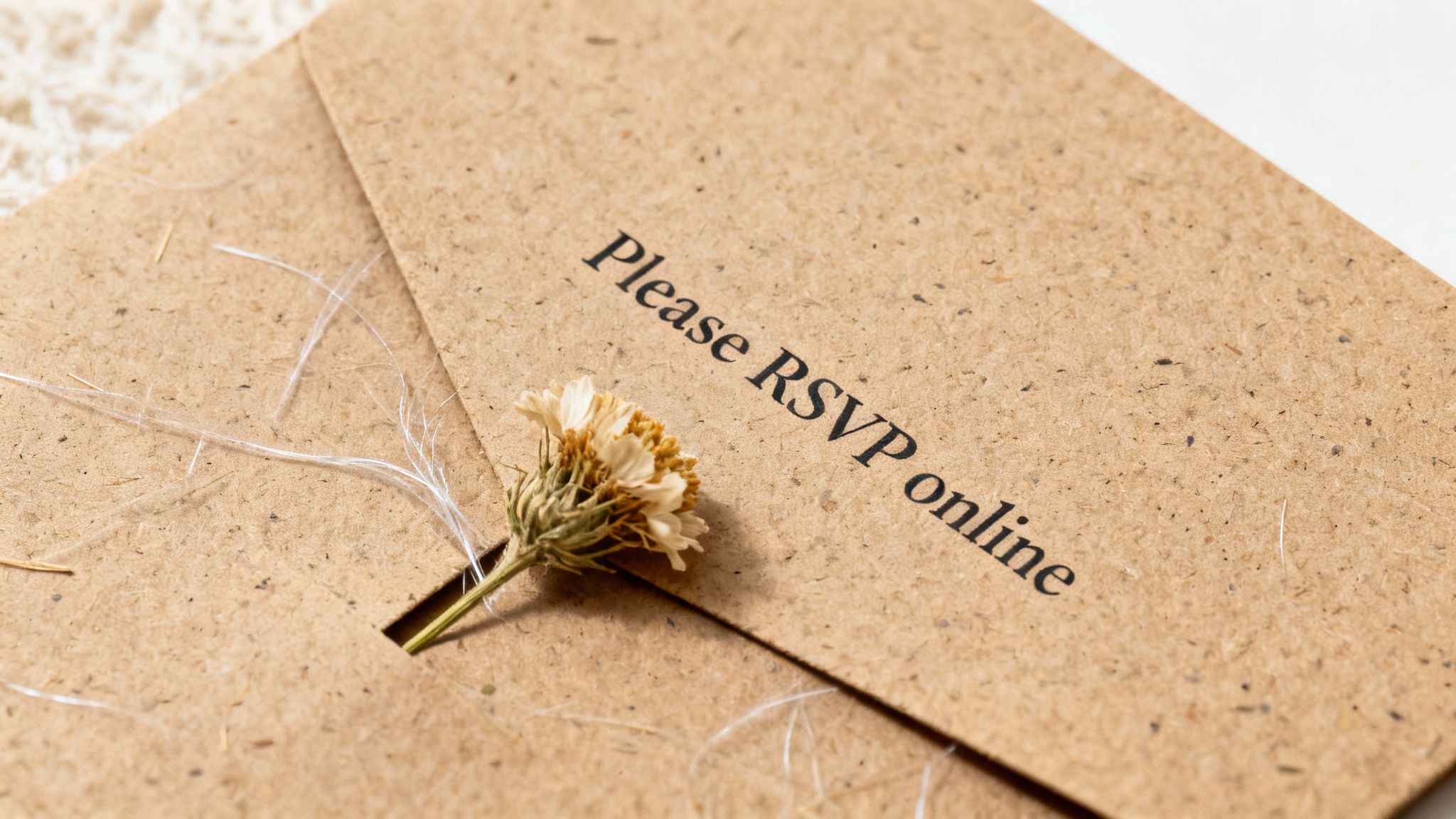
To honour our commitment to the environment, this invitation is printed on recycled paper. Please help us reduce waste by responding via our wedding website: [website address]
Strategic Analysis
Value Statement: The opening line, "With joy and a deep love for our planet," immediately establishes the couple's environmental values as a core theme of their celebration.
Actionable Information: The invitation explicitly states the sustainable choice made ("printed on recycled paper"), educating guests and reinforcing the theme.
Clear Call to Action: It directly asks guests to participate in a sustainable practice ("Please help us reduce waste by responding via our wedding website"), guiding them toward a paperless RSVP.
Integrated Tone: The eco-friendly messaging is woven seamlessly into the invitation's details, feeling like a natural and authentic part of the event rather than an afterthought.
Actionable Takeaways
To effectively use this style in your wording for wedding invitations, consider these tips:
Lead with Your Values: Start with a brief, positive statement about your commitment to sustainability to frame the invitation.
Highlight Your Choices: Mention specific details, such as "printed on plantable seed paper" or "we've opted for digital RSVPs to save trees."
Keep it Positive: Focus on the beauty and intention behind your choices, using inviting language like "join us in celebrating sustainably" instead of making guests feel guilty.
Provide Clear Digital Instructions: If you're directing guests online to RSVP or find more information, ensure the website URL or QR code is prominent and easy to use.
7. Religious/Spiritual Wording
Religious or spiritual wording for wedding invitations infuses the announcement with the couple's deeply held faith and beliefs. This style is ideal for ceremonies held in a place of worship or for couples who wish to honour God, a higher power, or specific spiritual traditions as a central part of their union. It signals to guests that the ceremony will be a sacred and faith-based event, rooted in reverence and spiritual commitment.
This approach often incorporates scriptural verses, blessings, or traditional phrases specific to a particular religion, such as Christianity, Judaism, or Islam. The language is typically formal and respectful, reflecting the sanctity of the occasion while inviting loved ones to bear witness to a covenant made before God.
Example Breakdown
Here is a common example of religious wording for wedding invitations, reflecting a Christian ceremony hosted by the couple:
With joyful hearts and in the presence of God Jessica Louise O’Connell and Michael James Ryan request the honour of your presence as they are united in the Sacrament of Holy Matrimony Saturday, the twelfth of April Two thousand and twenty-six at two o’clock in the afternoon St. Patrick's Cathedral, Melbourne A celebration with dinner and dancing will follow at The Conservatory
Strategic Analysis
Faith-Centric Opening: The invitation opens with "With joyful hearts and in the presence of God," immediately establishing the spiritual context and joyful tone of the ceremony.
Sacramental Language: Using the phrase "Sacrament of Holy Matrimony" is specific to Catholic and some other Christian denominations, clearly defining the religious nature and significance of the rite.
Formal Request Line: The traditional phrase "honour of your presence" is correctly used for a ceremony taking place in a house of worship, maintaining a high level of formality.
Clear Hosting: While spiritual, the wording makes it clear the couple ("Jessica Louise O’Connell and Michael James Ryan") are the hosts, which is a modern yet respectful approach.
Actionable Takeaways
To effectively use religious wording for wedding invitations, consider these essential points:
Consult Your Officiant: Speak with your priest, rabbi, imam, or spiritual leader to ensure the wording is appropriate and respectful of your faith’s traditions and requirements.
Use Specific Terminology: Incorporate terms that are meaningful to your faith. For a Jewish wedding, you might mention being married "under the chuppah." For an Islamic ceremony, you could reference the Nikah.
Be Mindful of Interfaith Guests: If many guests are from different backgrounds, consider adding a small, elegant note on an enclosure card briefly explaining the significance of a particular ritual they will witness.
Maintain Respect and Reverence: The tone should always be reverent. This style prioritises the sacredness of the commitment over casual or trendy phrasing.
8. Destination/Adventure Wedding Wording
Destination or adventure wedding wording is designed to build excitement while providing essential travel information for guests. This style moves beyond a simple invitation, acting as the first step in a travel experience. It's perfect for couples getting married abroad or in a remote, scenic location, as it sets clear expectations and helps guests plan for a multi-day celebration. The tone is often a blend of informative and enthusiastic, aiming to inspire guests to join the journey.
This approach requires more detail than a traditional invitation. It must clearly communicate travel logistics, accommodation suggestions, and the schedule of events, ensuring guests feel supported and informed rather than overwhelmed by the prospect of travel.
Example Breakdown
Here’s an example of wording for a destination wedding that balances excitement with crucial information:
Please join us for a week of sun, sand, and celebration as we, Chloe and Liam tie the knot in paradise! Saturday, the eighteenth of May Two thousand and twenty-six at four o'clock in the afternoon The Cliffside Terrace Santorini, Greece A weekend of festivities will precede the ceremony. For full travel details, accommodation, and our wedding itinerary, please visit our wedding website: chloeandliam.com
Strategic Analysis
Enthusiastic Opening: The invitation starts with an exciting call to action ("join us for a week of sun, sand, and celebration"), immediately setting a vibrant, holiday-like tone.
Centralised Information: Instead of cluttering the main invitation, it directs guests to a wedding website for all logistical details. This keeps the primary card clean while ensuring guests have access to comprehensive information.
Clear Expectations: Mentioning "a week of sun" and "a weekend of festivities" clearly communicates that this is more than a single-day event, allowing guests to plan accordingly.
Couple as Hosts: The wording "we, Chloe and Liam" establishes a personal, modern feel, positioning the couple as the hosts of their destination adventure.
Actionable Takeaways
To create effective wording for wedding invitations to a destination event, follow these guidelines:
Lead with Excitement: Start with a line that captures the spirit of the destination or adventure.
Create a Wedding Website: Use a dedicated website to house all travel details, accommodation blocks, itineraries, and FAQs. It is the single most important tool for a destination wedding.
Include Key Details Only: The physical invitation should contain the who, what, where, and when of the main ceremony. Everything else can live on the website.
Communicate the Timeline: Clearly state the duration of the celebration (e.g., "weekend" or "week-long") so guests understand the time commitment. For those wanting to contribute to the experience, a travel registry can be an excellent option. Find out more about how a travel registry works on EasyRegistry.
Include travel/accommodation details, visas, timelines, budget guidance
Bringing It All Together: Final Touches and Key Takeaways
Navigating the nuances of wording for wedding invitations can feel like a significant undertaking, but it’s ultimately an exercise in storytelling. Throughout this guide, we've explored a vast landscape of options, from the timeless elegance of formal scripts to the playful charm of casual, witty phrasing. Your invitation is the prologue to your wedding day, offering guests their very first glimpse into the celebration you have so carefully planned.
The central theme weaving through every example, whether for a grand traditional ceremony or an intimate destination elopement, is authenticity. The most effective invitation wording is a direct reflection of you as a couple. It captures your shared voice, honours your families and traditions where appropriate, and sets a clear and accurate expectation for the event’s tone and formality.
Recapping the Core Principles
As you finalise your choices, let's distill our extensive exploration into a few core, actionable principles. These are the foundational pillars that ensure your invitation is not just beautiful, but also functional and heartfelt.
Clarity is Paramount: Above all else, your invitation must be clear. Ensure the who, what, when, and where are instantly recognisable. Ambiguity leads to confusion for your guests, so prioritise straightforward communication of the essential details.
Tone Matching is Crucial: The language you choose should align perfectly with the atmosphere of your wedding. A black-tie event calls for formal, third-person phrasing, while a relaxed backyard gathering is wonderfully introduced with warm, first-person language. A mismatch can be jarring for guests.
The Host Dictates the Opening: Remember the golden rule of hosting. The names at the top of the invitation are those of the hosts. Whether it's parents, the couple themselves, or a combination, this structure is a time-honoured tradition that conveys respect and clarity.
Proofread, Then Proofread Again: A simple spelling mistake or incorrect date can cause significant issues. Read your draft aloud, have multiple friends or family members review it, and check every single detail before sending it to the printer. This small step saves major headaches later.
From Invitation to Celebration: The Bigger Picture
Mastering the wording for wedding invitations is a valuable skill that extends beyond just the main card. The care and attention to detail you apply here will inform how you phrase your RSVP details, your wishing well or registry information, and even the content on your wedding website. Each piece of communication works together to create a cohesive and welcoming experience for your guests.
This journey of finding the right words is also excellent practice for other significant moments in your wedding planning. The process of blending your individual voices into a unified message is a skill you’ll use again, particularly when it comes to the deeply personal task of crafting heartfelt wedding vows. Just as your invitation speaks for you as a couple, so too will your vows on the day itself.
Ultimately, your wedding invitation is more than just an administrative tool; it's a keepsake, a formal announcement, and the beginning of a beautiful new chapter. By selecting words that genuinely resonate with your love story, you’re not just inviting people to an event. You are inviting them to bear witness to a pivotal moment in your lives, wrapped in language that is uniquely and beautifully yours.
Ready to simplify your gift registry and wishing well? With EasyRegistry, you can create a single, elegant registry for gifts, cash funds, and honeymoon contributions, making it seamless for guests to contribute. Pair your perfectly worded invitation with a modern, user-friendly registry that truly reflects your needs. Get started with EasyRegistry today
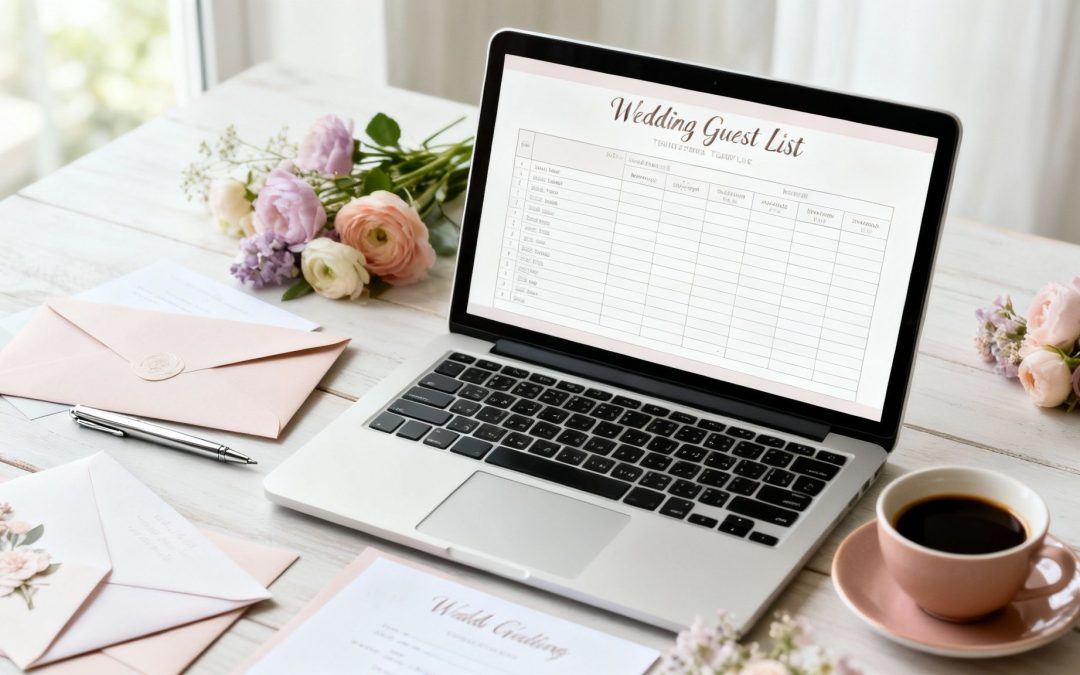
At its heart, a simple wedding guest list template is just a spreadsheet or document that helps you get a handle on everyone you want to invite to your big day. Think of it as your master control centre for names, contact details, RSVPs, and everything in between, turning what can feel like an overwhelming task into something totally manageable.
Building the Foundation of Your Wedding Guest List
Before you even think about opening a spreadsheet, you need a game plan. Your guest list isn't just a list of names; it's the very foundation of your wedding. It has a massive impact on your budget, your choice of venue, and the whole vibe of the day. Honestly, almost every other decision you make will stem from this one.
This is where you and your partner need to sit down and have a really honest chat about what you both actually want. Are you dreaming of a massive party with all your friends and extended family? Or is a smaller, more intimate day with your absolute nearest and dearest more your style?
Key Takeaway: Getting on the same page about the size and feel of your wedding before you start adding names is the single most important step. This shared vision will be your guide and save you from potential disagreements later on.
Navigating Family Expectations
Ah, the family conversation. Talking to your parents about who they think should be invited, especially if they're helping out financially, can feel like walking a tightrope. The key is to set some clear, kind boundaries right from the get-go so you stay in the driver's seat.
Get in early: Bring it up with them before they have a chance to draw up their own dream list. Share your vision and your rough numbers first.
Talk money openly: If your parents are contributing, it's totally fair for them to have some input on the guest list. A popular solution is to give each family a set number of invitations to "spend" as they wish.
Be a team: Make sure you and your partner present a united front. It shows everyone that the final decisions are being made by the two of you, together.
Tackling these conversations early means you can start building your list with confidence. A well-organised guest list also makes other parts of planning so much simpler, like setting up a wedding gift registry for the people you know are definitely coming.
Understanding Modern Wedding Sizes
If it feels like weddings are getting smaller, you're not imagining it. Couples are increasingly prioritising more personal, meaningful experiences, and a smaller guest list is often the best way to achieve that.
In fact, the average Aussie wedding now has around 88 guests. That number has been slowly dropping from 89 in 2024, 92 in 2023, and a pre-COVID high of 98. A big reason for this is the rising cost of living, which is encouraging couples to really think about who they share their day with. It’s always interesting to see how current wedding trends are shaping the way people celebrate.
Creating Your Master Wedding Guest List Template
Alright, you've got a shared vision for your wedding size. Now it's time to turn that vision into a practical, powerful tool. A simple list of names just won’t cut it; the key to staying organised is creating a proper guest list template. Think of this as your wedding command centre—the single source of truth for everything from posting invitations to finalising your seating chart.
Let's build a master spreadsheet that works as hard as you do. This isn't just about who's coming. It’s about creating a system that will save you countless hours and prevent that dreaded last-minute panic.
The Anatomy of a Perfect Guest List
A truly useful guest list goes way beyond just names and addresses. By thinking ahead and adding specific columns from the very beginning, you’ll gather all the crucial information you'll need later on. Trust me, this proactive approach means you won't be scrambling for details in the final, hectic weeks before the wedding.
Imagine this scenario: your caterer needs final numbers, and fast, including a complete list of dietary requirements. If you've been tracking this info in your spreadsheet all along, it's a simple case of filtering a column. If not, you’re suddenly faced with chasing down dozens of guests right when you’re at your busiest.
Here’s a breakdown of the essential columns you should set up in your wedding guest list template. Setting this up properly from the start is a game-changer.
Essential Columns For Your Wedding Guest List Template
This table breaks down the must-have fields for your spreadsheet, explaining why each one is so valuable for streamlined planning.
Column/Field Name
Purpose and Key Benefit
Full Name(s)
Give every single guest their own row, even if they're a couple or family. This makes getting an accurate headcount a breeze later on.
Relationship Tier (A/B/C)
This is your private prioritisation system. A-listers are the non-negotiables, B-listers are invited if space opens up, and C-listers might be for an evening reception or a reserve list.
Plus-One Status
A simple 'Yes/No' or the name of their partner. Decide on your plus-one rule early and stick to it—this column helps you apply it consistently.
Dietary Needs/Allergies
This is an absolute must-have. Capturing this information as RSVPs come in is a massive favour to your future self and your caterer.
Invitation Sent
Use a checkbox or pop in the date to confirm their invitation is in the mail. No more "Did we send that one?" questions.
RSVP Received
Another simple checkbox. It feels so good to tick this one off as the replies roll in!
Attending (Yes/No)
The most important field for locking in your final numbers and costs.
Table Number
This will stay empty for a while, but it's where you'll map out your seating plan. It's incredibly satisfying to fill this in.
Gift Log
A space to jot down a brief description of any gift received. Crucial for thank-yous.
Thank-You Card Sent
The final step! A checkbox to make sure every guest's generosity is properly acknowledged.
By setting these columns up from day one, you’ll find your spreadsheet evolves naturally with your planning journey.
It starts as a brainstorming tool, becomes an RSVP tracker, transforms into a seating chart planner, and finally, serves as your thank-you card checklist. It's a living document that supports you at every stage.
Practical Tips for Managing Your Template
Keeping this master list clean and up-to-date is everything. As you start filling it out, you'll quickly see how all the pieces of information connect. For example, that relationship tier becomes your best friend when an A-lister regretfully declines, helping you decide exactly who to invite from the B-list without any guesswork.
A well-organised gift log is another lifesaver. When you receive a present, immediately note what it is and who sent it. Trying to remember this weeks after the wedding, when you're in a post-celebration haze, is a recipe for stress and potential mix-ups.
This simple habit makes writing thoughtful, personal thank-you notes a genuinely lovely experience, rather than a dreaded chore. It’s what turns your wedding guest list template from just a pre-wedding tool into a genuinely valuable post-wedding asset.
How to Prioritise Guests and Make the Final Cut
Okay, you've emptied your brains and listed everyone from your primary school bestie to your parents' friendly neighbours. Now for the hard part – deciding who actually makes it onto the final invitation list. This is where the practical realities of your budget and venue capacity can feel a bit brutal. It often means making some really tough calls.
The secret is to come at it with a clear head and a solid plan, not just pure emotion. Having a structured approach takes a lot of the personal sting out of it and helps you and your partner work as a team. This way, the final list truly reflects who you both want standing with you on the day.
The A-List and B-List Strategy
Probably the most effective way to wrangle your list is to use a tier system. You can build this right into your guest list spreadsheet by splitting everyone into an A-list and a B-list. It creates a clear, logical path forward and seriously reduces the stress.
The A-List: These are your non-negotiables. We're talking immediate family (parents and siblings), your ride-or-die best friends, and your bridal party. Basically, the people you couldn't imagine getting married without.
The B-List: This is everyone else you’d absolutely love to celebrate with if space and budget weren't an issue. Think cousins, great-aunts, close work friends, or friends you don't get to see as often. They aren't 'second-best' guests; they’re just in the next circle out.
Here’s how it works in practice: send out invitations to everyone on your A-list first. As the RSVPs start to come back and you get a few 'regrets', you can then start sending invites to people on your B-list to fill those spots. This rolling approach lets you fill every seat without accidentally going over your headcount.
Remember, the B-list is a practical tool, not a ranking of how much you value someone. It’s simply a smart way to manage the very real constraints of space and money that almost every couple deals with.
This is more relevant than ever. On average, Australian couples are trimming their dream guest list of 116 down to a more realistic 88. It's a direct result of rising costs, with the average wedding now costing between $35,315 and $36,000. Knowing you're not alone in this can make those tough decisions a little easier. You can also find some amazing tips to save money on your wedding day while still having an incredible celebration.
Handling Tricky Guest List Situations
Even with a perfect A/B system, some tricky scenarios are bound to pop up. Having a few game plans ready will help you navigate these conversations without any awkwardness.
Dealing with Parental Input
Let's be real: your parents might have their own vision for the guest list, especially if they're helping foot the bill. It's only fair to include them in the conversation. A great compromise is to give each set of parents a specific number of invitations they can 'own'. This honours their contribution and makes them feel involved, but it keeps you in control of the overall numbers.
The Plus-One Dilemma
First, know this: you do not have to give every single guest a plus-one. A common, and very fair, rule of thumb is to offer a plus-one to anyone who is married, engaged, or in a serious, long-term relationship.
For your single friends, it’s completely up to you. The most important thing is to decide on your rule and then apply it consistently to everyone. That consistency is key to making sure nobody feels left out or unfairly treated.
RSVPs, Follow-Ups, and Nailing Down Your Final Numbers
This is when it all starts to feel real. Once those invitations are sent, your guest list spreadsheet shifts from a planning tool to your command centre for tracking RSVPs. It's an exciting time as the replies start trickling (or flooding!) in.
Whether you're getting traditional mail-in cards or digital responses through a wedding website, the game plan is the same. Update your spreadsheet the moment you get a reply. Pop a 'Yes' in the 'RSVP Received' column and, most importantly, update their status in the 'Attending' column. Staying on top of this in real-time saves you a massive headache later and gives you a constantly accurate picture of who is coming.
Dealing with the Stragglers
Don't stress – there will always be a handful of people who miss the RSVP deadline. It happens at every single wedding. A polite and gentle nudge is all you need to get an answer. The trick is to be friendly but firm, especially since your caterer and venue will be waiting on your final numbers.
A quick text or email usually does the job perfectly.
Here's a go-to script: "Hi [Guest Name], hope you're well! We're getting so excited for the wedding and are just finalising our numbers for the caterer. Just wanted to check if you think you'll be able to make it? We need to give them the final headcount by [Date], so would be great to know by then. Hope we get to celebrate with you!"
This approach works wonders because it's warm, it explains why you're chasing them (it's for the caterer, not because you're nagging!), and it gives them a new, clear deadline. It takes the pressure off and gets you the answer you need without any awkwardness.
Turning Your Final Count into Action
Once you've collected all your RSVPs, you have the magic number: your final headcount. This one number is the key to unlocking the last major phase of your wedding planning. It's what you’ll hand over to your venue and caterer, which will determine a huge chunk of your final costs.
This is also the perfect time to turn to your B-list. If you had more declines than you expected, you can now send out those invitations. Because you've been so organised, this becomes a smooth and simple process, not a last-minute scramble.
And with that confirmed list, you're ready to tackle the next big puzzle: the seating chart. Knowing exactly who will be in the room lets you start thoughtfully planning tables and making sure everyone has a great time. As you dive into these details, you can also explore the helpful EasyRegistry sharing and tracking features to make managing everything from gifts to guest communication even simpler.
Turning Your Guest List into a Seating Chart
Your guest list has been your planning bible up to this point, but it has one final, crucial job: helping you create the seating chart. This isn't just about assigning seats; it's about engineering the perfect vibe for your reception.
All that information you carefully gathered is about to pay off big time. The columns noting how you know someone, their age group, or even little personal details are your secret weapon for creating tables where conversations spark and guests feel at ease. Once you have your final numbers, tackling the seating plan is the next big puzzle. If you need some extra guidance, there are some great strategies for seating your wedding guests that can make this process a whole lot easier.
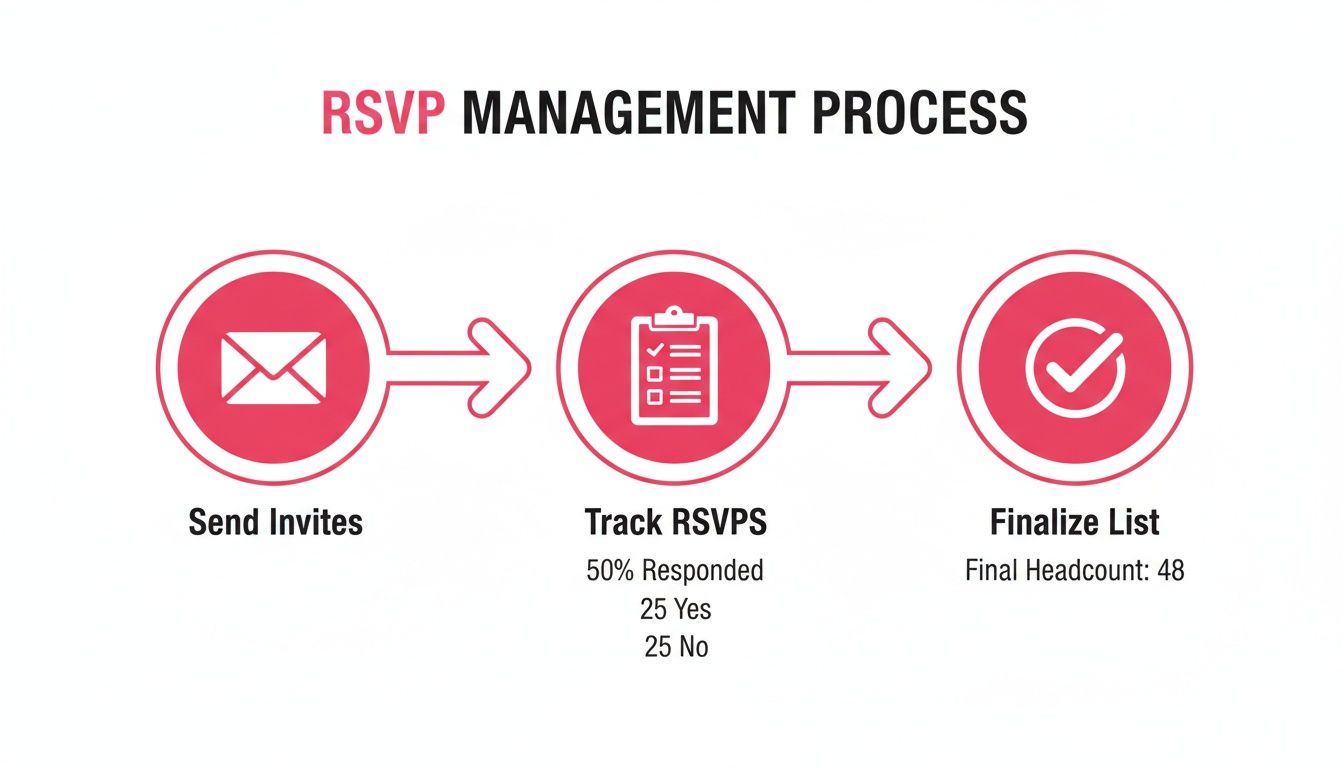
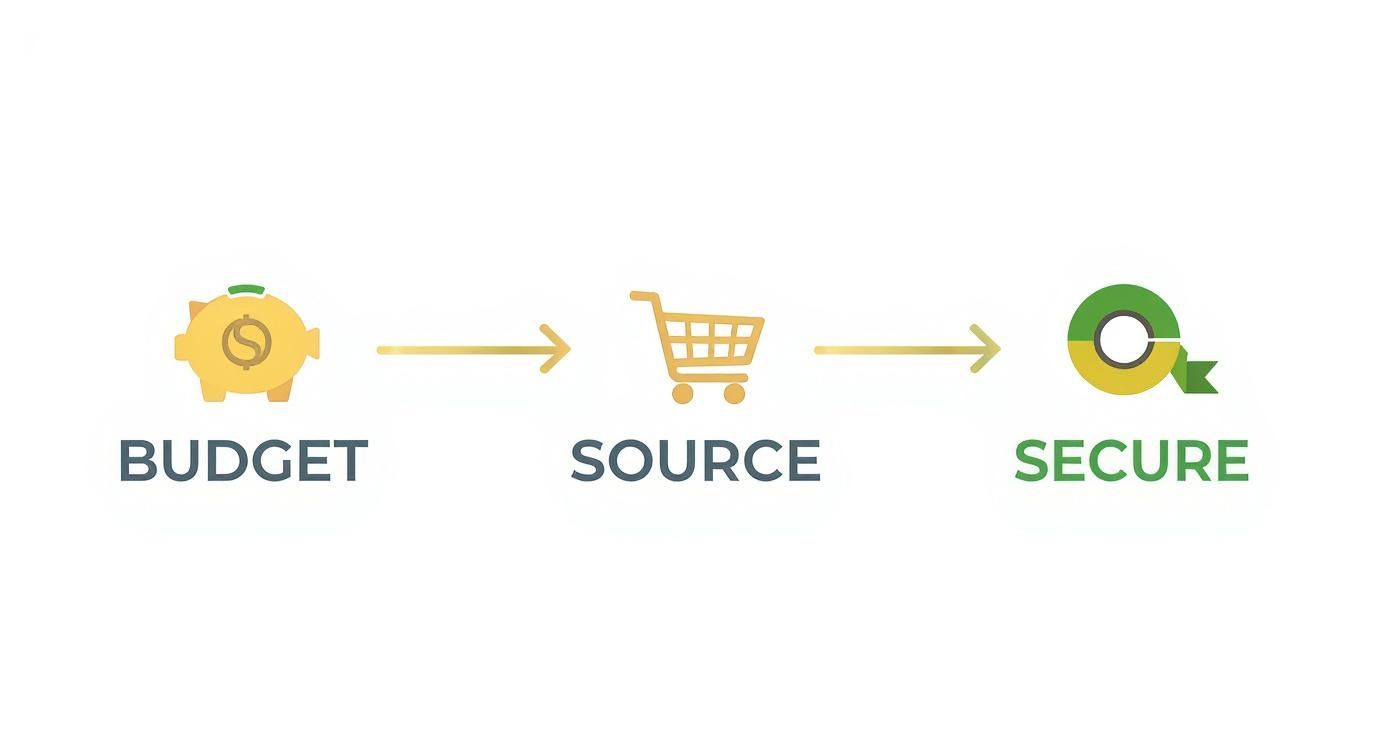
The RSVP management workflow is what gets you to this final, exciting stage.
As you can see, a clear process makes it simple to get from sending invites to having that finalised list, ready for you to work your magic on the seating plan.
Crafting a Thoughtful Seating Arrangement
The ultimate goal here is to make every single guest feel welcome and comfortable. A good place to start is with your 'anchor' tables—think immediate family and the bridal party—placing them in the best spots in the room. From there, it's all about creating mini-communities at each table.
Group by connection: The easiest win is to seat guests with people they already know. It gives them a familiar and comfortable home base for the night.
Mix in some shared interests: Think of yourself as a friendship matchmaker! Mix friends from different parts of your life who you know share similar jobs, hobbies, or are at a similar life stage.
Consider the vibe: Got some super social, outgoing friends? Put them at a table in the middle of the action to help get the party started. Your quieter guests might appreciate a table that’s a bit further from the dance floor and speakers.
A brilliant seating chart doesn't just organise people; it engineers a fantastic party. A little bit of thought here goes a long way and has a huge impact on how much your guests enjoy the celebration.
Your Template's Post-Wedding Life
Don't be so quick to delete that spreadsheet after the last dance! It has one last, very important role to play in your post-wedding to-do list: thank-you cards.
Remember those 'Gift Log' and 'Address' columns? They're now your best friends. With all the details in one place, you can breeze through your list, making sure every thoughtful gift is acknowledged with a personal note sent to the right address. This turns your wedding guest list template from a planning workhorse into a post-wedding lifesaver, making the final task of your wedding journey organised and genuinely enjoyable.
Answering Those Tricky Guest List Questions
Even the most organised spreadsheet can't answer every question that pops up when you're building your guest list. Navigating the etiquette side of things can feel like a minefield, but don't worry—we've got the answers to the most common queries couples have.
How Far Out Should We Finalise Our Guest List?
Getting your timing right is a game-changer. You'll want to have a solid draft of your guest list sorted about 9-12 months before your wedding. This isn't just a rough number; it's the key piece of information you need to choose and book a venue that can actually fit everyone you want to celebrate with.
The list you'll use for sending out invitations needs to be locked in 3-4 months before the big day. As for that final, final headcount for your caterer? They'll usually need it 1-2 weeks before the wedding, once all your RSVPs are in.
Do We Really Have to Give Everyone a Plus-One?
Honestly? No, you don't. Modern wedding etiquette has become much more flexible, which is a huge relief for most couples. A good, practical rule of thumb is to automatically offer a plus-one to any guest who is married, engaged, or in a serious, long-term relationship. It's a simple way to acknowledge and respect their partnership.
When it comes to your single friends, the decision is completely up to you. Often, it just comes down to your budget and how much space you have at the venue. The most important thing here is to be consistent. Decide on a rule for plus-ones and stick to it for everyone to avoid any awkwardness or hurt feelings.
What’s the Best Way to Manage a B-List?
Handling a "B-list" is all about being tactful and timely. As soon as you start getting RSVPs back from your initial "A-list" with a 'no', you can begin sending invitations to guests on your secondary list.
Pro Tip: You don't want anyone to feel like they were a backup choice. To avoid this, make sure their invitation is sent at least 6-8 weeks before the wedding. A good strategy is to send them out in small batches as you get declines, rather than waiting to send them all at once.
How Do We Politely Tell Someone They Aren’t Invited?
First things first: you are under no obligation to announce who isn't invited. If someone puts you on the spot and asks directly, the best strategy is to be kind, but also honest and firm.
A simple, straightforward response works best. You could say something like, "We've had to make some really tough choices to keep our wedding small and stick to our budget." Resist the urge to over-explain or make up excuses. A short, polite answer is all that's needed.
As you navigate these details, remember every decision helps shape the day you're dreaming of. For more creative ideas on planning your celebration, you can find some beautiful wedding photo shoot inspiration.
Once you've nailed down your guest list, let EasyRegistry make the next part of your wedding planning a breeze. We help you create a simple, stylish gift registry your guests will find a joy to use.
So, you're getting married! Amidst the whirlwind of venue scouting and cake tasting, one of the very first things to land on your to-do list should be your save the date cards. Far from being just another piece of wedding stationery, they're your official opening act.
Think of them as the trailer for your wedding movie. They don't give away the whole plot, but they set the scene and get everyone excited for the main event.
Giving Your Guests a Much-Needed Heads-Up
Let's be practical. The main job of a save the date is to give your favourite people enough time to actually plan to be there. This is a game-changer, especially for anyone who needs to travel.
Whether you've got friends flying in from interstate or family making a long drive, that early notice is what allows them to:
Snag cheaper travel and accommodation: We all know booking flights and hotels last minute is a recipe for a budget blowout.
Book time off work: Getting annual leave approved often takes time, so the more notice, the better.
Line up childcare: For parents, organising a babysitter for a whole weekend isn't always a simple task.
Sort out their finances: Being a wedding guest is an honour, but it can be costly. A heads-up helps everyone budget properly.
Here in Australia, with longer engagements becoming more common, locking in your date with guests early is more critical than ever. We're seeing more couples push their weddings out to save up, with recent research showing 40% of couples are extending their engagements by a full year. This makes a save the date essential for making sure your VIPs are available. You can read more about what's happening in the local wedding scene in the 2024 Australian Wedding Industry Report.
Setting the Scene for Your Big Day
Beyond the pure logistics, your save the date is the very first taste your guests get of your wedding's vibe. It’s your chance to make a brilliant first impression and start building that buzz.
Your save the date isn't just an announcement; it's the prologue to your wedding story. It sets the scene, introduces the main characters (that’s you!), and gives everyone a reason to be excited for the main event.
This is where you start to tell your story. A sleek, minimalist card hints at a modern city wedding, while something with a floral, rustic feel might suggest a relaxed celebration in the countryside. It’s your first real opportunity to show off your personality as a couple. You’re not just asking them to circle a date on the calendar; you're officially inviting them to be part of your journey from the get-go.
Nailing the Timing and Guest List Etiquette
Figuring out when to send your save the dates is one of the first big decisions you'll make, and it really comes down to two things: where you're getting married and who's coming. The whole point is to give your favourite people a heads-up, so the more notice they need, the earlier you should get them in the mail.
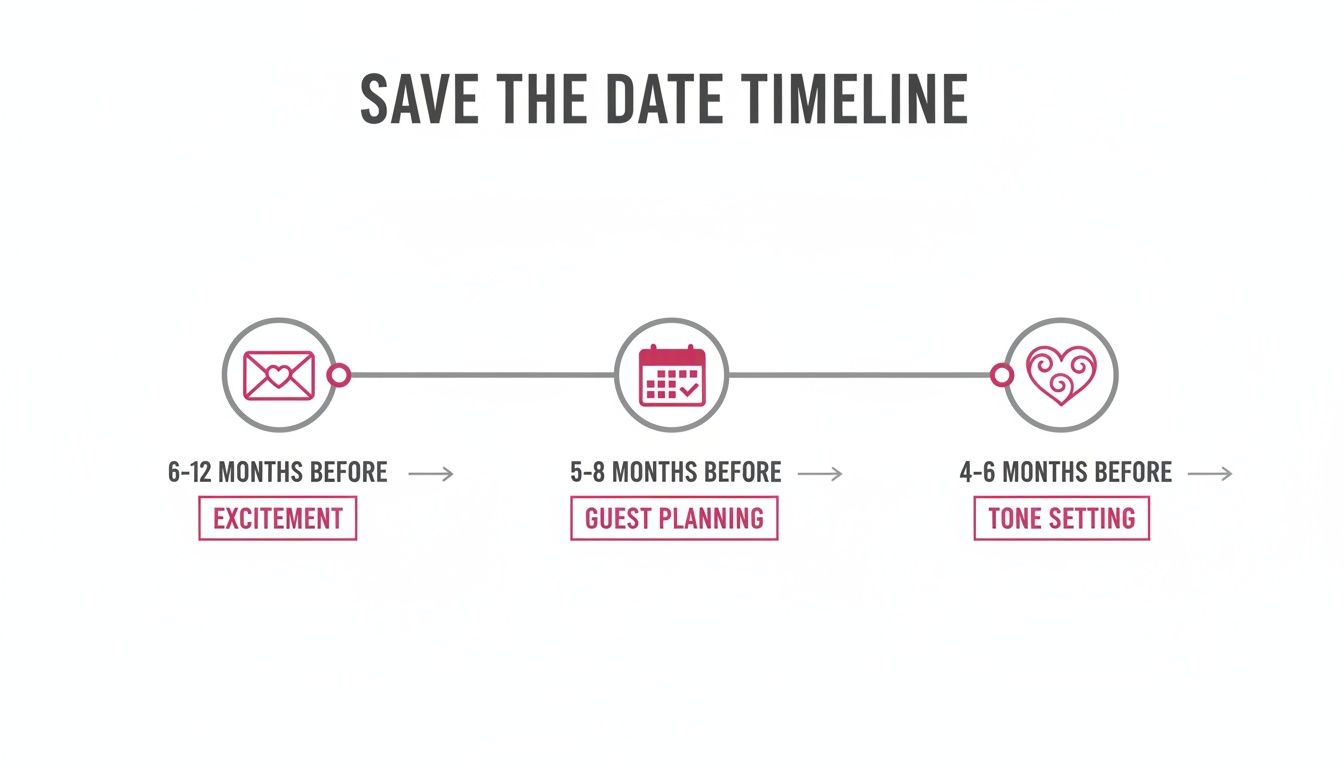
For a local wedding where most of your guests live nearby, the sweet spot is around six to eight months before the big day. This gives everyone plenty of time to pop it on their calendar and book a day or two off work, but it’s not so far in advance that they forget about it entirely.
What About Destination Weddings?
That standard timeline goes right out the window if you’re planning a destination wedding or have lots of guests flying in from interstate or overseas. For these situations, you need to be way more generous with your timing.
If your wedding involves passports and serious travel plans, you’ll want to send your save the dates nine to twelve months in advance. Honestly, you can’t give too much notice here. This gives your guests the best possible chance to scout out affordable flights, book good accommodation, and sort out their annual leave. The earlier they know, the more likely they can make it.
It all starts with that initial excitement, moves into the nitty-gritty of guest planning, and then you set the whole vibe for your event.
This journey from a happy announcement to practical planning is why a solid timeline is so crucial. Following a comprehensive ultimate wedding planning timeline can be a real lifesaver.
The Unbreakable Rule of the Guest List
Okay, let's get serious for a moment about the single most important rule of wedding etiquette: if you send someone a save the date, you must send them a wedding invitation. No ifs, ands, or buts.
A save the date isn't a "maybe" or a way to test the waters. It's a promise that a formal invitation is coming their way. Sending one and then pulling the invitation is a major faux pas that will definitely cause hurt and confusion. Before you order a single card or click 'send' on an e-vite, your guest list needs to be locked in.
Think of your save the date list as your final "A-list." You can always add more people later by just sending them an invitation, but you can never, ever subtract someone once they've received a save the date.
This is why it's so important to have your venue's capacity confirmed. Before you tell anyone to mark their calendar, be absolutely sure you and your budget can accommodate every single person on that list. If you're still deciding on a spot, check out our guide on the crucial https://blog.easyregistry.com.au/wedding-venue-questions/ to help you finalise those details.
How to Handle Plus-Ones (and Avoid Awkwardness)
Clarity is everything when it comes to your guest list. Your save the date should make it crystal clear exactly who is invited, which saves you from so many headaches later on.
Couples: Address the card to both people by name (e.g., "Sarah Chen & David Miller").
Single guests with a plus-one: If you’re happy for them to bring someone, write "James Smith & Guest." This explicitly gives them the option.
Families: If you’re inviting kids, address it to "The Thompson Family." If it’s an adults-only affair, address it just to the parents ("Mr & Mrs Thompson").
Being specific right from the start manages everyone's expectations and helps you dodge those tricky "So, can I bring my cousin?" conversations. Your save the dates are the first impression of your wedding—make it a clear and thoughtful one.
Crafting Wording That Is Clear And Captivating
The words on your save the date are more than just an announcement; they’re the very first glimpse your guests get into your wedding story. It’s their first impression, setting the tone and delivering the need-to-know info, all while showing off your unique personality as a couple. The trick is to find that sweet spot between crystal-clear information and your own personal flair.
At the end of the day, the message needs to be simple and straight to the point. Drowning your guests in details will only cause confusion and take away from the card’s main job: getting them to circle the date on their calendar. Think of it as the headline, not the full story—that can come later on your wedding website and the formal invitation.
The Absolute Must-Haves
Before you start getting creative, there are a few non-negotiable details every save the date needs. Skip any of these, and you can expect a flood of texts and calls from confused friends and family.
Make sure your card clearly states:
Your Names: Seems obvious, but you need to be clear about who’s getting married! Whether you use first names or full names really depends on how formal your wedding will be.
The Wedding Date: This is the hero of the card. Always include the full date—day of the week, date, month, and year—to avoid any mix-ups. For example, "Saturday, 25 October 2025".
The Location (City and State/Country): Your guests don't need the exact venue address just yet. What they do need is the city and state (or country, if it's a destination wedding). This is the crucial bit of info they'll use to book flights and accommodation.
A Note About the Formal Invitation: A simple line like "Formal invitation to follow" is a must. It lets everyone know this isn't the final invitation, so they shouldn't be hunting for an RSVP card.
Think of your save the date as a friendly heads-up, not a formal summons. The language should feel personal and exciting, giving guests just enough information to get them planning without overwhelming them with details that might still change.
What To Leave Out For Now
Just as important as what you put on the card is what you leave off. A common mistake is cluttering the save the date with too much information, which can create confusion. Save the finer points for the formal invitation and your wedding website.
For now, be sure to skip:
Specific Venue Details: The city is enough for now. You can share the ceremony and reception locations later on.
Registry Information: It’s considered poor etiquette to put gift registry details on a save the date. This is best placed on your wedding website or shared by close family if guests ask.
RSVP Requests: It’s way too early to ask for a firm headcount. The official RSVPs will be collected with the formal invitations, which are typically sent 6-8 weeks before the wedding.
A Detailed Schedule: Times for the ceremony, cocktail hour, and reception are not necessary at this stage. Plus, these details are often finalised much closer to the date.
Finding Your Voice: Wording Examples For Every Style
Now for the fun part—letting your personality shine through. The tone you choose should be a true reflection of you as a couple and the vibe you want for your wedding day. Are you planning an elegant, black-tie affair or a chilled-out, barefoot-on-the-beach kind of day?
Finding the right words can be tough, so here are a few examples to get you started, sorted by the kind of wedding you're planning.
Save The Date Wording Examples for Every Style
Wedding Style
Wording Example
Traditional & Formal
"Please save the date for the wedding of Amelia Grace Thompson and Liam James Carter"
Modern & Casual
"Save our date! Chloe & Ben are getting married!"
Minimalist & Chic
"Save the Date. Olivia and Jack. 25.10.25. Melbourne, VIC."
Playful & Humorous
"It’s about time! Save the date for Zoe & Leo's wedding."
Destination Wedding
"Pack your bags! We’re getting married in Bali! Save the date for Mia and Noah."
Ultimately, the best wording for your save the date is whatever feels most authentic to you. It’s the first chapter of your wedding story, so have fun with it and make it a great one.
Choosing Between Paper and Digital Designs
Alright, you’ve sorted out your guest list and locked in a timeline. Now for the fun part: deciding what your save the dates will actually look and feel like. This is where your wedding's visual story really begins, and the choice between traditional paper and sleek digital designs says a lot about your style, budget, and the vibe you want to create.
Honestly, there’s no right or wrong answer here. The best choice is the one that feels most like you as a couple. Let's break down the pros and cons of each to help you land on the perfect fit for your big day.
The Timeless Charm of Tangible Cards
There's just something special about receiving a beautiful piece of mail, isn't there? A physical save the date is a tangible keepsake your guests can stick on the fridge—a happy, constant reminder of the celebration to come. This traditional route immediately sets a certain tone, often hinting at a more formal or classic wedding style.
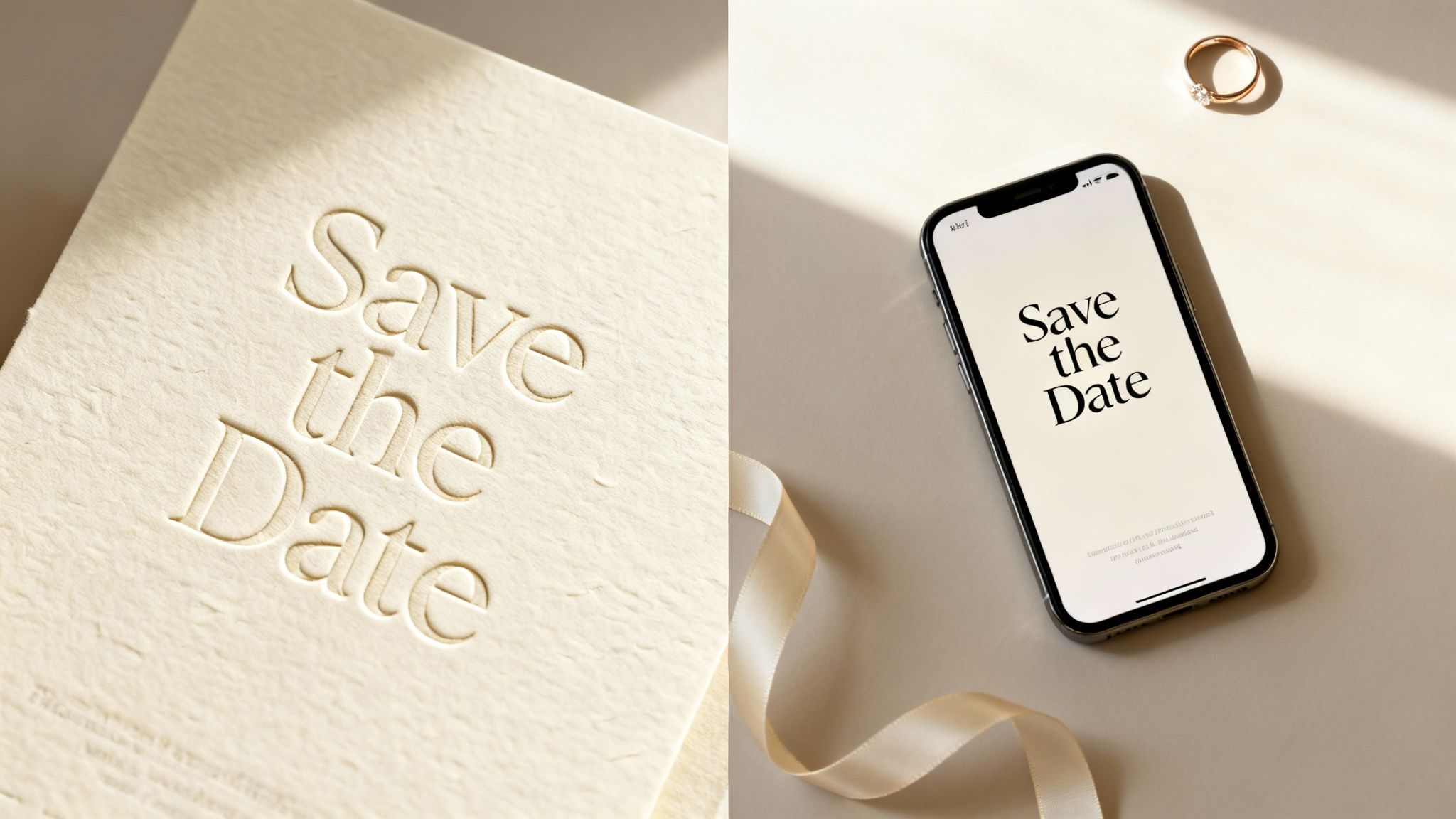
You simply can't replicate the tactile experience of paper. The weight of the cardstock, the texture of a letterpress design, or the shimmer of gold foil all combine to make a powerful first impression. These little details make your announcement feel significant and thoughtfully planned.
It's this sentiment that keeps physical cards so popular. Even with all the digital options out there, traditional stationery still dominates for milestone events like weddings because it just feels more special.
Exploring Your Paper and Print Options
If you're leaning towards paper, you’ve got a whole world of creative possibilities to explore. The materials you choose will have a huge impact on the final look and feel of your announcement.
Paper Stock: This is all about the thickness and texture of your card. A heavier stock (measured in GSM, or grams per square metre) feels more luxurious and substantial. You can choose from smooth matte and glossy finishes to more textured linen or even eco-friendly recycled paper. For a deep dive, check out a comprehensive guide to paper weights—it's surprisingly helpful.
Printing Techniques: Different methods create completely different effects. Digital printing is the most common and budget-friendly option. For a more high-end, tactile finish, look into techniques like letterpress (where the design is pressed into the paper) or foil stamping.
Key Takeaway: A physical save the date is more than just information; it’s a sensory experience. The weight, texture, and visual details create a lasting impression and give your guests a tangible piece of your wedding story to hold onto.
The Efficiency and Ease of Digital Designs
For modern, eco-conscious, or budget-savvy couples, digital save the dates are a brilliant alternative. They offer unmatched convenience and speed. With just a few clicks, your announcement can land directly in your guests' inboxes, saving you a small fortune on postage and reducing your wedding's carbon footprint.
Digital platforms also make managing your guest list a breeze. You can track who has opened the email, send out gentle reminders, and link everyone directly to your wedding website. This immediate connection is a massive plus, as it encourages guests to check out travel details or accommodation options straight away.
This approach works especially well for more casual weddings or for couples who are used to managing their lives online. It reflects a modern, streamlined style of planning.
Considering a Hybrid Approach?
You don't have to be all-or-nothing. A hybrid model can genuinely offer the best of both worlds.
Many couples send beautiful paper save the dates to close family and older guests who they know will appreciate a traditional announcement. Then, they’ll send a stylish e-card to friends and younger relatives who are perfectly happy with digital comms. This method is thoughtful and efficient, ensuring everyone feels included while you still get to take advantage of digital convenience.
Using Wedding Websites and QR Codes Effectively
Think of your save-the-date card as more than just a heads-up. It's really the first official touchpoint of your wedding experience, and by pairing it with a wedding website and a QR code, you can turn that small piece of paper into a super-helpful info hub for your guests. It’s a bit of a game-changer for modern wedding planning.
A wedding website becomes the single source of truth for your guests. It answers all their questions before they even have a chance to ask them, which drastically cuts down on those repetitive texts and phone calls about logistics. This frees you up to focus on the bigger picture and lets you share more of your story to get everyone excited.
What to Include on Your Website at This Stage
Don't feel pressured to have your entire wedding website perfectly polished when the save-the-dates go out. The real goal right now is to give your guests the essential details they need to start planning, especially if they’re travelling.
Here’s what you should aim to have live:
A Warm Welcome & Your Story: A short welcome message and a little background on you as a couple really helps guests feel connected to the celebration.
The Key Event Details: Just reiterate your names, the date, and the city or town. You don't need to have the specific venue locked in and announced, but confirming the general location is crucial.
Travel and Accommodation Advice: This is probably the most important part for out-of-towners. Suggest a few hotels (and mention any room blocks you've arranged), list the closest airports, and offer some tips for getting around.
A Simple FAQ Section: Start with the big questions you anticipate, like "Is there a dress code?" or "Can we bring our kids?". You can always add to this later as more queries come in.
The finer points—like the detailed schedule for the day, menu choices, and specific transport plans—can absolutely wait until you send the formal invitations. For now, it's all about providing just enough information to make things easy.
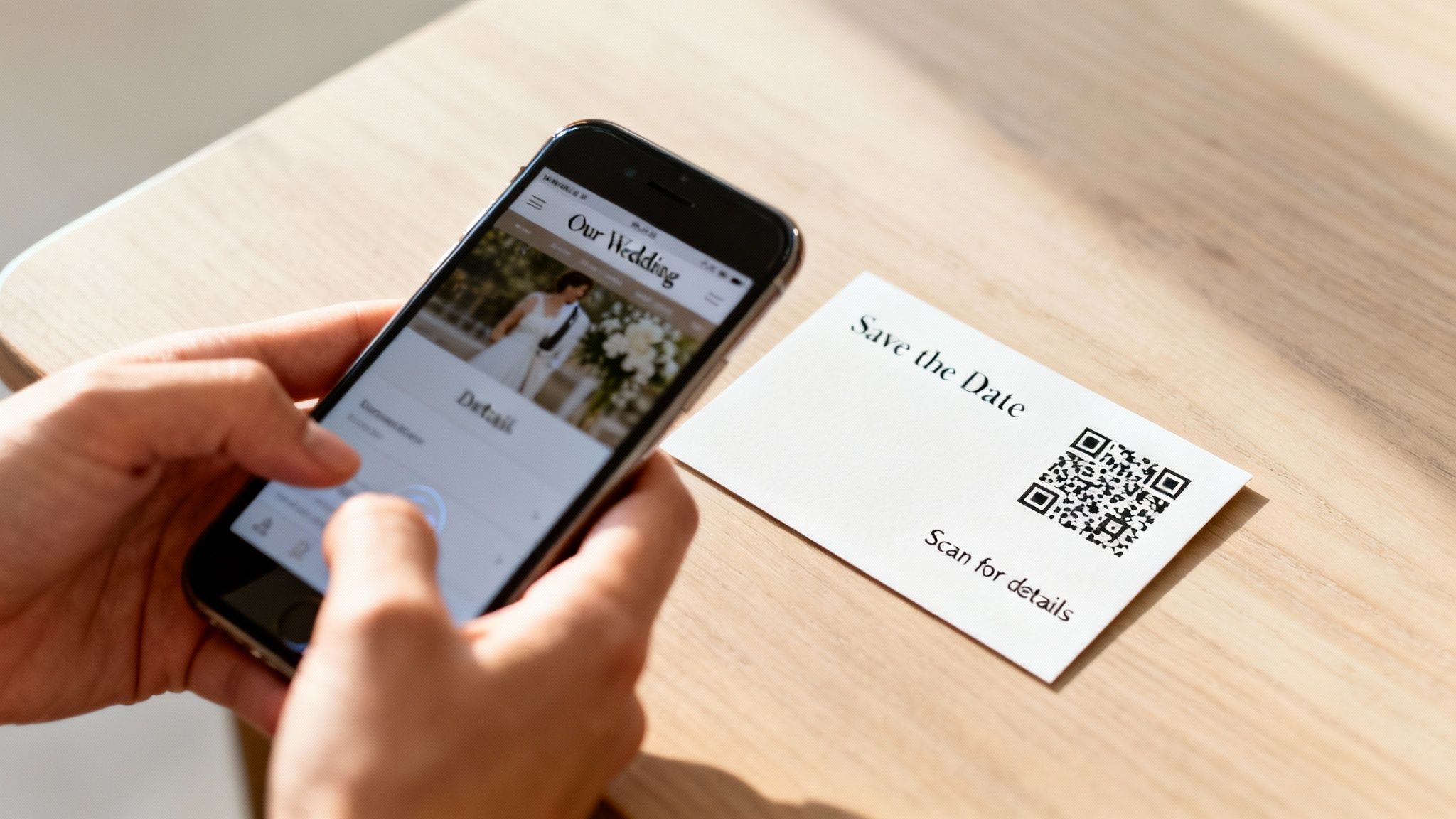
By directing guests to a central online hub, you streamline communication from day one. A wedding website paired with a QR code on your save the date cards empowers guests to find information independently, making their experience smoother and your planning process far more organised.
The Power of a Simple QR Code
QR codes have become the seamless bridge between your physical save-the-date and your digital wedding website. In fact, recent data shows that 38% of couples now include QR codes on their wedding stationery. It's a simple, effective tool that virtually everyone with a smartphone knows how to use.
With a quick scan, your guests get instant access to all the helpful information you've put together on your website. No more squinting to type out a long, complicated URL. They just point their camera, and they’re there.
It's all about making things easy for your guests, and a clean, user-friendly interface makes all the difference. When the time comes for your gift registry, you’ll see how a simple design can make the process smooth for everyone. You can learn more about how an online registry works to see just how seamless it can be.
Getting the Call-to-Action Right
Don't just slap a QR code on your card and call it a day! You need to give your guests a little nudge in the right direction. A clear, friendly call-to-action is key to getting them to actually scan it.
Keep the wording simple and direct. Something like:
"Scan for our wedding website and travel details!"
"For more info and to read our story, pop over to our website."
"Visit our wedding website for accommodation tips and more."
This tiny bit of text removes any confusion and encourages people to engage with your website straight away. It’s a small detail that makes a huge difference in keeping everyone in the loop and excited for your big day.
Your Save The Date Questions, Answered
Even with a perfect plan, you’re bound to have questions crop up when you get to the wedding stationery stage. We get it. Let’s walk through some of the most common queries we see, with clear answers to help you tick this off your list with confidence.
Do We Really Need to Send Save The Dates to Everyone?
Not necessarily, but it’s a very smart move for your most important people. Think of them as non-negotiable for anyone travelling from interstate or overseas, your immediate family, and your wedding party. These are the people who need a serious heads-up to book flights, sort out accommodation, and take time off work.
What about local guests? It’s a lovely gesture but less critical, especially if you have a shorter engagement.
Just remember the golden rule: anyone who gets a save the date must get a formal invitation later. This is a promise, so only send them to people you are 100% sure will be on your final guest list. There’s no taking it back.
What’s the Biggest Mistake Couples Make?
Hands down, the single biggest mistake is sending save the dates before the guest list is set in stone. It’s so tempting to get excited and send them out, but a save the date is a commitment to send an invitation. If you have to cut people later due to budget or venue limits, it creates hurt feelings and incredibly awkward conversations.
Another classic slip-up is putting way too much information on the card. Details about your gift registry, the exact ceremony time, or the dress code can all wait. Keep it clean and simple—save the nitty-gritty for the wedding website and the formal invitation.
The point of a save the date is to inform, not overwhelm. Keeping it simple and sending it only to a confirmed guest list sets a clear, considerate tone for your whole wedding experience.
Should We Ask for RSVPs on the Save The Date?
Definitely not. The whole point is just to give your guests a heads-up so they can block out the date. You're not asking for a firm commitment this far out. People’s plans change, and any RSVPs you collect now will be unreliable.
However, you can use it to get a soft headcount. A great way to do this is by adding a friendly note next to your wedding website details. Something like, "Head to our website for travel info and to let us know if you think you can make it!" This gives you a rough idea of numbers without pressuring anyone for a final answer. Save the formal RSVPs for the official invitations.
Is It Okay to Send Save The Dates by Email?
Absolutely! Digital save the dates are a fantastic, modern option. They’re eco-friendly, budget-conscious, and incredibly efficient—you save a bundle on printing and postage, and they’re delivered instantly. Plus, guests can click straight through to your wedding website.
The key is to know your audience. Older relatives, like grandparents, might not be as comfortable with digital invites and would probably cherish getting a physical card in the mail.
A hybrid approach is often the perfect solution. Many couples now:
Send beautiful paper cards to close family and older guests.
Email a stylish e-card to friends and younger relatives.
This way, everyone gets the news in a format that works for them. If you have more specific questions about how online wedding tools work, our team has put together a detailed list of answers to help with your planning. You can explore our own frequently asked questions for extra guidance.
Ready to streamline your gift-giving experience? With EasyRegistry, you can create a beautiful, user-friendly registry for your wedding, baby shower, or any special occasion. Give your guests the gift of choice and make your planning process simpler. Create your free registry today at https://www.easyregistry.com.au.
Writing your own wedding vows is all about bottling up your unique love story into a few heartfelt promises. It's a process of sifting through your favourite memories, weaving them into a short, personal narrative, and making real commitments to your partner for the life you're about to build together.
Why Your Personal Vows Are So Important
Let's be real—the idea of writing your own vows can feel like one of the most nerve-wracking parts of wedding planning. But it's also, without a doubt, the most powerful. When you step away from the traditional scripts, you give yourselves the chance to create promises that actually sound and feel like you.
This is so much more than just saying "I do." You're setting the emotional tone for your entire marriage, in your own words. These vows become the heart and soul of your ceremony, creating a moment that you, your partner, and your guests will never forget. Just the act of putting these deep feelings onto paper can bring you closer before you even walk down the aisle.
A Modern Take on Tradition
These days, more and more couples are personalising their ceremonies to make them a true reflection of their partnership. The trend is huge in Australia, where a staggering 78% of couples now include personal vows in their wedding. This shift really shows how much we value a more intimate and genuine way to express our commitment.
Adding this personal touch turns the ceremony from a formal procedure into a genuine celebration of your unique love story. It’s your chance to tell everyone what makes your partner so incredible, in front of all the people who mean the most to you.
Your vows are the one part of the wedding day that is entirely yours. They are the promises that will echo long after the music fades and the flowers have wilted—the true foundation of your marriage.
More Than Just Words
Think of your vows as the script for the most important scene of the day. Just as much thought goes into choosing your wedding bands to symbolise your commitment, the promises you make are the emotional equivalent of those rings. They’re a tangible symbol of your future.
Taking the time to write your own vows allows you to:
Express your love authentically: Ditch the generic phrases. Share what your partner really means to you.
Create a lasting memory: Your guests will remember raw, genuine emotion far longer than they'll remember the table settings. Your sincerity will be the highlight.
Affirm your future together: By speaking your shared vision and promises out loud, you solidify the foundation of the life you're building.
Ultimately, your vows are a gift you give to each other. They become a cherished cornerstone of your wedding day that you’ll both look back on for decades to come.
Gathering Your Thoughts Before You Write
The best wedding vows—the ones that really hit home—come from the heart, not a cookie-cutter template. Before you even think about putting sentences together, the real work starts with a bit of quiet reflection. This is your brainstorming phase, where you’ll gather all the raw materials: the memories, the inside jokes, and the deep feelings that make your relationship what it is.
Think of it as creating a personal ‘story bank’. You’re collecting all the small, specific details that paint a picture of your love. Forget about writing perfect prose right now. Your only job is to get ideas down as they pop into your head, creating a rich well of material to pull from later.
Unlocking Your Memories with Simple Prompts
Staring at a blank page is intimidating for anyone. The hardest part is often just getting started, so a few targeted questions can work wonders to get your thoughts flowing. You don't need to answer every single one; just see which ones spark an idea or a forgotten memory.
Find a quiet moment and mull over these prompts:
What was your very first impression of your partner? How has that changed?
Can you remember the exact moment you realised you were in love with them?
What’s a small, everyday thing they do that always makes you smile?
Think of a time they really had your back. How did that feel?
Describe a challenge you conquered together. What did it teach you about your partnership?
What’s your all-time favourite memory together, and why does it stick with you?
How has your partner helped you become a better version of yourself?
What are you most excited about for your future together?
Don't censor yourself here. Jot down everything that comes to mind, no matter how small or silly it feels. The most powerful vows are often built from these tiny, authentic details.
Practical Ways to Capture Your Ideas
Let’s be honest, inspiration rarely shows up on schedule. A perfect memory is more likely to pop into your head while you’re stuck in traffic or waiting for your flat white than when you’re sitting at a desk. The trick is being ready to catch these thoughts the moment they appear.
Try a few different methods to build up your story bank:
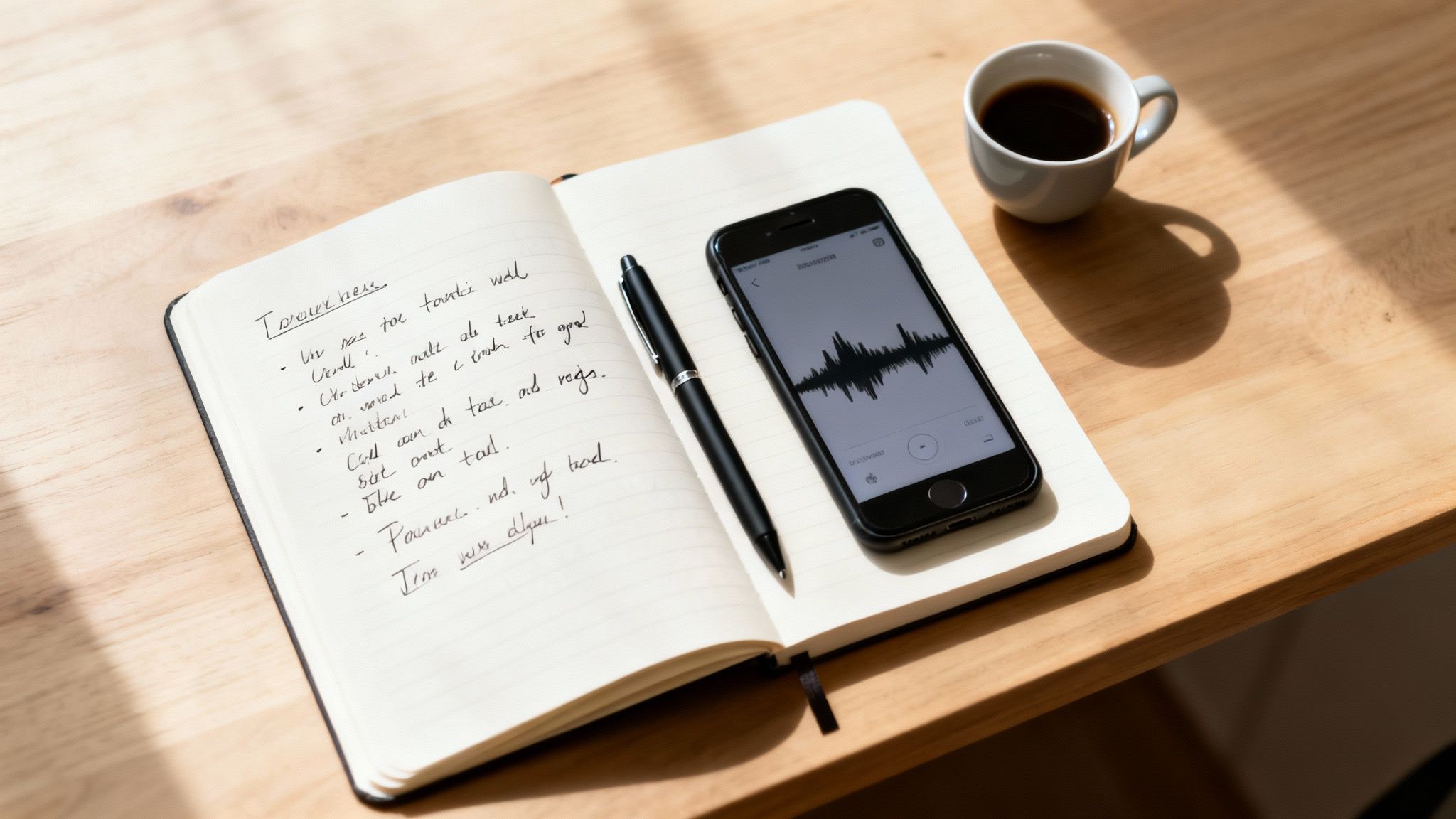
Voice Memos: Use your phone to quickly record thoughts while you’re driving or out for a walk. Sometimes speaking an idea out loud feels more natural than writing it.
Shared Digital Note: Start a shared note in an app like Google Keep or Apple Notes. You and your partner can both drop in memories as they come up—just make a pact not to peek at each other's final vow drafts!
A Dedicated Notebook: An old-school notebook works wonders. Keeping a small one on you to scribble down phrases or promises can help you connect with the emotion behind the words.
This groundwork is probably the most important part of writing your vows. By focusing on gathering real, honest material first, you’re guaranteeing your final words will be packed with genuine emotion and personal details. Taking the time to do this now makes the actual writing process so much smoother and more meaningful. It's a smart investment, much like finding amazing tips to save money on your wedding day, because it lets you focus your energy on what truly matters. Building this story bank is how you prepare to create vows that will resonate for a lifetime.
Structuring Your Vows for Emotional Impact
So, you've gathered all those wonderful memories, inside jokes, and heartfelt feelings. Fantastic. Now, how do you turn that beautiful mess of ideas into vows that actually flow? The secret is a simple structure. Think of it less like a rigid script and more like a roadmap to guide your thoughts.
Having a framework helps you build your vows piece by piece, so you feel in control rather than completely overwhelmed by the blank page. It’s the key to turning scattered notes into a story that builds emotion and feels completely natural.
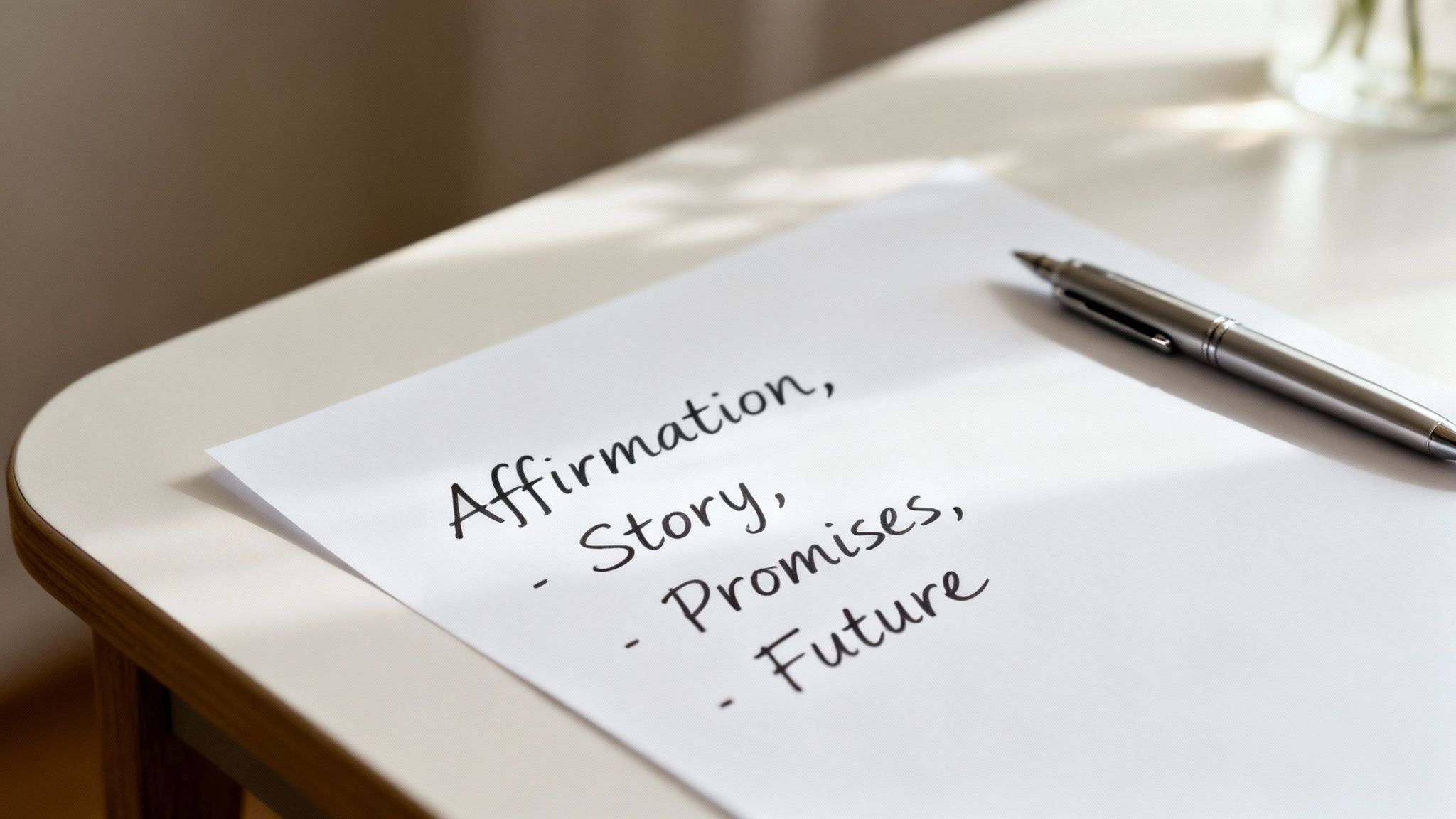
This isn't about ticking boxes. It's about taking your partner—and your guests—on a journey. A good set of vows usually has four key landmarks: a heartfelt affirmation, a personal story, your core promises, and a shared vision for the future. Hitting these points ensures your vows have a beginning, a middle, and an end that truly lands.
To help you get started, here's a simple framework I've seen work countless times. It’s designed to help you organise your thoughts and promises into a coherent and heartfelt declaration.
A Simple Framework for Your Wedding Vows
Vow Section
What It Accomplishes
Guiding Questions to Ask Yourself
The Affirmation
Sets the tone and hooks your partner in immediately. It's a direct, powerful statement of love.
What is the very first thing I want them to hear? Why are we standing here today?
The Story
Shows, rather than tells, why you love them. It makes your connection real and relatable.
What one memory perfectly captures who they are or what we have together?
The Promises
This is the heart of your vows. It's your concrete commitment for your marriage.
What do they need from me? What can I realistically promise to do and be for them?
The Future
Ends on a hopeful, forward-looking note, summarising your lifelong commitment.
What is my biggest dream for our life together? What is the final thought I want to leave them with?
Let's break down each of these sections a little further.
Start with a Powerful Affirmation
Kick things off by speaking directly to your partner. This first line is your chance to grab their attention and set an intimate, personal tone. It’s where you state, without any fluff, what this day or what they mean to you.
This isn’t the place for a long-winded story; it’s for a direct, heartfelt statement of love. It could be as simple as, “From the moment I met you, I knew my life was about to change in the most wonderful way.”
Here are a few ideas to get you thinking:
A Statement of Belief: “I used to think soulmates were just a nice idea, but then I met you.”
A Direct Address: “My love, standing here with you today feels like coming home.”
A Reflection on Time: “It feels like only yesterday we were…, and now here we are, about to start our forever.”
This opening line grounds your vows and creates an anchor for everything that follows.
Tell a Brief, Meaningful Story
Okay, now it’s time to bring your love to life. A short, specific anecdote is what separates good vows from unforgettable ones. You’re moving from telling everyone you love your partner to showing them why. A well-chosen story is so much more powerful than a list of adjectives.
Pick one single memory that captures the essence of your relationship. Maybe it was a funny disaster on your first trip away that showed their incredible patience. Or perhaps it was a quiet moment where their support meant the world to you.
For example, instead of saying, “You’re so supportive,” you could share a moment: “I’ll never forget the night before my big exam when you stayed up making me flashcards and cups of tea, even though you had to be up at 5 am. In that small, quiet moment, I saw the incredible depth of your kindness.”
Choose one story and tell it well. You don’t need to recount your entire relationship timeline. A single, vivid snapshot will connect with your partner and your guests on a much deeper level.
Make Your Core Promises
This is the heart and soul of your vows. You’ve just explained why you love them with your story; now you’re going to make clear, intentional promises for your future together. These are the commitments that will guide your marriage long after the wedding day is over.
Try to go beyond the classic “in sickness and in health.” While it's a beautiful sentiment, this is your chance to make promises that are unique to your partnership. What does your partner truly need from you? What do you need to promise to be the best spouse you can be?
Feel free to mix the serious with the lighthearted:
Serious: “I promise to always be your biggest supporter, celebrating your wins and holding your hand through any challenges.”
Personal: “I promise to always listen, even when we’re debating which pizza topping is superior.”
Future-Oriented: “I promise to build a life with you that is filled with laughter, adventure, and endless cups of coffee in bed.”
These promises are the covenant you’re making. Make them count.
Close with a Vision for the Future
End your vows by looking forward. This final part ties everything together and leaves your partner and guests feeling hopeful and excited for what’s next. It’s your shared dream, spoken out loud.
Your closing line should be a powerful summary of your commitment and love. It’s the final thought you want ringing in your partner’s ears.
A strong closing might sound like one of these:
“With you by my side, I know the best is yet to come. I can’t wait to spend the rest of my life with you.”
“You are my greatest adventure, and I promise to love you fiercely and completely, today and all of our tomorrows.”
“I choose you. Today, and every day for the rest of our lives.”
Following this flow provides a simple yet incredibly effective way to organise your thoughts, ensuring your vows are coherent, emotional, and deeply personal.
Polishing Your Draft Until It Shines
Getting that first draft onto paper is a huge win. Seriously, give yourself a pat on the back. But the real magic happens in the editing. This is where your good ideas transform into an unforgettable declaration of love—where you polish every sentence until it sounds exactly like you.
Think of editing less as finding flaws and more as sharpening your focus. You’ll be amazed at how a few small tweaks can make your vows clearer, more powerful, and a whole lot easier to deliver when you’re standing up there.
Read Your Vows Out Loud
If you only do one thing to edit your vows, make it this. It’s non-negotiable. Words can look perfect on a page, but vows are meant to be heard. Reading them aloud is the only way to catch what your eyes will miss.
As you speak, listen for a few key things:
The Rhythm and Flow: Does it sound natural, like you’re actually talking? Or are some sentences a bit stiff and clunky?
Awkward Phrasing: Are there any tongue-twisters or phrases you keep stumbling over? If you trip up in your living room, you’ll definitely trip up at the altar.
Pacing and Breath: Are you running out of air mid-sentence? That’s a clear sign you need to add a comma or break a long sentence into two shorter ones.
Hearing your own voice will instantly show you where the emotional beats land and where the rhythm feels off. It’s the best way to make sure you sound like yourself, not a greeting card.
Your vows should sound like the best, most heartfelt conversation you’d ever have with your partner. Reading them aloud is the only real way to know if you've nailed it.
Find the Sweet Spot for Length
You’ve poured your heart out, but remember, your guests (and maybe even your partner!) have a limited attention span. The sweet spot for wedding vows is between one and three minutes. It might not sound like a lot, but it’s more than enough time to say something truly meaningful.
A three-minute speech clocks in at around 350-450 words, give or take, depending on how quickly you speak. The best way to check? Time yourself reading your draft aloud.
If you’re running over, it’s time to be a little ruthless. Look for repeated ideas or stories that could be told more concisely. Every single word needs to earn its place.
Get a Second Opinion From Someone You Trust
You're way too close to your own writing to see it clearly. Getting feedback from a trusted friend, a sibling, or your celebrant can be a game-changer. Just be sure to pick someone who gets you and your partner, and who you can count on for honest, constructive advice.
To get the most helpful feedback, ask them specific questions:
Does this genuinely sound like me?
Is the tone right for the kind of wedding we're having?
Are there any bits that are confusing?
Is there anything you think I could cut?
This outside perspective is especially useful when you think about your audience. Saturdays are the most popular day for weddings in Australia, hosting about 55% of all ceremonies, which often means a bigger guest list. A friend can help you find that perfect balance between the deeply personal promises meant only for your partner and the public declaration everyone is there to witness. If you're curious about other trends, the Celebrant Institute’s website has some great insights.
Ultimately, this final polish is what makes your vows land with real heart. By reading them aloud, trimming them down, and getting a fresh perspective, you'll craft words that aren't just beautiful on paper but are delivered with confidence and pure sincerity.
Delivering Your Vows with Confidence
You’ve poured your heart onto the page, and now it’s time to make sure your delivery does those beautiful words justice. This is the emotional peak of your ceremony, and a little preparation will help you feel present, connected, and wonderfully calm when the moment arrives.
This isn't about giving a flawless performance or memorising a script. It’s about getting so comfortable with your own words that you can share them with the same love you put into writing them.
Practice Makes Present, Not Perfect
Let's get one thing straight: the goal here isn't to memorise every line. In fact, being too rehearsed can make your vows sound a bit robotic. The real reason to practise is to get familiar with the rhythm and feel of the sentences.
Why? So you can look up from the page and actually make eye contact with your partner.
In the days leading up to the wedding, read your vows aloud a few times. Try it in front of a mirror to see your own expressions. This is the best way to catch any clunky phrases you might stumble over and find the natural places to pause and breathe.
The most powerful vows feel like an intimate conversation, just with a few more people watching. Familiarity with your words lets you focus on your partner, not the paper in your hands.
Speaking from the heart is what it's all about. Delivering your vows with sincerity and confidence is just as important as the writing itself. For more advice on public speaking at weddings, you might find these tips for delivering impactful wedding speeches helpful.
Managing Your Nerves on the Day
It’s completely normal to feel a rush of adrenaline and a few butterflies. Public speaking is a huge fear for many people, and when you add the emotional weight of a wedding, it’s a recipe for jitters. But you can use that energy to your advantage.
Here are a few simple tricks to keep you grounded:
Take a Deep Breath: Just before it’s your turn, take one slow, deep breath. It’s a tiny action that sends a huge signal to your nervous system to calm down.
Focus on Your Partner: Look directly into their eyes. They are your anchor. This makes the moment feel like it's just the two of you, creating an intimate bubble that shuts out everything else.
Slow Down: When we’re nervous, we talk fast. Make a conscious effort to speak more slowly than you normally would. It gives your words weight and makes you much easier to understand.
Embrace the Emotion: If your voice cracks or a tear escapes, that’s okay. It’s beautiful. Those raw moments of vulnerability are what make your vows real and unforgettable. Don’t fight it.
Remember, every single person in that room is on your team. They’re your biggest cheerleaders.
Choosing How to Read Your Vows
Finally, let’s talk logistics. You absolutely shouldn’t try to memorise your vows, so you'll need something to read from. The presentation matters, as it will be in all your ceremony photos for years to come. It's one of those practical details to sort out, just like finalising the key questions to ask your wedding venue before the big day.
Here are the most common options:
A Vow Book: Small, elegant notebooks are a fantastic choice. They look beautiful in photos and become a cherished keepsake you can hold onto forever.
Discreet Cards: Neatly written or printed cards are a classic for a reason. Go for thick cardstock so they don’t flutter in a breeze, and make sure the text is large enough to read easily at a glance.
Your Phone: While convenient, a phone can be a little distracting. The screen can cast a blueish glow on your face in photos, and there's always the risk of a notification popping up. If you must use it, put it on aeroplane mode.
Pick the option that feels most comfortable and natural for you. With these preparations sorted, you’ll be ready to deliver your vows with all the love and confidence they deserve.
Here are some of the most common mistakes I see couples make when they sit down to write their vows. Don't worry, they're all easily avoidable once you know what to look for.
Let's be real: the whole point is to make your partner feel like the only person in the world, not to confuse your guests or make promises you can’t possibly keep. A little awareness goes a long way in making sure your vows are remembered for all the right reasons.
Making It an Inside Joke
Your vows are for your partner, first and foremost. But they're also being shared with your favourite people. One of the biggest traps is packing them with so many inside jokes or super-specific references that your guests are left scratching their heads.
A touch of shared history is perfect, but if your vows need a 10-minute TED Talk to explain, you've gone too far. The emotion should feel intimate, but the message needs to land with everyone in the room.
Instead of a cryptic reference, just add a little context. For example, rather than saying, "I'll never forget 'the great emu incident'," you could say, "I knew I loved you during that disastrous road trip when we were chased by an emu, because even in total chaos, you were the one who couldn't stop laughing." See? Everyone gets it now.
Your vows are for your partner, but they are witnessed by your community. Aim for that sweet spot where the core message is deeply personal, but the story is accessible to everyone there to celebrate you.
Promising the Impossible
It’s so tempting to get swept up in the moment and promise the moon, the stars, and an eternity of perfect happiness. But grand, sweeping statements can sometimes feel a bit hollow.
Saying things like "I'll always make you happy" or "I'll never let you down" is a beautiful thought, but life is messy. No one is perfect. Making promises you can’t realistically keep can undermine the authenticity of your vows.
The trick is to be specific and grounded. Focus on the real, everyday actions that define your commitment.
Instead of saying, "I promise to always be there for you," try something like, "I promise to be the one you can always count on for a hot cup of tea and a listening ear after a rough day."
Instead of, "I promise we'll never fight," a more realistic approach is, "I promise to always fight for us—to listen with an open heart and to always find our way back to each other when we disagree."
These kinds of promises feel so much more genuine because they show you understand what it truly takes to build a life together. It’s the small, consistent actions that create a lifetime of love.
Got Questions About Your Vows? We've Got Answers
Even with the best plan, a few questions are bound to pop up as you start writing your vows. It’s completely normal. Let's tackle some of the most common ones I hear from couples, so you can sort out those final details and feel totally confident.
Should We Keep Our Vows a Secret From Each Other?
This is a big one, and honestly, it’s a great idea. Keeping your vows under wraps until the ceremony creates a truly genuine, emotional moment. There's nothing quite like hearing those words for the very first time as you stand opposite each other. It makes the experience incredibly powerful.
That said, it's not a hard and fast rule. Some couples find a lot of joy in writing their vows together. It can be a really special bonding experience, and it guarantees you’re both on the same page with the tone and feel.
Here’s what I usually recommend: Keep the final vows a secret, but chat about the general vibe and length beforehand. This way, you get the best of both worlds—your vows will feel cohesive, but you still get that magical, heart-stopping surprise on the day.
So, How Long Should My Vows Actually Be?
You're aiming for the sweet spot: between one and three minutes. That usually works out to be somewhere around 150 to 350 words.
This gives you enough time to tell a short, meaningful story and make your promises without losing everyone's attention. The last thing you want is to feel rushed or see your guests' eyes start to glaze over.
The best way to check is to time yourself. Read your draft out loud at a natural, slightly slow pace and see how long it takes. Remember, this is all about making an impact, not an endurance speech.
Do We Really Have to Memorise Them?
Please don't! In fact, I strongly advise against even trying. Attempting to memorise your vows just adds a mountain of unnecessary stress to a day that’s already full of emotion. With adrenaline and feelings running high, it's so easy to forget a line and spiral into a panic.
A much better approach is to use a vow book or a few neat note cards. Here's why:
It helps you stay present. You can focus on your partner instead of frantically trying to remember what comes next.
You can speak from the heart without the fear of your mind suddenly going blank.
They become a beautiful keepsake you can look back on for years to come.
The goal is to deliver your vows with sincerity, not to give a flawless performance. Having your notes ensures you can do just that, calmly and confidently. Thinking about these personal touches might also inspire you to explore other unique wedding gift ideas for your day.
The average Australian wedding can set couples back tens of thousands of dollars, a staggering figure that can feel overwhelming when you're just starting your life together. But what if you could have the celebration you've always imagined for a fraction of the cost? Planning weddings on a budget isn't about compromise or sacrifice; it's about making smart, strategic choices that prioritise what truly matters to you as a couple. It’s about focusing your resources on the elements that will bring you the most joy, while creatively minimising costs elsewhere.
From savvy vendor negotiations to creative DIY projects, there are countless ways to reduce expenses without sacrificing the magic and significance of your special day. To ensure your dream wedding doesn't break the bank, effectively managing your finances from the start is key. Consider utilising a comprehensive event budget planning template to track all expenses, which helps maintain financial clarity and control throughout the entire process.
This guide dives into ten of the most effective, actionable strategies to help you plan a beautiful, memorable wedding that respects your financial goals. We'll cover everything from major cost-cutters like venue selection and guest list management to clever tricks for catering, decor, photography, and entertainment. Forget the idea that a smaller budget means a lesser celebration. Get ready to discover how a little creativity and careful planning can lead to the wedding of your dreams, completely debt-free.
1. Off-Season Wedding Dates
One of the most impactful strategies for planning weddings on a budget is to sidestep the traditional peak season. By choosing a date outside the high-demand period of September to April, you unlock significant savings across nearly every category, from your venue to your photographer. This simple shift in timing leverages the basic economic principle of supply and demand in your favour.
Why Timing is Everything
Venues and vendors have higher overheads and fewer bookings during the cooler months (typically May to August in Australia) or on weekdays. To secure business, they are far more willing to offer substantial discounts and flexible packages. This isn't just a minor price reduction; it can translate into thousands of dollars in savings, freeing up your budget for other priorities.
A Saturday wedding in October is the most expensive day of the year, while a Friday in July could reduce your venue hire cost by 30-50%. Imagine saving $4,000 on your venue simply by choosing a winter date over a spring one. This is a common scenario that makes off-season planning a powerful tool.
Key Insight: The date you choose is the single biggest lever you can pull to control your overall wedding budget. A less popular date means more negotiating power and lower base prices.
Actionable Tips for Off-Season Savings
To maximise the benefits of this approach, consider these practical steps:
Book in Advance: Secure your preferred off-season date 12-18 months ahead to get the best possible rates before vendors fill their calendars.
Negotiate with Confidence: When demand is low, vendors are more open to negotiation. Don't hesitate to ask for included extras like a complimentary bar hour, upgraded linens, or a reduced per-head cost.
Plan for the Weather: If you opt for a winter wedding, ensure your venue has a beautiful indoor ceremony and reception space. Consider purchasing wedding insurance for peace of mind against extreme weather events.
By being flexible with your timing, you can achieve the wedding of your dreams without the premium price tag. For more ideas on how to reduce costs, you can find additional tips to save money on your wedding day.
2. Digital and Hybrid Invitations
One of the most straightforward ways to cut costs when planning weddings on a budget is to rethink your invitations. By replacing or supplementing traditional paper stationery with digital alternatives, you can eliminate significant expenses related to printing, custom design, and postage while simplifying guest management and communication. This modern approach is not only cost-effective but also eco-friendly and incredibly efficient.
Why Timing is Everything
Going digital can translate to immediate and substantial savings. The cost of bespoke printed invitations, including save-the-dates, RSVP cards, and envelopes, can easily reach $500 to $1,500 or more, depending on your guest count and design complexity. Platforms like Paperless Post or a custom wedding website built on Squarespace can reduce this expense to a fraction of the cost, or even eliminate it entirely.
For example, a couple inviting 100 guests could save over $600 on printing and postage alone. This saved money can then be reallocated to more impactful areas of your wedding, such as catering or entertainment, making it a smart and strategic choice for any budget-conscious couple.
Key Insight: Digital invitations offer more than just cost savings; they provide a centralised hub for guest information, online RSVP tracking, and instant updates, streamlining your planning process.
Actionable Tips for Off-Season Savings
To maximise the benefits of this approach, consider these practical steps:
Implement a Hybrid Model: Cater to all your guests by sending beautiful, free e-invites to the majority and a small batch of printed invitations to older relatives or those who may not be tech-savvy.
Use QR Codes: For printed save-the-dates or invitations, include a QR code that links directly to your wedding website. This gives guests easy access to all details, maps, and your online RSVP form.
Leverage Guest Management Tools: Choose a digital platform that includes built-in guest management features. This allows you to track RSVPs in real time, send automated reminders, and easily communicate any last-minute changes.
3. DIY Decorations and Centerpieces
Embracing a do-it-yourself approach to your decorations and centrepieces is a classic and highly effective strategy for planning weddings on a budget. Instead of allocating thousands to professional decorators and florists, you can leverage creativity and craft supplies to design a personalised and beautiful aesthetic that reflects your unique style.
Why Crafting Cuts Costs
The savings from DIY decor are substantial because you are eliminating labour costs, which form a large portion of professional styling fees. Simple, elegant centrepieces like mason jars with LED fairy lights and baby's breath can be assembled for just a few dollars each, compared to the $50-100+ per table quoted by many professionals.
Sourcing your own materials from craft stores, wholesale suppliers, or even nature allows you to control every dollar spent. For example, couples often save over $1,000 on florals alone by purchasing bulk flowers from a market and arranging their own bouquets and centrepieces. This hands-on approach delivers immense value and a deep sense of personal accomplishment.
Key Insight: DIY decorations transform a major wedding expense into a manageable and creative project. Your personal touch becomes a memorable part of the day, not just a line item on an invoice.
Actionable Tips for DIY Success
To ensure your DIY projects look polished and professional, follow these practical steps:
Start Early and Practise: Begin gathering inspiration and doing trial runs of your key designs, like centrepieces, at least 3-4 months before the wedding. This avoids last-minute stress.
Enlist a Crafting Crew: Turn your DIY projects into fun pre-wedding events. Host crafting parties with friends and family who have a knack for creativity to help with assembly.
Source Smart: Buy flowers in bulk from wholesale markets or stores like Costco. Look for decor items at discount shops or online marketplaces well in advance.
Create a Timeline: Develop a detailed schedule for what needs to be made and when. Create simple instruction sheets for your helpers to ensure consistency across all items.
4. Buffet and Family-Style Dining vs. Plated Service
Catering is often one of the largest expenses in a wedding budget, but rethinking the service style can lead to dramatic savings. Opting for a buffet or family-style dining experience over a traditional multi-course plated service directly reduces costs by minimising the required number of kitchen and waitstaff. This approach creates a more relaxed, communal atmosphere while being kinder to your wallet.
Why Service Style Matters
The primary cost difference between plated meals and other styles lies in labour. A formal plated dinner requires a large team to individually prepare, plate, and serve each course to every guest simultaneously. In contrast, buffets and family-style service, where large platters are placed on tables for guests to share, require significantly fewer staff.
This reduction in labour can save you anywhere from $20 to $30 per person. For a wedding of 100 guests, that’s an immediate saving of $2,000 to $3,000. Additionally, these formats often allow for more cost-effective menu choices, such as a hearty barbecue or Italian feast, which can be 40% cheaper than their plated counterparts.
Key Insight: The way you serve your food is just as important as what you serve. Shifting from individual plates to shared platters is a simple change that cuts down on the single biggest catering cost: staff.
Actionable Tips for Shared Dining Savings
To get the most value from a buffet or family-style meal, consider these practical steps:
Curate a Simple Menu: Focus on two to three delicious main dishes rather than a wide array of options. This streamlines preparation and reduces food waste and cost.
Optimise the Buffet Layout: If choosing a buffet, position the station strategically to manage guest flow and prevent long queues. A double-sided setup is often the most efficient.
Choose Resilient Dishes: Select menu items that hold up well in chafing dishes or on platters, such as slow-cooked meats, pasta bakes, or roasted vegetable medleys.
Simplify Your Beverage Options: Complement your relaxed dining style with a limited beverage package. Offering a curated selection of beer, wine, and soft drinks is far more budget-friendly than a full open bar.
5. Hire Photography Students or Emerging Professionals
Wedding photography is a significant investment, often consuming a large portion of the budget. A creative and highly effective cost-saving strategy is to look beyond established professionals and consider hiring talented photography students or emerging photographers who are actively building their portfolios. This approach allows you to secure quality memories of your day for a fraction of the standard cost.
Why Timing is Everything
Newer photographers are eager to gain experience and build a strong portfolio to attract future clients. They often charge significantly lower rates than seasoned professionals, who have higher overheads and established reputations. This isn't about sacrificing quality; it's about finding skilled individuals at an earlier stage in their career who are keen to produce beautiful work.
For example, a student from a local TAFE or university might charge $300-$600 for a full day's coverage, whereas an emerging photographer with a few weddings under their belt might charge $800-$1,200. This presents a massive saving compared to the $3,000+ you would expect to pay for an experienced professional, making it a powerful choice for weddings on a budget.
Key Insight: An emerging photographer's need for portfolio-worthy images aligns perfectly with your need for a budget-friendly service. You get beautiful photos at a lower price point, and they get invaluable experience and content for their business.
Actionable Tips for Off-Season Savings
To ensure you find the right emerging talent and have a successful experience, follow these practical steps:
Scrutinise Their Portfolio: Thoroughly review their existing work, even if it’s not all wedding-related. Look for a consistent style, good composition, and skilled editing that matches your vision.
Request a Contract: A professional contract is non-negotiable, regardless of experience level. It should outline deliverables, hours of coverage, payment schedule, and contingency plans for emergencies.
Schedule a Trial Run: Book an engagement shoot with your chosen photographer. This is a low-stakes way to assess their working style, see how you feel in front of their camera, and ensure you love the final product.
To make an informed decision, it's beneficial to research industry standards. Gaining insight into the market by understanding typical wedding photo costs can help you recognise a good value offer and negotiate with confidence.
6. Venue Versatility and Alternative Spaces
Moving beyond traditional wedding reception centres is a game-changing strategy for planning weddings on a budget. By exploring alternative spaces like community halls, public parks, or even a family backyard, you can drastically reduce one of the biggest expenses in your wedding budget. These non-traditional venues not only offer immense savings but also provide a unique, personalised backdrop for your special day.
Why Location is a Lever
The financial difference between a standard venue and an alternative space is significant. A permit for a public park ceremony might only cost $100-$300, whereas hiring a private garden could be thousands. Similarly, a family backyard eliminates venue hire fees entirely, leaving more funds for catering, entertainment, or your honeymoon.
This approach gives you a "blank canvas" to customise every detail, from the decor to the floor plan, without the restrictions often imposed by all-inclusive venues. While it requires more coordination, the creative freedom and financial rewards are often well worth the effort.
Key Insight: Your venue doesn't have to be a dedicated "wedding venue." Choosing a space for its character, location, or personal meaning can unlock thousands in savings and result in a more memorable celebration.
Actionable Tips for Alternative Venue Savings
To successfully use a non-traditional space, careful planning is essential:
Logistics First: Before booking, confirm access to essentials like electricity, running water, and restrooms. If these aren't available, you will need to budget for hiring generators and portable toilets.
Permits and Insurance: Check with your local council about any required permits, noise restrictions, or alcohol licensing. You may also need to arrange public liability insurance, which is often a requirement for using public spaces.
Hire a Coordinator: Consider hiring a day-of coordinator who has experience with non-traditional venues. They will be invaluable in managing vendor arrivals, setup, and troubleshooting on the day.
Choosing an alternative space requires more hands-on organisation, but it's one of the most effective ways to host a beautiful wedding on a budget. To ensure you cover all your bases, make sure you know the essential wedding venue questions to ask before you commit.
7. Curated Playlist and DIY DJ Services
Music sets the entire mood for your celebration, but professional entertainment can consume a significant portion of your budget. Opting for a do-it-yourself (DIY) music solution allows you to maintain complete creative control while saving hundreds, if not thousands, of dollars. By leveraging streaming services and quality rental equipment, you can create a personalised and memorable soundtrack without the professional DJ price tag.
Why You Can Be Your Own DJ
A professional DJ often costs upwards of $1,200 for a standard reception. In contrast, hiring a high-quality sound system with speakers and a microphone typically ranges from $150 to $400 for a weekend. Paired with a Spotify or Apple Music subscription, this approach delivers a custom-curated atmosphere for a fraction of the cost.
This method isn't just about saving money; it’s about personalisation. You get to hand-pick every song, from the ceremony processional to the last dance, ensuring the music perfectly reflects your relationship and taste. For many couples planning weddings on a budget, this level of control is a huge bonus.
Key Insight: The money you save by forgoing a professional DJ can be reallocated to enhance other guest experiences, such as upgrading the catering, offering a late-night snack, or extending the open bar.
Actionable Tips for a Flawless DIY Playlist
To ensure your DIY music setup runs smoothly, a little preparation goes a long way:
Organise Your Playlists: Create separate, meticulously organised playlists for each part of the day: guest arrival, ceremony, cocktail hour, dinner, and dancing. Over-plan the length to avoid any silent gaps.
Rent Quality Equipment: Don’t rely on a small Bluetooth speaker. Invest in a proper PA system rental. Ask the rental company for a system that includes two speakers, a subwoofer for the dance music, and a wireless microphone for speeches.
Appoint a Music Manager: Designate a reliable friend or family member to act as the informal MC. Their role is to press play at the right times, manage transitions between playlists, and handle any announcements.
Conduct a Sound Check: Test all equipment at the venue before the guests arrive. Check volume levels, microphone clarity, and ensure your music device connects seamlessly to the system. Have a backup device and offline playlists ready just in case.
8. Limited Guest List and Intimate Gatherings
Perhaps the most direct and effective strategy for managing weddings on a budget is to curate a smaller, more intimate guest list. Each guest represents a cost for catering, seating, stationery, and favours, so reducing the number of attendees has a significant ripple effect across your entire budget. This approach prioritises a high-quality experience with your closest circle over a large-scale event.
Why Timing is Everything
The per-head cost is a primary driver of wedding expenses. A traditional 150-person wedding with a per-head cost of $150 totals $22,500 on catering alone. By contrast, an intimate gathering of 50 people at the same rate costs just $7,500, a staggering saving of $15,000. This is money that can be reallocated to elevate the guest experience, fund a dream honeymoon, or contribute to a home deposit.
Focusing on a smaller group allows you to invest in what truly matters. Instead of a standard buffet for 200, you could host a gourmet multi-course dinner for 40. The focus shifts from quantity to quality, creating a more memorable and personal celebration for everyone involved.
Key Insight: Your guest list is the most powerful budget control tool you have. Every person you add directly increases your costs, while every reduction creates significant savings and opportunities for a more meaningful experience.
Actionable Tips for Off-Season Savings
To navigate guest list decisions gracefully and maximise savings, consider these steps:
Establish Clear Criteria: Decide on your guest "tiers" early on. This might be immediate family only, or include bridal party and closest friends. Stick to your rules consistently to avoid hurt feelings.
Communicate Thoughtfully: If you receive questions from those not invited, be honest but kind. Explain that you've chosen to have a very small, intimate wedding to keep it personal and within your budget.
Plan for Intimacy: A smaller group opens up possibilities for unique venues like a favourite restaurant, a boutique hotel, or a beautiful holiday home. You can also plan more interactive activities that wouldn't be feasible with a large crowd.
Consider a Wishing Well: With a smaller guest list, a wishing well registry becomes an even more practical option, allowing guests to contribute towards larger goals. You can learn more about how a wishing well registry works.
9. Strategic Vendor Bundling and Package Deals
One of the most effective methods for managing weddings on a budget is to seek out vendors who offer bundled services or all-inclusive packages. By combining multiple necessities like catering, decor, and photography into a single agreement, you leverage volume purchasing to unlock significant discounts and simplify your planning process. This approach minimises the number of contracts you manage and reduces overall costs.
Why Timing is Everything
Vendors, particularly venues, often create comprehensive packages that include catering, tables, chairs, and basic linens because it streamlines their operations. This efficiency translates into savings for you. A venue might offer a package that, when priced out individually, would cost $1,500-$3,000 more. Similarly, a photographer might bundle an engagement shoot and a wedding album into their main package at a rate far cheaper than booking each service separately.
This strategy is about more than just convenience; it’s about maximising value. By committing to a single supplier for multiple services, you become a more valuable client, which gives you greater negotiating power to secure better rates or added perks.
Key Insight: Bundling services transforms multiple small expenses into one larger, more manageable, and often discounted, cost. It’s a powerful tool for simplifying logistics and saving money.
Actionable Tips for Off-Season Savings
To make the most of package deals, approach them with a strategic mindset:
Request an Itemised Breakdown: Always ask for a detailed price list of what’s included in the bundle. This helps you understand where the value lies and ensures you aren't paying for services you don’t need.
Negotiate Add-Ons: Use your larger commitment as leverage. Ask if they can include an upgrade, like premium linens or an extra hour of photography coverage, as part of the package deal.
Compare Against A La Carte: Before signing, get individual quotes from other vendors. Sometimes, bundling isn't the cheapest option, so it’s crucial to do your research to confirm you’re getting a genuine deal.
10. Simplified Menu and Seasonal Ingredients
Your wedding catering is often one of the largest expenses, but it doesn't have to be. By designing your menu around seasonal, locally-sourced ingredients and opting for simpler preparations, you can significantly reduce costs without sacrificing flavour or quality. This approach not only supports local farmers but also ensures your guests enjoy the freshest, most delicious food possible.
Why Timing is Everything
Ingredients that are in season and readily available locally are far less expensive than those that need to be imported or grown in specialised conditions. A caterer's costs are directly tied to ingredient prices, so a menu built on seasonal abundance is a powerful strategy for planning weddings on a budget. This simple change can make a substantial difference to your final bill.
For example, a spring wedding featuring asparagus and fresh local vegetables can be far more cost-effective than demanding those same items for an autumn event. Similarly, a hearty, harvest-themed menu with pumpkin and root vegetables in autumn could reduce your per-head cost by up to 20% compared to a menu requiring out-of-season produce.
Key Insight: Aligning your menu with the seasons is a financially savvy decision that results in a higher-quality dining experience. You pay less for ingredients that are at their peak of flavour and freshness.
Actionable Tips for Seasonal Savings
To maximise the benefits of a seasonal menu, consider these practical steps:
Consult Your Caterer Early: Discuss seasonal options with your caterer 3-4 months before the wedding. Ask them what will be at its best and most affordable for your chosen date.
Limit Your Choices: Instead of offering a wide array of options, stick to two or three delicious main courses. This streamlines preparation and reduces food waste and cost.
Embrace Simpler Styles: Consider more relaxed dining formats like a high-quality BBQ, a gourmet food truck, or a farm-to-table buffet. These often use whole, local ingredients and can save you $15 or more per person.
Top 10 Budget Wedding Strategies Compared
Option
Implementation Complexity ?
Resource Requirements ?
Expected Outcomes ?
Ideal Use Cases ?
Key Advantages ?
Off-Season Wedding Dates
Low — choose non-peak dates and negotiate
Low–Medium — flexible scheduling; possible weather contingencies
High savings (20–40%); better venue/vendor availability
Budget-focused couples flexible on season/day
High cost-effectiveness and negotiation leverage ????
Digital and Hybrid Invitations
Low — set up platform and guest list
Very low — internet, platform subscription or service
$300–600 saved; faster RSVPs and instant updates
Tech-savvy guests; couples who value speed and eco options
Efficient, eco-friendly, real-time tracking ???
DIY Decorations and Centerpieces
Medium–High — time and skill intensive
Moderate — craft supplies, volunteers, workspace
$800–2,500 saved; highly personalized aesthetic
Hands-on couples with craft help from friends/family
High customization and significant savings ???
Buffet / Family-Style Dining (vs Plated)
Low–Medium — plan flow and signage
Lower staffing; buffet/serving equipment
15–25% catering cost reduction; flexible portions
Casual receptions, large groups, varied diets
Cost-efficient and adaptable service style ???
Hire Photography Students / Emerging Pros
Low — sourcing and vetting required
Low cost; may need backup contingency
$500–1,500 saved; variable quality risk
Budget couples comfortable with portfolio-based hires
Affordable talent and flexible packages ??
Venue Versatility & Alternative Spaces
Medium–High — permits, logistics, backup plans
Variable — may require rentals (tents, toilets, power)
Bringing It All Together for Your Perfect, Budget-Friendly Day
Navigating the world of wedding planning can often feel like a tightrope walk between your dream celebration and your financial reality. As we've explored, creating unforgettable weddings on a budget isn't about sacrifice; it's about making strategic, creative, and intentional choices that reflect who you are as a couple. The journey to your special day should be filled with excitement, not financial stress.
By embracing the strategies detailed in this guide, you are now equipped with a powerful toolkit to craft a celebration that is both beautiful and affordable. The key is to shift your perspective from what you can't have to what you can create. Instead of a lavish, multi-course plated dinner, you have the opportunity to host a vibrant, communal feast with a family-style service. In place of expensive, imported floral arrangements, you can design unique, heartfelt DIY centrepieces that tell a story.
Your Roadmap to a Budget-Savvy Celebration
Let's distill the core principles we've covered into a clear action plan. These are the foundational pillars that will support your entire budget-friendly wedding strategy:
Prioritise Ruthlessly: Before you book a single vendor, sit down with your partner and define your top three non-negotiables. Is it the photography? The food? The atmosphere? Allocating your budget to what truly matters most to you ensures that your spending has the maximum impact on your experience. Everything else becomes a flexible detail.
Embrace Creative Flexibility: The most significant savings are found in flexibility. Being open to an off-season date, a Friday or Sunday wedding, or a non-traditional venue like a community hall or a beautiful park can slash your biggest expense right from the start. This mindset extends to every decision, from your guest list to your menu.
Leverage Your Community (and Your Skills): Your wedding is a celebration of community, so don't be afraid to lean into it. Talented friends and family may be thrilled to help with baking, decorating, or creating a music playlist. Likewise, mastering a few simple DIY projects not only saves money but also infuses your day with a deeply personal touch that guests will remember and appreciate.
Key Takeaway: A budget-friendly wedding is not a "lesser" wedding. It is a smarter, more personalised celebration that prioritises the experience of love and connection over lavish expenditure.
The Modern Approach to Wedding Gifting
Beyond trimming costs, modern tools can fundamentally change the financial dynamic of your wedding. Traditional gift registries, while well-intentioned, often result in couples receiving items they don't need. This is where a contemporary approach can make a monumental difference for couples planning weddings on a budget.
By using a flexible registry service, you empower your guests to contribute in ways that are genuinely helpful. Instead of another toaster or set of towels, their generosity can be channelled towards your honeymoon fund, a deposit on your first home, or even directly towards a specific wedding cost, like the photographer or the catering bill. This transforms gift-giving from a simple transaction into a collaborative effort to help you build your future together. It’s a practical, meaningful, and incredibly effective way to alleviate financial pressure without compromising on your dream day. Ultimately, your wedding is a single, beautiful day, but the support you receive can set you up for a lifetime of happiness.
Ready to take control of your wedding finances and make gift-giving meaningful? Create a flexible and free cash fund or wishing well with EasyRegistry. Our platform helps you coordinate contributions for your honeymoon, home deposit, or any other goal, making it simple for guests to give a gift that truly matters. Get started today at EasyRegistry and build the foundation for your future together.
Your getaway car isn't just a ride from A to B—it's your grand exit. It’s the final flourish on your wedding day and the very first journey of your new life together. Nailing the look of your car decorations for weddings is all about mixing your personal style with a bit of practical savvy. The result? A stunning send-off that looks amazing in photos and doesn't cause any last-minute stress.
Crafting Your Perfect Wedding Getaway Car
The tradition of dressing up the wedding car is a classic for a reason. It’s a joyful, public announcement of your new marital status that really captures the buzz of the moment. This guide will take you beyond the usual ideas to help you design a getaway car that’s a true reflection of your wedding theme—whether you're all about classic romance, rustic charm, or clean, modern lines.
Of course, before you get to the fun of decorating, you need the right wheels. This wedding transportation guide is a fantastic resource for exploring different car options and figuring out the logistics.
Planning and Budgeting Your Exit
Figuring out your car’s look is about more than just tying on a few ribbons. You're aiming for a cohesive design that feels like a natural extension of your wedding's aesthetic. Consider your colour scheme, the types of flowers you're using, and even the car's personality. A vintage Rolls-Royce, for instance, practically begs for elegant floral arrangements, while a quirky Kombi van can handle vibrant streamers and a fun, custom banner.
This is also the time to talk numbers and set a realistic budget. Here in Australia, the wedding car is a pretty significant line item. On average, couples spend around AUD 1,137 on their wedding car hire. It’s a key part of an industry where the total cost of a wedding can hit AUD 41,000 in states like Victoria.
Think of your getaway car as the final piece of décor your guests will see. It’s worth putting in the same thoughtful planning as your venue styling to guarantee a departure that’s both memorable and photo-ready.
It's so important to factor these transport costs into your overall wedding budget from the start. To help manage these bigger expenses, many couples are turning to a wedding services registry. It's a clever way to let guests contribute to experiences like your car hire or professional decorating services, rather than traditional physical gifts. This makes it simpler for everyone involved and helps you afford the send-off you've been dreaming of.
Finding Your Wedding Car Decoration Style
Think of your wedding car as more than just a ride—it's the first and last thing your guests see, a moving piece of your celebration. The right decorations can turn it from a simple vehicle into a real statement piece. The trick is to make sure the car's style feels like a natural extension of your wedding day's overall vibe.
The best place to start? Your wedding theme. If you're planning a classic, elegant affair, you'll probably lean towards timeless touches like lush floral garlands and delicate silk ribbons. But for a modern, minimalist wedding, you might prefer something sleeker, like a swag of greenery or a custom-designed vinyl decal.
Don't forget to consider the car itself, too. A vintage Bentley and a sporty convertible have completely different personalities, and what looks incredible on one might feel totally wrong on the other. You want to complement the car, not fight its design.
Classic and Romantic Styles
For that timeless, storybook look, you really can't go past flowers. The classic romantic style is all about soft textures, traditional blooms, and an undeniable sense of elegance. It’s incredibly versatile and looks stunning on almost any vehicle, whether it’s a modern luxury sedan or a vintage Rolls-Royce.
Here’s how to nail that romantic aesthetic:
Floral Garlands: Picture a lush garland of white roses, peonies, and trailing ivy gracefully draped across the bonnet or boot. It’s the ultimate romantic statement.
Ribbon Accents: Long, flowing satin or silk ribbons tied to door handles and mirrors create beautiful, soft movement as the car pulls away.
A Coordinated Palette: Weaving your wedding colours into the car décor ties everything together. Whites, creams, and blush pinks give off a dreamy vibe, while deeper tones like burgundy can add a touch of sophisticated drama.
This is the perfect choice for couples who want their car decorations for weddings to look polished and photo-ready from every angle. It’s a surefire way to create that beautiful, memorable exit.
Modern and Minimalist Designs
If your personal style is more clean and contemporary, a minimalist approach can make an incredibly chic statement. This look is all about simplicity, clean lines, and using fewer elements to create a bigger impact. It works especially well on modern cars, where you want the vehicle's own design to shine.
Here are a few modern ideas to get you started:
Greenery Only: Instead of big floral arrangements, consider an elegant swag of eucalyptus, olive branches, or even striking monstera leaves. The look is fresh, organic, and effortlessly cool.
Custom Vinyl Decals: A professionally made decal featuring your names, the wedding date, or a "Just Married" message in a stylish font adds a crisp, personalised touch that’s super sharp.
Single Colour Streamers: Rather than a mix of colours, try using high-quality fabric streamers in one bold, impactful shade that ties into your wedding palette.
Minimalist designs prove you don't need a lot to make a big impression. By focusing on just one or two key elements, like a beautifully crafted greenery swag or a sharp decal, you can ensure your car looks polished and totally modern.
Boho and Rustic Charm
For those with a more laid-back, free-spirited vibe, a bohemian or rustic style is a perfect fit. This aesthetic is all about celebrating natural textures, wildflowers, and a sense of effortless, organic beauty. It's an obvious choice for barn weddings or outdoor ceremonies and looks amazing on vintage cars, classic Kombi vans, or even a rugged 4WD.
To get this look right, start mixing textures and embrace a little bit of beautiful imperfection. Think about combining dried elements like pampas grass with fresh, colourful wildflowers for a real textural pop. A hand-painted wooden sign is another fantastic option that adds a charming, personal touch and nails that rustic feel.
Budgeting and Sourcing Your Decoration Materials
Alright, let's get down to the practical side of things: figuring out your budget and gathering all the bits and pieces you'll need. Deciding how much you want to spend on your car decorations for weddings early on is a smart move. It stops any last-minute budget blowouts and helps you make choices that are both stylish and sensible.
So, what are other couples spending? On average, Australian couples put aside about 3-5% of their total wedding budget for their vehicle hire and decorations. With the average wedding costing somewhere between AUD 30,000 and AUD 40,000, that usually works out to be an investment of AUD 1,000 to AUD 2,000 for the getaway car. As these wedding spending trends show, the send-off is a really valued part of the celebration.
One of the first big calls you'll need to make is whether to go the DIY route or bring in a professional. This decision alone will have the biggest impact on your budget.
DIY vs Professional Services
Tackling the decorations yourself gives you total creative freedom and is a wonderful way to pour a bit of your own personality into the day. The catch? It takes time, a bit of effort, and a solid plan to pull it off well.
On the other hand, hiring a professional—like your florist or a decorator who specialises in cars—takes all the stress off your shoulders. You get the peace of mind that comes with knowing everything will look incredible and, most importantly, be securely attached.
Choosing between DIY and a professional service often comes down to a simple trade-off: your time versus your money. A DIY project can save you cash but will cost you time, while hiring a pro saves you time but costs more upfront.
To help you weigh it up, let's look at how the two approaches stack up against each other.
DIY vs Professional Wedding Car Decorations Comparison
Deciding whether to roll up your sleeves or call in an expert is a personal choice. This table breaks down the key things to consider, helping you figure out which path is the best fit for your wedding plans, budget, and schedule.
Factor
DIY Decorations
Professional Service
Cost
Generally lower, limited to material costs.
Higher, includes materials, labour, and expertise.
Time Commitment
High. Requires sourcing, assembly, and installation.
Low. The vendor handles everything for you.
Skill Required
Basic crafting skills needed for a polished look.
No skills required from you.
Convenience
Low. You are responsible for the entire process.
High. A stress-free, hands-off experience.
Outcome
Can be highly personal but may lack a professional finish.
Guaranteed professional and secure installation.
Ultimately, there's no right or wrong answer—just what's right for you. Whether you decide to DIY or hire a professional, knowing where to get the best materials is the key to bringing your vision to life without breaking the bank. For more ideas on keeping costs in check, our guide offers some amazing tips to save money on your wedding day.
Where to Source Your Materials
This is where the fun really begins, as your design ideas start to become real. If you're going down the DIY path, knowing where to shop for quality supplies is half the battle. Even if you're working with a pro, it's helpful to know what's out there so you can explain your vision clearly.
For Floral and Greenery Elements:
Fresh Flowers: Your wedding florist is your best first stop. They can often provide extra blooms that perfectly match your bouquets or even create a custom piece for the car. Local flower markets are also a treasure trove for finding beautiful, seasonal flowers at a great price.
Artificial Flowers: For something that will definitely last the day, check out craft stores like Lincraft or Spotlight. They have a massive range of high-quality silk and faux flowers. For something truly unique, have a browse through online marketplaces like Etsy, where you can find gorgeous handmade floral pieces.
For Signage and Banners:
Custom Signs: A local sign writer can create a stunning, personalised "Just Married" sign on wood, acrylic, or as a vinyl decal. You'll also find heaps of talented creators on Etsy who can ship a custom sign right to your door.
Ready-Made Banners: If you're after something quick and cheerful, party supply shops and online retailers like Amazon are full of affordable, ready-to-hang banners and letter garlands.
For Ribbons, Tulle, and Streamers:
Fabric stores are your best friend here. You'll find a huge variety of colours and textures to match your theme. A little tip: if there's even a slight chance of rain, look for materials that are weather-resistant.
For Attachment Supplies:
For all the practical bits, head to a hardware store like Bunnings or any big craft store. You'll find car-safe tape, zip ties, and floral wire. If you're planning to use magnets, make sure you get ones with a soft felt backing to protect the car's paintwork from any scratches.
How to Secure Decorations Without Damaging the Car
The last thing you want to find on your wedding day is a scratch on the getaway car. It’s one thing to get your wedding car decorations looking absolutely perfect, but it’s another to make sure the car’s paintwork stays pristine underneath. The good news is, with the right materials and a little know-how, you can have a stunning look that’s both road-safe and completely damage-free.
The golden rule here is to avoid anything with a harsh adhesive or a rough surface. This means common household items like duct tape, packing tape, or your standard sticky tape are completely out of the question. They can leave behind a stubborn, gummy residue that’s a nightmare to remove, and in the worst-case scenario, they can even lift the paint’s clear coat.
The process is quite straightforward: you plan your budget, find your materials, and then, most importantly, secure them safely.
As you can see, properly attaching everything is the final, crucial step that brings your vision to life without any costly mishaps.
Choosing the Right Tools for the Job
Your success really comes down to using products designed to be gentle on automotive finishes. Think like a professional and get the correct tools from the start—it will save you a world of stress.
Painter's Tape: This is your best friend. It has a low-tack adhesive made for delicate surfaces, providing enough hold for lightweight items without leaving any gunk behind.
Car-Safe Floral Foam: If you're planning a floral arrangement for the bonnet or boot, look for foam blocks that come with a suction cup base. These create a surprisingly strong vacuum seal that holds tight without any adhesive at all.
Soft-Backed Magnets: Using a magnetic sign? Make sure it has a soft felt backing. This simple feature prevents any micro-scratches that can happen when metal makes direct contact with the car’s body.
Soft, Wide Ribbons: For tying bows and streamers to door handles or mirrors, go for materials like satin or silk. They’re far less likely to cause abrasion than rougher options like jute or hessian.
These specialised materials are your best defence against accidental damage, ensuring the car looks just as good after the decorations are removed as it did before.
Pro Tip: Before you stick or suction anything to the car, give the spot a quick wipe-down. The surface needs to be impeccably clean and dry. Even a tiny speck of dirt trapped underneath can act like sandpaper and cause fine scratches.
Damage-Free Installation Techniques
How you apply your decorations is just as important as the supplies you use. Let’s walk through the best way to handle the most popular types of wedding car decorations.
For those beautiful floral arrangements on the bonnet, start by positioning your suction-cupped floral foam. Press down firmly in the centre to create a strong seal—you should feel it grip. From there, you can build your arrangement directly onto the foam, securing the stems with floral wire.
When you’re attaching ribbons or tulle to door handles and wing mirrors, loop them on gently and tie them securely, but don’t pull them ridiculously tight. The aim is for them to flow gracefully in the breeze, not to put unnecessary strain on the car’s fittings.
Got a "Just Married" sign for the back? Magnets are a fantastic, hassle-free option. Place the sign carefully onto the boot, ensuring the magnets make flat, even contact. Whatever you do, don't slide it into place, as this can easily drag grit across the paint.
Your Pre-Drive Safety Checklist
Right before the big send-off, it’s essential to do a quick but thorough final check. This isn't just about protecting the car; it's about making sure everyone is safe on the road.
The Tug Test: Give every single decoration a gentle tug. Your floral arrangement shouldn't wobble, ribbons should feel snug, and any signs must be firmly attached.
Driver's View Check: Hop into the driver's seat and check your visibility from all angles. Decorations on the bonnet must not block the view of the road ahead, and nothing should obstruct the windscreen, rear window, or wing mirrors.
Number Plate Visibility: This one’s a legal requirement in Australia. Your number plates must be clearly visible at all times. Double-check that no stray ribbons, flowers, or signs are covering them, even partially.
Light and Indicator Check: Do a quick walk-around to make sure none of your beautiful decorations are obscuring the headlights, taillights, or indicators.
Staying Safe and Legal on Australian Roads
With your gorgeous car decorations for weddings all set up, there’s one last check before you can make that grand exit. You absolutely must make sure your getaway car is playing by Australian road rules. This isn't just about dodging a fine; it’s about making sure you, your partner, and everyone else on the road stays safe.
Australian road laws are pretty strict when it comes to things attached to your car, and temporary decorations definitely count. The big things they worry about are driver visibility and the risk of something flying off and hitting another car or a pedestrian. Following a few key rules will make sure your send-off is memorable for all the right reasons.
Key Legal Requirements for Wedding Cars
Before you turn the key, do a quick run-through of this legal checklist. The specifics can vary a little between states and territories, but these are the big ones that apply pretty much everywhere in Australia.
Don't Hide the Number Plates: Both front and rear number plates need to be totally visible and easy to read from a distance. A dangling ribbon or a bit of greenery might look pretty, but if it covers even a part of the plate, you could be in trouble.
Keep the Driver's View Clear: The driver needs a completely clear view out of the front windscreen, the rear window, and through the side mirrors. Any decorations on the bonnet should be kept low and well out of the driver's line of sight.
Lights Must Be Seen: Make sure all your lights are shining bright. This means headlights, taillights, brake lights, and indicators can't be covered by flowers, signs, or anything else.
I've seen it happen plenty of times: a beautiful "Just Married" sign gets mounted a little too low and ends up covering the top of the rear number plate. Even a tiny overlap is enough to get you pulled over, so always place signs well above or to the side.
Sticking to these simple rules is the best way to guarantee a smooth, stress-free first drive as a married couple. It’s a small step that prevents a whole lot of potential hassle.
The Post-Celebration Clean-Up
Once the party is over, there's one last job to do: getting the car back to how it started. This is super important if it's a hire car, as you'll want to avoid any nasty cleaning or damage fees. A bit of care here goes a long way.
First, gently untie any ribbons and snip off the cable ties. If you've used floral arrangements with suction cups, don't just rip them off. Instead, carefully lift the edge of one of the cups to break the seal, and the whole thing will come away easily.
If you find any sticky residue left behind from tape, grab a soft microfibre cloth and a proper automotive adhesive remover. Steer clear of household cleaners or solvents, as they can strip the car's protective clear coat. Taking your time with the clean-up is the final touch on a perfectly planned detail, leaving you with nothing but fantastic memories.
Common Questions About Wedding Car Decorations
As you start locking in the final details for your getaway car, a few questions always seem to surface. Getting these sorted ahead of time means you can enjoy that picture-perfect grand exit without any last-minute stress. Let's run through some of the most common things couples ask when it comes to car decorations for weddings.
Timing is a big one. My advice is always to decorate the car on the morning of the wedding. If you absolutely have to, the night before is okay, but only if the car is tucked away securely in a garage where it’s safe from the elements. This keeps everything looking fresh and prevents any overnight dew or unexpected rain from ruining your work.
How Long Does It Take to Decorate a Wedding Car?
This really depends on how ambitious your design is. If you're just tying on a few ribbons and a classic "Just Married" sign, you'll likely be done in 15-20 minutes. Easy.
But if you’ve got your heart set on something more elaborate—think lush floral garlands, custom signs, and streamers—you'll want to set aside at least an hour, maybe more.
For any DIYers out there, my best tip is to budget way more time than you think you need. Seriously. Have a trial run a week or so before the wedding. It lets you get a feel for the materials and figure out the best way to attach everything, so you’re not fumbling and feeling stressed on the day itself.
I've seen it happen too many times: couples underestimate the time and coordination needed. The best approach is to hand this job over to one or two trusted friends or family members. Give them clear instructions and a pre-packed kit with all the supplies ready to go.
Thinking about all the little details? I get it. While you're sorting out the car, you might also be finalising the groom's look. If that's the case, you could get some great ideas from this guide to stylish wedding watches for the groom.
Can I Use Real Flowers on the Car?
Yes, absolutely! Fresh flowers look incredible, but they do require a bit of extra thought. They're delicate and can wilt quickly, especially under the harsh Aussie sun. The key is to attach them as close to your departure time as possible.
Chat with your florist about this. They can recommend hardy blooms that will hold up well against the wind and heat. For other general wedding questions that might pop up as you finalise your plans, our comprehensive list of frequently asked questions is a fantastic place to find answers.